Showing posts with label Giuseppe Chiari. Show all posts

Friday, October 20, 2017

SPADA PALACE - SPADA GALLERY (second part)

GALLERIA SPADA
Opened to the public in 1927, closed in the forties and reopened in 1951 for the commitment of the great art historian Federico Zeri who reorganized it, trying to recreate the original appearance of this seventeenth-century private collection
Room I
The decorations on the ceiling and the frieze date back to 1777
“St. Jerome” and “Portrait of Cardinal Bernardino Spada” 1631 by Guido Reni (1575/1642), who maybe also painted the “Slave of Ripa Grande”
“Portrait of Cardinal Bernardino Spada” 1631 by Giovanni Francesco Barbieri aka Guercino (1591/1666)
“Cardinal Bernardino Spada during his papal legation in Bologna (1627-1631) had befriended several artists and especially Reni and Guercino. (...) Both became his official painters so much that he did not hesitate to introduce their skills to the Queen of France, Marie de' Medici, who immediately ordered them some important works. (...) In the painting by Reni the refined and vibrant rendition of the colors and the minute details revealed in the representation of the cardinal outfit, enhance his appearance and his aristocratic look smart and aloof” (Maria Lucrezia Vicini)
“David and Goliath” and “Portrait of Cardinal Bernardino Spada” in 1653 by Giovanni Domenico Cerrini (1609/81)
“Landscape” by Domenico Zampieri aka Domenichino (1581/1641)
“Portrait of Cardinal Fabrizio Spada” 1754 by Sebastiano Ceccarini (1703/83)
“Bacchus and Ariadne”, “Apollo and Daphne”, “Latona transforming shepherd into frogs” and “Mercury entrusts Bacchus to the nymphs” 1695/99 by Giuseppe Chiari (1654/1727), pupil of Carlo Maratta
Beautiful mythological tableaux reproducing episodes of Ovid's Metamorphoses with a delicate color taste and sensual compositional lightness
They could be considered a fitting visual counterpart to the sublime notes of many dramatic cantatas by Georg Friedrich Händel (1685/1759)
“Solomon worships idols”, “St. John of God cure the lepers” and various “Roman Emperors” by Lazzaro Baldi (about 1624/1703)
“Roman Charity” and “Sacrifice of Mirtillus” by Niccolò Tornioli (1598/1651) from Siena
“Cardinal Bernardino Spada in November 1643 bought seven paintings from Niccolò Tornioli, eclectic painter who could expertly merge Caravaggio's culture with the current Baroque of Pietro da Cortona. Of the seven paintings originally in the gallery, remain only four” (Maria Lucrezia Vicini)
Two “Still Life with small geniuses” 1714 by Onofrio Loth (1665/1715)
“Landscape with Figures” about 1660 and “Landscape with shepherds” about 1670 by Gaspard Dughet (1615/75)
Four “Battles” by the specialist in this genre Jacques Courtois aka Borgognone (1628/79)
“Portrait of Cardinal Benedetto Naro” about 1825 by Vincenzo Camuccini (1771/1844)
“St. Jerome in Penitence” about 1605 by G.B. Crespi aka Cerano (1567/1632)
Room II
The room was designed in the year 1636/37 by Gian Lorenzo Bernini (1598/1680)
Frieze by Pietro Bonaccorsi aka Perin del Vaga (1501/47) which was to serve as a model for the tapestries designed to cover the plinth of the Last Judgement in the Sistine Chapel
“The Visitation” maybe by Andrea d'Agnolo aka Andrea del Sarto (1486/1531)
“Portrait of a Man” by Leandro da Ponte aka Leandro Bassano (1557/1622) the son of the more famous Jacopo Bassano
“Portrait of Luca Stella Archbishop of Zadar” by Domenico Robusti aka Tintoretto (1560/1635), the son of the more famous Jacopo Tintoretto
“One of the last works by Domenico Tintoretto, excellent portraitist who manages to effortlessly mix components of the Veneto region culture with the one of Lombardy. In the background it's possible to see the city of Zadar where Luca Stella was archbishop from 1615 to 1624” (Maria Lucrezia Vicini)
“Passage of the Red Sea” and “Moses drawing water from a rock” plus four paintings of “Night scenes” by the very original Giovanni Andrea Danducci aka Mastelletta (1575/1655)
“The paintings with stories of Moses are early works made out of delicate pastel colors dating back to the 'bright' period of the painter and clearly reflect the influence of Bassano, of the culture of Ferrara and Bologna, of Dossi and Nicolò dell'Abate, with hints of Caravaggio, as can be noted in the figure of the wanderer with the donkey, at the center of the Passage of the Red Sea. To the same painter belong four other works to be referred to his 'dark' period adopted in the mature stage of its activity. They are very impressive nighttime scenes, with fairy-tale characteristics, inspired perhaps by the chivalry poems, that were staged a lot by theater companies between the sixteenth and seventeenth centuries, and where also there's no lack of reference to the painter Ludovico Carracci” (Maria Lucrezia Vicini)
Three portraits: “Notable”, “Botanist” and “King David” about 1570 by Bartolomeo Passerotti (1529/92)
“Portrait of Violinist” about 1515 by Tiziano Vecellio (Titian) (about 1490/1576)
“The astrologer” by Prospero Fontana (1512/97), father of Lavinia Fontana
“Three heads” maybe by Francesco Mazzola aka Parmigianino (1503/40)
“Cleopatra” about 1580 by Lavinia Fontana (1552/1614)
“Cardinal Nicolò Gaetani and a prelate” about 1580 by Bartolomeo Cesi (1556/1629)
Two tempera on two sides of a wooden panel with “St. Christopher” (recto) and “St. Luke” (verso) about 1510 by Amico Aspertini (1457/1552) from Bologna, who was heavily influenced by the painting of the north of Europe
“Way to Calvary” and “Eternal God Blessing” about 1495 by Marco Palmezzano (1459/1539)
“The Way to Calvary, taken from the Synoptic Gospels (Matthew, Mark and Luke), captures the particular moment in which Simon of Cyrene is forced to help Christ carry the cross, in a calm atmosphere albeit painful, where citations from Melozzo da Forlì in the framing of the composition blend with Bellini themes in the choice of colors with silvery tones and in the background landscape” (Maria Lucrezia Vicini)
“Portrait of young man” 1531 by the Dutchman Jan Van Scorel (1495/1562)
Vivid “Portrait of Julius III Ciocchi del Monte (1550/55)” by an anonymous sixteenth-century Roman artist
“Marble bust of Laocoon” maybe by Gian Lorenzo Bernini

Monday, August 22, 2016

DE CAROLIS PALACE

PALAZZO DE CAROLIS

1714/24 Alessandro Specchi (1668/1729) for Livio De Carolis bourgeois scion of a wealthy family of merchants of grain who wanted to build his palace next to those of the patrician families
The exorbitant cost of the construction contributed to the ruin of the family who was forced to put the building up for auction
It passed in 1750 to the Jesuits who gave it to rent to famous people
It was from 1769 the French Embassy and with Cardinal François-Joachim de Bernis it was the site of parties and beautiful banquets that gave to the French cardinal the popular nickname of King of Rome
Later it belonged to the Simonetti and Boncompagni Ludovisi families
In 1833 the attic was added and the cornice was modified
The building belongs since 1908 to the BANCA DI ROMA and it was enlarged and adapted by Pio Piacentini (1846/1928). He covered the courtyard that became the hall of the bank and changed some of the rooms in Art Nouveau style
Wonderful SPIRAL STAIRCASE by Alessandro Specchi considered one of the wonders of Rome
On the external left end side “Speaking Statue of a Porter” one of the six of Rome, to which anonymous messages were posted
It dates back to the time of Gregory XIII Boncompagni (1572/85) although it is erroneously attributed by popular tradition to Michelangelo Buonarroti
In the courtyard there is a cannonball fired by the French in 1849 embedded in the second floor
The lower stretch of Via del Collegio Romano was named after Alessandro Specchi only in 1980, an incredible delay in making a toponymic tribute to the gigantic but unfortunately underestimated Roman architect
“Citing the close-by Palazzo d'Aste of which it repeats the decorative windows and the corner solution, perhaps at the suggestion of the client who wanted a house clearly inspired by the traditional type of mansion” (Paolo Portoghesi)
Rooms of the first floor with ceilings painted by some of the best painters working in Rome in the early eighteenth century:
GALLERY
Now used as a library
“Triptych Bacchus, Venus and Ceres” by Giuseppe Chiari (1654/1727)
“Diana and her Companions” by Benedetto Luti (1666/1724)
“Chariot of Apollo with Aurora and Muses” by Luigi Garzi (1638/1721)
HALL OF MINERVA
“Allegory of caste Love with passionate Love represented by Minerva who takes away Youth from Venus and give it to Hercules symbol of strength and virtue” and “Venus and Vulcan” by Francesco Trevisani (1656/1746) from Istria
“At age 21 he moved to Rome. Here he studied the works of Carraci, was inspired by Correggio and attended the circle of Carlo Maratta. He had a good success as the representative of Venetian Rococo style. He produced altarpieces with very pathetic tones, but he was also appreciated as a very precise portrait painter and for his vast landscape scenes, which are the background of historical or mythological events” (Consorzio La Venaria Reale - www.lavenaria.it)
“Allegory of the arts and wisdom” by Sebastiano Conca (1680/1764)
“Aurora” by Andrea Procaccini (1671/1734)
More paintings by Domenico Maria Muratori (1661/1742), Ludovico Mazzanti (1686/1775) and Giovanni Odazzi (1663/1731)

Friday, June 17, 2016

COLONNA PALACE - COLONNA GALLERY (fourth part)

Room of the War Column

In the middle of the room there is a column of rosso antico (antique red) marble symbol of the family
On the steps cannonball fired by the French in 1849 and left there where it fell
Vault “Apotheosis of Marcantonio II Colonna” 1700 masterpiece by Giuseppe Chiari (1654/1727)
“Madonna and Child, St. Peter and donor” by Jacopo Negretti aka Jacopo Palma the Elder (about 1480/1528)
“Rape of the Sabine Women” and “Peace between Sabines and Romans” by Bartolomeo di Giovanni (about 1458/1501)
“Venus, Cupid and Satyr” by Agnolo di Cosimo Tori aka Bronzino (1503/72)
“Here the cartoon of Venus by Michelangelo, which may have given the initial impetus to these representations plays a greater role than in the two previous versions, now in Budapest and London. (...) In this painting the attitude of Venus is very forced, and Bronzino couldn't even resist to use the eye-catching diagonal effect (the Z line drawn from the upper arm and the lower arm of Venus). But the main group, compared to the London painting, is greatly simplified and the whole composition is represented in a more clear and unified way. And this time the satyr is not an allegorical unreal figure, but a very credible being in the flesh, whose grimace on the face is so naturalistic to appear almost repellent” (Hermann Voss)
“The Night”, “The Dawn” and “Venus and Cupid” by Michele di Ridolfo del Ghirlandaio
“Narcissus at the spring” by Jacopo Robusti aka Tintoretto (1518/94) landscape background of the canvas attributed to Pauwels Franck (Paolo il Fiammingo) (about1540/96)
“Portrait of Cardinal Pompeo Colonna” maybe by Lorenzo Lotto (about 1480/1556)
“The Holy Spirit worshiped by a family” by Domenico Robusti aka Tintoretto (1560/1635) son of the more famous Jacopo Robusti aka Tintoretto
“Portrait of St. Pius V Ghislieri (1566/72)” and “Portrait of Marcantonio II Colonna” by Scipione Pulzone (about 1550/98)
“Everyone praised in the paintings of Pulzone the incredible precision in imitation of details, for example the reflection of the frame of the windows in the eyes' pupils, the accuracy of the representation of hair and so on. His real artistic qualities are of course others, especially the interpretation and casual and non-rhetoric characterization of the human personality, the noble tranquility of the naturally distinct attitude that he knew how to give to his models” (Hermann Voss)
“The Temptation of St. Anthony” maybe by a follower of Hieronymus Bosch

Monday, April 18, 2016

BRASCHI PALACE - MUSEUM OF ROME (fifth part)

Artists in Rome
ROOM 10
“Self-portrait with family” about 1709 by Giuseppe Chiari (1654/1727)
“The clear and measured forms, defined on the basis of the proportions of classical statuary, and the subtle interpretation of faces and feelings placed the portrait in the more mature production of Roman neoclassicism, derived from the portraits of Anton Raphael Mengs and Pompeo Batoni. (...) Even the choice of clothing (...) seems to allude to the refusal of contemporary social codes, in an atmosphere of brotherhood intellectual precursor of instances of the nineteenth century” (Rossella Leone)
Plaster sculpure “Self-Portrait” about 1799 and painting “Portrait of the Vitali Family” about 1790/98 by Antonio Canova (1757/1822)
“The plaster bust is the original model of the great self-portrait of Antonio Canova (1812), placed in the sarcophagus of the Temple of Possagno dedicated to him. The work, which comes from the study of his favorite pupil, Adamo Tadolini, lets see the 'spots' for the translation in marble and provides an idealizing image of the artist, destined to be handed down to posterity. From the bust, characterized by the look to the sky and the half-open mouth, almost in an otherworldly dimension, were taken several copies that the sculptor gave to friends and admirers” (Official website of the Museo di Roma - www.museodiroma.it)
“Bust of Luigi Gonzaga of Castiglione” 1776 and “Bust of the poet Maria Maddalena Morelli Fernandez” 1776 by the Irishman Christopher Hewetson (about 1739/1797)
“Portrait of the doge Michelangelo Cambiaso” about 1792 by the Viennese Anton Von Maron (173/1808)
“Self-Portrait” about 1766 by Charles-Joseph Natoire (1700/77)
“Portrait of Catherine Bishopp” 1757 by Joshua Reynolds (1723/92)
“He also distinguished himself as a portraitist, required by the most distinguished foreign guests, especially English. He inaugurated the kind of portrait of the Enlightenment, by portraying the character in an elegant pose, random only in appearance, in the background of landscapes and fragments of the ancient world. He was admired by the English artists, especially Joshua Reynolds, who was in Batoni's studio in Rome between 1750 and 1752” (Carlo Bertelli, Giuliano Briganti, Antonio Giuliano)
“Self-Portrait of Pompeo Batoni” about 1774/87 copy by an unknown artist of the studio of Pompeo Batoni from the original self portrait of the great master of the eighteenth century
“Portrait of Giacinta Orsini” (arcade poet who died in childbirth only nineteen years old) 1757/58 copy of Teresa Tibaldi from original by Pompeo Batoni
“Portrait of G.B. Piranesi” by Pietro Labruzzi 1779 (1738/1805)
“In line with the circle of artists who worked for Pius VI (...) during the eighties, his painting style became increasingly dramatized, opening up to a palette of tones bright and earthy - it was the same chromatic path of Domenico Corvi - and to restless faces with emphatic accents of expressionism” (Francesco Leone - Dizionario Biografico degli Italiani Treccani)
“Roman and Flemish Artists in a tavern” by the so-called Bamboccio Pieter Van Laer (about 1595/1642)
Extraordinary painting “St. Camillus de Lellis rescues the sick at the S. Spirito Hospital during the flood of the Tiber in 1598” 1746 by the French Pierre Subleyras (1699/1749). It was painted on the occasion of the ceremony of canonization of St. Camillus de Lellis
 “Painted at the time of full artistic maturity of the artist, the image is one of the highest synthesis between the ideal of classical forms and proportions and the representation of events and real emotions. Nobility of the faces, simplified according to formulas Raphael, gestures composed and without emphasis, accompany the drama of the episode that culminates in the left half-naked body of the patient to the right, alluding to a sacred deposition. (...) The obvious derivation from the group of Aeneas and Anchises by Federico Barocci resolves in a classic and heroic key the uplifting intent this picture of canonization was intended for” (Rossella Leone)

Monday, March 7, 2016

BARBERINI PALACE - NATIONAL ART GALLERY (twenty-sixth part)

Room XXXIII - Fabrizio and Fiammetta Lemme Donation. Designing Great Art

Preparatory sketches for paintings on canvas in the nave of St. Clement executed in the years 1711/16 including “Glory of St. Clement” by Giuseppe Chiari (1654/1727) for the ceiling of the church
“As it has been pointed out, the central figure is derived from the assumption of Annibale Carracci in S. Maria del Popolo, but the reference point is the Allegory of Mercy painted by Carlo Maratta in Palazzo Altieri in 1676. Fidelity to the text of his teacher borders here on plagiarism, or perhaps indicates the use of the original cartoons, in the group of two putti supporting the anchor down” (Lorenza Mochi Onori)
“Stories of St. Clement and St. Ignatius of Antioch” for the walls of the church by some of the best painters in Rome in the second decade of 1700s:
“Death of S. Servolo” by Tommaso Chiari (1665/1773) brother of Giuseppe
“Among the works of this cycle it is one of those that show 'more intensely maratta-like' features. With a composition of light classical approach proposing 'in decidedly eighteenth century tone, the golden language of Raphael'. The peculiar character of this sketch that marks also other works by De Pietri (for example, the Madonna and Child with Saints in S. Maria in Via Lata) is this intimate aspect, and it is one of the most original outcomes of Maratta's period' (Casale)” (Lorenza Mochi Onori)

“Martyrdom of St. Clement” by Giovanni Antonio Grecolini (1675/1725)
“Translation of the body of St. Clement” by Giovanni Odazzi (1663/1731)
“The sketch shows less freshness than the final version as a fresco. Some indecisions show up affecting mainly the faces of St. Clement and the prelate behind. The prelate knelt before the body of St. Clement recalls a figure of G.B. Gaulli, the St. Nicholas, in the altarpiece in St. Mary Magdalene, which inspired Odazzi some other times as well” (Lorenza Mochi Onori)
“Trajan condemning St. Ignatius of Antioch” by Giovanni Domenico Piastrini (1678/1740)
“St. Ignatius of Antioch meets St. Polycarp in Smyrna” by Giacomo Triga (1674/1746) pupil of Benedetto Luti
“Giacomo Triga, little-known pupil of Benedetto Luti, a virtuoso of the Pantheon, worked for the Patrizi and the Theodoli families, and in some Roman churches such as the Basilica of Sts. John and Paul, St. Francis of Paola and S. Marcello al Corso” (Lorenza Mochi Onori)
“Martyrdom of St. Ignatius of Antioch” by Pier Leone Ghezzi (1674/1755)
“As Casale mentioned, this painting by Ghezzi in the Clementine series is presented as 'the less academic and more whimsical of the group' and 'hard to the limits of unpleasantness. But original' due 'to an compositional vehemence impatient of conventions and rules of composition” (Lorenza Mochi Onori)
“Miracle of St. Clement in the Crimea” by Sebastiano Conca (1680/1764)
“It has been emphasized the differentiation of this sketch from the rest of the series for both the bright colors with respect to the general preference for crayon-like colors, and for the adoption of a small size that allows the presence of several figures without creating a scrum. ( ...) It as also noted by Casale (1998) that it is the masterpiece of the clementine series, a work in which the author reconciles the update on Maratti's reforms with a style that 'shows an early Rococo expression' (Sestieri)” (Francesca Mochi Onori)
The “Abandonment of Moses” and the “Sacrifice of Isaac” by Domenico Corvi (1721/1803) from Viterbo
They are models for the paintings in the side chapel of the Virgin of Seven Sorrows in S. Marcello al Corso, showing with their bright colors the influence of Corrado Giaquinto's painting
Extraordinary “Assumption of the Virgin” by Ludovico Mazzanti (1686/1775) a Gaulli's student, sketch for the 1720 fresco on the ceiling of the left transept of S. Ignatius
“Death of S. Joseph” 1712 by Francesco Trevisani (1656/1746) from Istria
It is a study for the altarpiece of the second chapel on the right in the church of St. Ignatius
Sketch of “Last meeting of Sts. Peter and Paul” for the 1766 canvas in the church of S. Lucia al Gonfalone, and preparatory sketch of '“Adoration of the Magi”, a work in S. Giuseppe alla Lungara, by the Sicilian Mariano Rossi (1731/1807)
“In the Last meeting of Sts. Peter and Paul mix, in a studied intersection of levels that follow the development of the action, relations with the work of Corrado Giaquinto but, as Giancarlo Sestieri pointed out, in an 'extreme simplification of form, based on an essentially linear conciseness' and 'developed especially in the footsteps of Marco Benefial and Francesco Mancini'“ (Lorenza Mochi Onori)
“Allegories of the four elements: water, air, fire and earth” 1767/68 by the Roman Stefano Pozzi (1699/1768) for the lunettes of the vault of a Cabinet in the Palazzo Doria Pamphilj

Saturday, February 6, 2016

BARBERINI PALACE - NATIONAL ART GALLERY (fifteenth part)

Room XVIII - From Mannerism to Nature

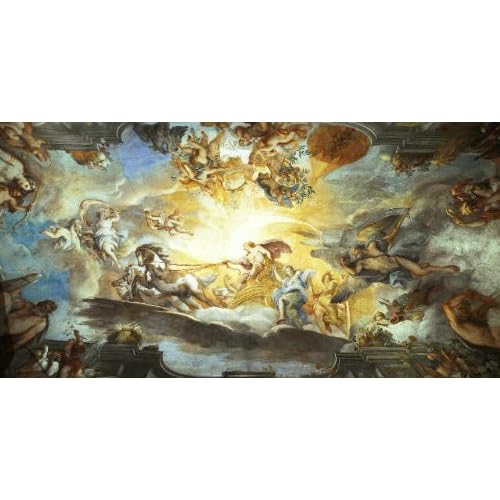
Vault: Spectacular “The chariot of the sun” 1693 by Giuseppe Chiari (1654/1727) for the wedding of Urbano Barberini and Felice Ventimiglia Pignatelli
“He participates intimately in the early Roman Rococo, of which however he cannot be counted among the protagonists; on the other hand, his action, later extended by Agostino Masucci, spans a bridge between Carlo Maratta and Anton Raphael Mengs, who, for his frescoes, followed on the style of Chiari considered a 'classic' in such decorative genre” (Giancarlo Sestieri)
“Butcher” and “Fishmonger” by Bartolomeo Passerotti (1529/92)
“In the Butcher, the scene is rendered with brutal accuracy, emphasizing the strong characters' features behind whom is painted a bird, a symbol and signature of Bartolomeo Passerotti. In the Fishmonger the fish world is presented in all its varieties with descriptive detail and with humor as with the sparrow-signature threatened by a hungry cat. On the left an old commoner hears the words of the veiled woman holding a fish-ball. The presence of this curious animal, an element required in the eclectic late-sixteenth-century collections, refers to the passion of Bartolomeo Passerotti for scientific museums of curiosities” (Official website of the Barberini Gallery - www.galleriabarberini.beniculturali.it)
“Madonna and Child, St. Joseph and St. Catherine of Alexandria” by the Flemish Denis Calvaert (1540/1619) who lived in Rome and in Bologna, where in 1572 founded a school of painting in which transited giants such as Guido Reni, Domenichino or Francesco Albani
The subjects of his paintings were mostly religious and his style, rich of various influences, was very eclectic
“Family Portrait” by Jacopo da Ponte aka Jacopo Bassano (about 1510/92)
This is probably the artist's family represented realistically and vividly
Room XIX - Landscapes and Figures

Formerly winter garden of the Princess Anna Colonna
Above the doors “Sacrifice of Juno” to evoke the female fertility and “Ceculo founder of Praeneste incited with a lightning bolt by Vulcan” to celebrate the rule of the Barberini family in Palestrina by Pietro Berrettini aka Pietro da Cortona (1597/1669) and assistants
“View of Villa Sacchetti in Castelfusano” about 1632/1639 by Pietro da Cortona
“Et in Arcadia Ego” about 1620 by Giovanni Francesco Barbieri aka Guercino (1591/1666)
Two feuds belonging to the Mattei family: “Castel S. Pietro” and “Giove” 1601 by Paul Brill (1554/1626)
“They are part of a series of five paintings commissioned by the Marquis Mattei in 1601 to document the possessions of the family. They have a perspective from the bottom up that is just typical of the Flemish art that Brill would help to spread in Rome. The views are captured at different times of the day: in the manor of Giove the dawn light illuminates the start of daily activities, in the other hues of the sunset invite to return from work” (Official website of the Barberini Gallery - www.galleriabarberini.beniculturali.it)
Two “Bacchanalian of putti” about 1626 and “Landscape with Hagar and the Angel” about 1660 by the great French painter Nicolas Poussin (1594/1665)

Monday, September 23, 2013

BASILICA OF St. CLEMENT

BASILICA S. CLEMENTE
Domus of the second half of the second century built next to a public building before the fire of AD 64 during Nero's reign. It is likely that this public building became later the MINT moved here by Domitian (81/96) from the original site on the Arx, according to some inscriptions from the time of Hadrian (118/138)
In the second century a MITHRAEUM, a place of worship for the followers of the mystery religion of Mithraism, was built in a courtyard of the domus and then maybe it became the domus ecclesia of Clement who was, according to tradition, a freed slave banned in Crimea under Trajan (97/118)
Clement apparently converted many people in Crimea and seventy-five churches were built after his preaching. Trajan, then, ordered Clement to be thrown into the sea with an anchor around his neck
After these events, each year on the anniversary of his death, the sea used to recede two miles, to reveal a shrine built "miraculously" that contained the bones of the martyr and allow the faithful to visit
He was later identified with his namesake Pope Clement I (88/97) the fourth pope, whose relics were brought to Rome by the Sts. Cyril and Methodius in 867 and kept in the basilica built, according to tradition, in the fourth century above the domus ecclesia
Sources on St. Clement are very fragmented and confusing, and perhaps add up in one personality two different Clements who lived in the first century AD
The first reliable news that the church was active, however, date back only to 417/418
After the fire of 1084 the Norman church was buried underground to support the new basilica built in the years 1118/25, raised 5 m (17 feet) higher than the old basilica
Because of the religious persecution in Ireland, it was granted in 1677 to the Irish Dominicans who still keep it today
1118/1125 commissioned by Paschal II (1099/1118)
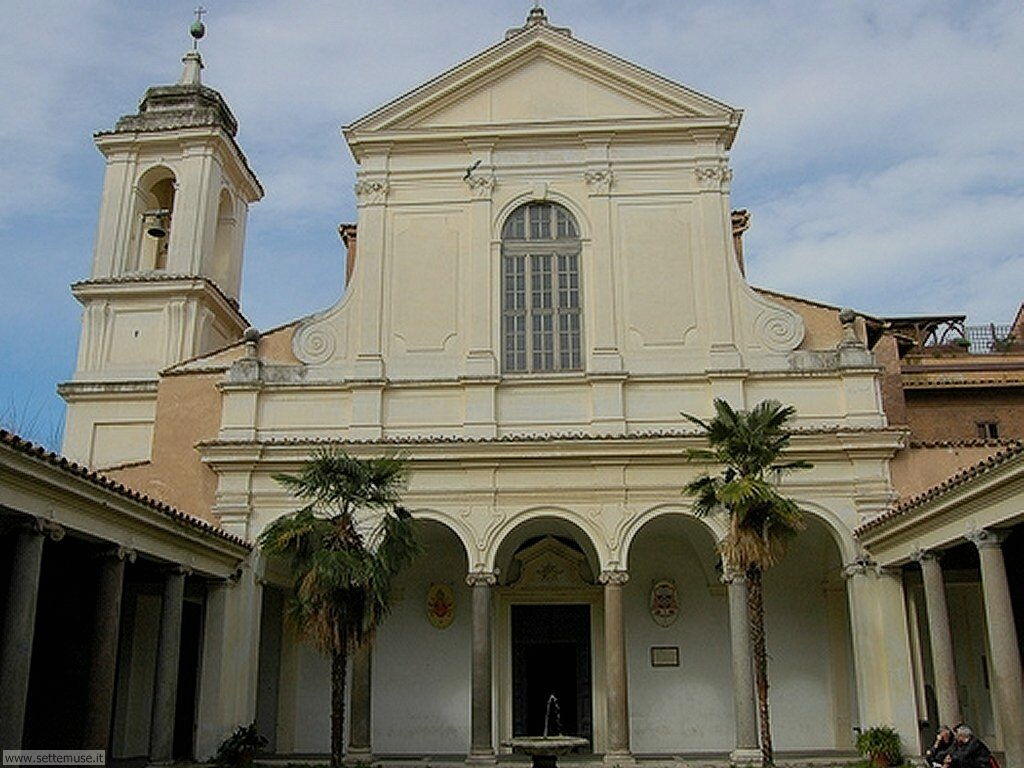
PORCH built in the eight or ninth century preceding the COURTYARD with portico on the four sides with a FAÇADE built in 1715/19 designed by Carlo Stefano Fontana (active 1700/about 1719), Carlo Fontana's son and Francesco Fontana's brother
BELL TOWER seventeenth century formerly located on the opposite side
Today's internal appearance of the church dates back to 1713/19 when Carlo Stefano Fontana gave it a late-baroque touch for Clement XI Albani (1700/21)
The liturgical apparatus known as "cosmatesco" in this church is the best preserved among those existing in Rome. It is the best example of the work of the first generation of the Cosmati's family and became the canonical type followed in Rome and in the Lazio region
There have been at least seven Cosmati, belonging to four different generations living between the twelfth and thirteenth century, famous for their architectural work, for their sculptures, but most of all for their mosaics and decorations in opus sectile especially for religious buildings
Their ability as mosaicists was such that even today the techniques used by these masters and their imitators are referred to as cosmatesque
On the PORTAL "Fragment of lintel with the name of the Roman Emperor Trajan"
Above the portal eighteenth-century "Cantoria" made of wood gilded and painted 
COSMATESQUE FLOOR
Discs known as porfiretici (rotae), made of red porphyry from Egypt
In the center of the floor "Tombstone of Cardinal Vincentius Laureus" who died in 1592
CEILING
1715 designed by Carlo Stefano Fontana with fresco "Glory of St. Clement" 1714/19 masterpiece by the Roman Giuseppe Chiari (1654/1727) one of the favorite pupils of Carlo Maratta
FRESCOES ON THE WALL ABOVE THE CORNICE
On the right "Stories of St. Ignatius of Antioch", on the left "Stories of St. Clement" 1711/16 by the best painters in Rome in the early eighteenth century:
Pietro Rasina "St. Cyril" and "St. Methodius" in the counter-façade
Pier Leone Ghezzi (1674/1755) on the right "Martyrdom of St. Ignatius in the Colosseum"
Giovanni Domenico Piastrini (1678/1740) on the right "Trajan sentences St. Ignatius to be eaten by the beasts"
Giacomo Triga (1674/1746) on the right "St. Ignatius takes his leave from St. Polycarp, bishop of Smyrna, before embarking for Rome"
Tommaso Chiari (1665/1773) Giuseppe Chiari's brother, on the right "Death of St. Servolo"
Giovanni Odazzi (1663/1731) on the left "Translation of the body of St. Clement"
Sebastiano Conca (1680/1764) on the left "Miracle of the spring of water by St. Clement in Crimea", "Apparition of the Angel" and "Miracle of the spring of water"
Pietro de Pietri (1663/1716) on the left "St. Clement presents the veil to St. Domitilla"
Giovanni Antonio Grecolini (1675/1725) on the left "Martyrdom of St. Clement"
RIGHT NAVE
1st RIGHT - CHAPEL OF St. DOMINIC
Ancient precious marble pieces framing "Ecstasy of St. Dominic" and on the left "Resurrection of the young Napoleone Orsini" by an unknown eighteenth century artist, pupil of Sebastiano Conca
On the right "Miracle of St. Dominic in S. Sisto Vecchio" 1715 Sebastiano Conca (1680/1764)
ENTRANCE TO THE SACRISTY
In the vault "Glory of St. Servolo" by Pietro Rasina
CHAPEL OF Sts. CYRIL AND METHODIUS
1882/86 with relics of St. Cyril
Paintings "Stories of Sts. Cyril and Methodius" by Salvatore Nobili (1865/1919) with, at the center, an eighteenth-century copy of the extremely famous religious image "Madonna of prayer" by G.B. Salvi aka Sassoferrato (1609/85)
ON THE RIGHT END SIDE OF THE PRESBYTERY
"Monument to Giovanni Francesco Brusati" who died in 1485 (nephew of Cardinal Roverella) Luigi Capponi (active end of 1400s/beginning of 1500s) and "Funerary monument of Cardinal Bartolomeo Roverella" who died in 1476 by Giovanni Duknovich aka Giovanni Dalmata (about 1440/1510) with maybe the help of Andrea Bregno (1418/1503)
Below the monument, fresco "Particular Judgment" from the eleventh century, moved here from the narthex of the lower basilica
AT THE END OF THE RIGHT NAVE - CHAPEL OF St. JOHN THE BAPTIST
"Statue of St. John the Baptist" end of 1500 maybe by an unknown artist follower of Andrea Sansovino and frescoes "God Father between two musical angels" and "Beheading of St. John the Baptist" maybe by Jacopo Zucchi (about 1542/96)
ON THE RIGHT PIER OF THE ARCH
Aedicula with relief "Cardinal Giacomo Caetani adoring the Virgin Mary" 1299, maybe by an artist from the school of Arnolfo di Cambio (about 1245/1302)
CENTRAL NAVE
At the center of the nave SCHOLA CANTORUM moved here from the lower church adapted in the twelfth century with polished elements of Proconnesio marble executed in Constantinople or Rome by Byzantine artisans
They are dated to about 534 under Pope John II (533/535), the first pope who changed his name (he was called Mercury): his coat of arms is reproduced in the monogram plutei. It is the most significant document of the proto-byzantine sculpture in Rome and one of the most important of the Byzantine world from the period of Justinian
MAIN ALTAR
Fenestella confessionis (window to allow contact with the relics) with inside relics of Sts. Clement and Ignatius of Antioch
Two AMBOS (podiums for Bible readings) and spiral cosmatesque CANDLESTICK
PRESBYTERY
Cosmatesque "Ciborium" and "Cattedra" (chair) of the twelfth century
APSE
High quality mosaic about 1130: "Crucifix with twelve doves between the Virgin and St. John, deers drinking from the Four Rivers of Paradise (Pison, Gihon, Tigris and Euphrates) and four doctors of the Western Church (Sts. Augustine, Jerome, Gregory and Ambrose)" bearing no iconographic connection whatsoever with any other mosaic crosses ever made before
At the base the titulus says: "We represented the Church of Christ with this grapevine which the Law dries up but which the Cross makes green"
BELOW THE ARCH
"Garlands of flowers and fruit originated from jars with a central Christological monogram (Chrismon) between the letters A and Ω
TRIUMPHAL ARCH
"Christ with the symbols of the Evangelists", on the right "Sts. Peter and Clement with Jeremiah and the city of Jerusalem", on the left "Sts. Lawrence and Paul with Isaiah with the city of Bethlehem"
IN THE LOWER PART
"Agnus Dei with twelve sheep". Under the mosaic fresco "Christ, the Virgin and the Apostles" early fourtheenth century
LEFT NAVE
Ceiling of the nave "Coronation of the Virgin" of the eighteenth-century by Pietro Rasina
AT THE END OF THE LEFT NAVE - CHAPEL OF THE HOLY SACRAMENT
"Madonna of the Rosary among the Sts. Dominic and Catherine" 1714 by Sebastiano Conca (1680/1764)
Outside on the right "Madonna and Child with St. John" 1580 Jacopo Zucchi (about 1542/96)
Entrance arch on the right "Jeremiah" and on the left "Isaiah" about 1617 and, inside, on the left "Stigmata of St. Francis" and on the right "Charity of St. Charles Borromeo" all attributed to artists of the Carracci school
On the left wall "Monument of Cardinal Antonio Venier" who died in 1479 maybe by the school of Isaia da Pisa (active 1447/64) or Andrea Bregno (1418/1503) with ancient columns and capitals reshaped in the early sixth century
CHAPEL OF St. CATHERINE OF ALEXANDRIA
Frescoes 1428/31 masterpiece of Masolino da Panicale (about 1383/1440) for Cardinal Branda Castiglioni in collaboration with other Florentine artists (Masaccio? Paolo Uccello? Domenico Veneziano?). They brought to Rome of the new, revolutionary Renaissance style
"He was the point of reference for those Florentine painters who dared not to look at Masaccio, at his dramatic humanity. For them the direction of "modern" was represented by Masolino, by his peaceful spirit" (Carlo Bertelli, Giuliano Briganti, Antonio Giuliano)
Outside the Chapel "St. Christopher", "Annunciation", "Apostles"
Vault "Doctors of the Western Church and Evangelists"
Altar wall "Crucifixion"
Right wall "Stories of St. Ambrose: birth, appointment as bishop of Milan, leaving the house of the rich, his study room and death"
Left wall "Stories of St. Catherine of Alexandria: refusal to worship idols, dispute with the 50 philosophers of Alexandria, conversion, beheading, the miracle of the sprocket wheel and the miraculous transportation of the body to Sinai"
Probably fourth century AD. The first reliable news that the church was active, however, date back only to 417/418
Rediscovered in 1818 and excavated 1857/70 at the behest of Joseph Mullooly, prior of St. Clement
Excavation completed 1912/14
The recent renovations and restorations have greatly enhanced the pleasure of visiting this incredible place, quintessential in its representation of Rome's overlapping layers of history 
NARTHEX
One fresco of the ninth century "Blessing Christ and Saints" and two frescoes of the eleventh century: "Miracle of St. Clement" with "St. Clement, the patron de Rapiza Beno and his family" below, and "Translation of the relics of St. Clement"
CENTRAL NAVE
On the left frescoes of the time of Leo IV (847/855) "Assumption"
Below "Apostles"
On the sides "Leo IV (with square nimbus of living) and St. Vitus"
Alongside "Crucifixion" (with Christ alive) "Maries to the tomb", "Descent of Christ into Limbo", "Marriage of Cana"
On the left wall frescoes "Legend of St. Alexis" end eleventh or early twelfth century, with, on the upper register "Christ enthroned between angels and saints"
Next on the left "Legend of St. Clement and Sisinnio" end eleventh or early twelfth century
It is the very first Italian vernacular with "dirty word" fili de le pute: the prefect Sisinnio angry about the conversion and the vow of chastity of his wife Theodora, followed her with some soldiers. When he found her in a room while attending a mass celebrated by Pope Clement, he ordered his arrest, but God did not allow it and blinded Sisinnio and his soldiers. The soldiers found themselves dragging a column believing they were dragging Theodora. The prefect remained blind until his return home
Above "St. Clement in the holy throne"
"The Stories of the Saints Clement and Alexis are an isolated masterpiece. Toesca sees in them a vague memory of the Hellenistic murals; there is undoubted influence from the Ottonian miniature. The painter seems to have proposed to transpose in the scale of the wall not only the narration, but the refined linear and coloristic range of illuminated manuscripts. It is therefore a well educated kind of painting, combining cleverly different cultural experiences, and however intended to popularize its contents, to stimulate the imagination and the feelings among the most sensitive of the faithful" (Giulio Carlo Argan)
RIGHT NAVE
Mid-wall niche with eight or ninth century fresco "Madonna Enthroned with Child"
Further down the nave "Sarcophagus with Phaedra and Hippolytus" first century AD
LEFT NAVE
Remains of a TOMB MAYBE OF St. CYRIL
The most important mission that was entrusted to the brothers Cyril and Methodius of Thessalonica was the one with the Slavs of Moravia and Pannonia. The ruler of Moravia, Rostislav, who later died as a martyr and was venerated as a saint, asked the Byzantine Emperor to send missionaries to his country, hiding behind religious motivations, his political concern of the German presence in his kingdom
Cyril accepted the invitation and, once arrived, he began to translate passages from the Gospel of John inventing, according to a tradition not scientifically established, a new alphabet called Glagolitic (from "глаголь" which means "word"), now better known as the Cyrillic alphabet. It is the alphabet used to write various Slavic languages: Belarusian, Bosnian, Serbian, Bulgarian, Macedonian, Russian, Ruthenian, Serbian and Ukrainian as well as other non-Slavic languages
In 867 Cyril and Methodius went to Rome to have some of their followers ordained priests. Adrian II (867/872) ordained Methodius and approved their translations of the Bible and liturgical texts into Slavonic. Cyril also gave him the relics of St. Clement, which he had found in Crimea
In 869, during his stay in Rome, Cyril died and was buried in the Basilica of St. Clement. Methodius later returned to Moravia
BAPTISTERY AND CONSIGNATORIUM
The baptistery of the time of John II (533/535) was found during recent excavations north of the basilica in the cellar of the monastery. Another small room was found, hypothetically considered the Consignatorium, or the place where Confirmation was administered
Rectangular building with short side of 29.60 m (97 feet) made of large blocks of tufa, made out of rooms with vaults and walls of mixed materials. It is likely it was the mint
It is separated from another building with a narrow gap
The inner courtyard of this second building was transformed into a mithraic temple maybe in the second quarter of the third century
Ara marble reliefs "Mithras and the bull, snake and two dadofori" third or fourth century AD