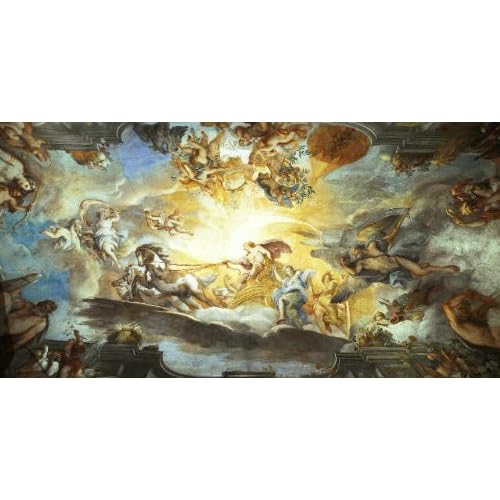
“Known in
the eighteenth century as 'Second Antechamber', the First Gallery was added,
along with the Antechamber, to the apartment of Neri Maria Corsini during the
extension work carried out in the years 1750/53 by the architect Ferdinando
Fuga” (Official Website the Corsini Gallery - galleriacorsini.beniculturali.it)
Small
bronze statues “Baptism of Jesus” and “Fauns on a goat with parrots”
by Alessandro Algardi (1598/1654) and “Lion Biting a Bull” copy by Antonio
Susini (1580/1624) from an ancient original statue
Impressive
and visually disturbing “Agony of Prometheus Bound to the Rocks”, “Marina with lighthouse” and six
other paintings by Salvator Rosa (1615/73)
“A man of
brilliant talents but eternal rebel, ruthless in his criticism of society,
obsessed with a pre-Romantic egotistical concept of genius, he used to take
offense when praised as a painter of landscapes, seascapes and battles. But it
is on the successes in this field more than on the large historical
compositions that his posthumous fame is resting. The 1700s saw in the
landscapes of Salvator Rosa and Claude Lorrain, the quintessence of the
contrast between the sublime and the beautiful. In the words of Sir Joshua
Reynolds, Claude leads us to the tranquility of the scenes of Arcadia and
fairyland, while the style of Rosa has the power to inspire feelings of
grandeur and sublimity” (Rudolf Wittkower)
“Landscape
with St. John the Baptist” and “Landscape with Horse
Riders” XVII
century, by an unknown Dutch painter
“Cozza, a
figure painter, favors narrative moments, by subordinating the landscape to the
arrangement of characters, expressing consequently a very individual style in
the landscape painting of the seventeenth century” (Ludovica Trezzani)
“Hare” by Hans Hoffman
(d. 1592)
“Jacob's Ladder” by Donato
Creti (1671/1749)
“Together
with the senior Marco Antonio Franceschini, Creti was the last significant
exponent of the doctrine of classical-idealism in Bolognese painting. He was
deeply engaged in what we might call the metaphysics of ideal form, i.e. the
search for the perfect shape in nature. For him the important thing was to make
the invention of the individual figure and outline its concept perfectly. He
was clearly a fanatical perfectionist” (David Miller - Dizionario Biografico
degli Italiani Treccani)
“Finding of Moses” by Luigi Garzi
(1638/1721) a pupil of Andrea Sacchi later influenced by Carlo Maratta
“Hunters on horses” by the Dutch artist Philips Wouwerman (1619/68)
“Wouwerman's
oeuvre consists mainly of small cabinet pieces with horses, such as battle and
hunting scenes, army camps, smithies and interiors of stables. He also painted
sensitively executed silvery-grey landscapes, genre pieces and a few original
representations of religious and mythological scenes. Wouwerman was also
exceptionally prolific. Although he only lived to the age of 48, more than a
thousand paintings bear his name. Even when one bears in mind that a number of
these paintings should actually be attributed to his brothers Pieter and Jan,
Philips left an extraordinarily large oeuvre” (from the web site
www.wouwerman.org)
“Architectonical Perspective” by Viviano
Codazzi (1604/70)
“Shepherds and Flock
by Some Ruins” by
the Dutch Cornelis Van Poelenburgh (about
1586/1667)
“Cornelis
van Poelenburgh was a founder of Dutch Italianate landscape painting. He
studied under the Utrecht Mannerist Abraham Bloemaert, but his years in Rome,
from 1617 to 1625, were more decisive for his development. An early member of the
schildersbent, the club for Rome's Netherlandish painters, he was nicknamed “Satyr.”
In Rome, a friend noted that Poelenburgh “exerted himself to the utmost to
paint his figures in the manner of Raphael.” Poelenburgh also copied German
artist Adam Elsheimer's Italianate landscapes, which were usually painted on
copper. (…) After returning from Italy, he became one of Utrecht's leading
artists, honored as Peter Paul Rubens's guide during his 1627 visit to the
city. At the king's invitation, Poelenburgh worked in England from 1638 to
1641. (…) Poelenburgh painted some history paintings, but his fame rests on the
enamel-smooth landscapes, often depicting romantic ruins and statuary
fragments, that he created after 1620. He was among the first artists to render
Italian sunlight and atmosphere convincingly. His highly detailed figures were
so admired that he was hired to paint them in other artists' works” (The J.
Paul Getty Museum Web Site – www.getty.edu)
“Holy Family with S.
Anna” by Pietro de’ Pietri (1655/1716)
“Holy Family” by Simone
Cantarini (1612/48)
“Triumph of Ovid” by Nicolas Poussin
(1594/1665)
“History was
for Poussin of the highest value, the ideal to which he gave vision. He faced
historical, biblical and mythological subjects, from which his spiritual
inclinations, which led to the denial of the purposes of the most striking Baroque
style, appear abundantly clear” (Carlo Bertelli, Giuliano Briganti, Antonio
Giuliano)
“Head of agonizing man” by an unknown
artist probably a pupil of Guercino
“Portrait of Pope Urban VIII Barberini (1623/44)” about 1636 by Guidobaldo Abbatini (1600/56)
“He can
combine with remarkable balance, the 'friendliness' of Matteo, highlighted by a
colorist opulence influenced by Pietro da Cortona, but still supported by
considerable technical qualities, with the description of a physical decline
that shines through, without drama, backlit. There is no doubt on Abbatini's
ability, as evidenced by how he can detect the golden embroidery stole, or how
casually he describes the lace and the folds of the clothes and he is able to
forge with a few touches, the heavy tissue that garnish the seat of the chair.
Surely these were the qualities that Bernini appreciated in the Umbrian painter
and that led him often to use his cooperation” (Sivigliano Alloisi)
“The departure of Jacob” by Giovanni
Benedetto Castiglione aka Grechetto (about 1611/65)
“Battle”, “Blindman’s Buff”, “The watering hole” and “St. John the Baptist Preaching” by the so-called bambocciante
Michelangelo Cerquozzi (1602/60)
“Portrait of a Man” by Federico Fiori aka
Barocci (1535/1612)
“For a long
time this painting was considered a self-portrait also by contemporary
historiography, until Olsen has expressed doubts about its authenticity.
Indeed, both inventory information and comparisons with the identified
self-portraits of the painter don't help to clarify the issue. (...) The
beautiful head alive and alert is in front of us with no conventionalities,
with an immediacy that goes beyond the conventional pose. It is framed by a
white collar, soft and smooth, which helps to give life to the face free and
gentle of the character. Even in the portrait, Barocci anticipates the demands
of the truth of many artists of the seventeenth century” (Sivigliano Alloisi)
Spectacular
“Denial of St. Peter” by the so called Master of the Judgment of
Solomon (XVII
century) or maybe by Jusepe de Ribera aka Spagnoletto (1591/1652)
“Hunt of Wild Beasts” XVII century, copy from
an original by Rubens
“Bivouac of soldiers in a cave” and “Breakfast
outside” by the
Flemish Anton Goubau (1616/98)
“Mystic Marriage of St. Catherine
with Baby Jesus at the Presence of St. Anthony of Padua” by Ippolito
Scarsella aka Scarsellino (1551/1620)
“St. Peter weeping” by Francesco Solimena
(1657/1747)
“The ransom” by the Flemish Christoffel Jacobsz Van Der Lamen (about 1606/about
1652)