Showing posts with label Sebastiano Conca. Show all posts

Thursday, February 21, 2019

St. GREGORY OF NAZIANZUS

S. GREGORIO NAZIANZENO
It was built over a building of the fourth century AD
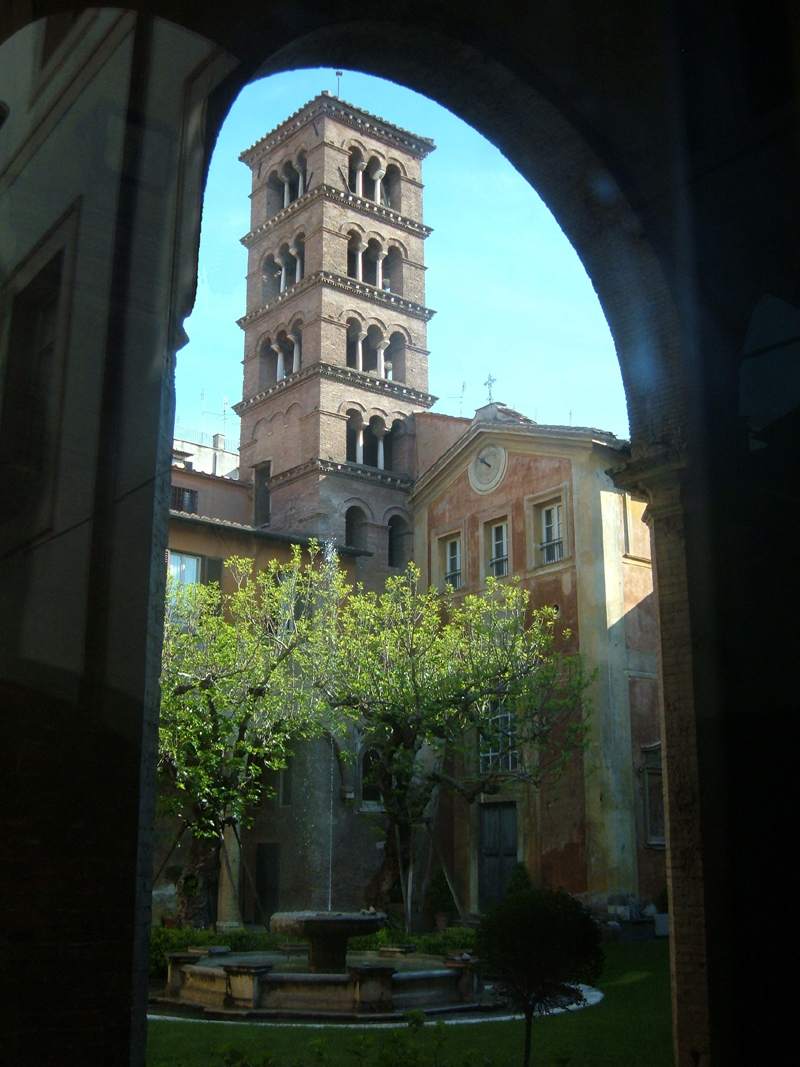
BELL TOWER
1100/1200

INTERIOR
Frescoes 1000/1100

REFECTORY OF THE MONASTERY
Lunette with “Christ in the House of Martha and Mary” by Sebastiano Conca (1680/1764)
The Monastery is now one of the seats of the Chamber of Deputies of the Italian Parliament and the church serves as a chapel for Members themselves
In the Monastery used to be kept the great “Final Judgment” of the end of the twelfth century by Giovanni and Nicolò now in the Paintings Gallery (Pinacoteca) of the Vatican Museums

Monday, August 22, 2016

DE CAROLIS PALACE

PALAZZO DE CAROLIS

1714/24 Alessandro Specchi (1668/1729) for Livio De Carolis bourgeois scion of a wealthy family of merchants of grain who wanted to build his palace next to those of the patrician families
The exorbitant cost of the construction contributed to the ruin of the family who was forced to put the building up for auction
It passed in 1750 to the Jesuits who gave it to rent to famous people
It was from 1769 the French Embassy and with Cardinal François-Joachim de Bernis it was the site of parties and beautiful banquets that gave to the French cardinal the popular nickname of King of Rome
Later it belonged to the Simonetti and Boncompagni Ludovisi families
In 1833 the attic was added and the cornice was modified
The building belongs since 1908 to the BANCA DI ROMA and it was enlarged and adapted by Pio Piacentini (1846/1928). He covered the courtyard that became the hall of the bank and changed some of the rooms in Art Nouveau style
Wonderful SPIRAL STAIRCASE by Alessandro Specchi considered one of the wonders of Rome
On the external left end side “Speaking Statue of a Porter” one of the six of Rome, to which anonymous messages were posted
It dates back to the time of Gregory XIII Boncompagni (1572/85) although it is erroneously attributed by popular tradition to Michelangelo Buonarroti
In the courtyard there is a cannonball fired by the French in 1849 embedded in the second floor
The lower stretch of Via del Collegio Romano was named after Alessandro Specchi only in 1980, an incredible delay in making a toponymic tribute to the gigantic but unfortunately underestimated Roman architect
“Citing the close-by Palazzo d'Aste of which it repeats the decorative windows and the corner solution, perhaps at the suggestion of the client who wanted a house clearly inspired by the traditional type of mansion” (Paolo Portoghesi)
Rooms of the first floor with ceilings painted by some of the best painters working in Rome in the early eighteenth century:
GALLERY
Now used as a library
“Triptych Bacchus, Venus and Ceres” by Giuseppe Chiari (1654/1727)
“Diana and her Companions” by Benedetto Luti (1666/1724)
“Chariot of Apollo with Aurora and Muses” by Luigi Garzi (1638/1721)
HALL OF MINERVA
“Allegory of caste Love with passionate Love represented by Minerva who takes away Youth from Venus and give it to Hercules symbol of strength and virtue” and “Venus and Vulcan” by Francesco Trevisani (1656/1746) from Istria
“At age 21 he moved to Rome. Here he studied the works of Carraci, was inspired by Correggio and attended the circle of Carlo Maratta. He had a good success as the representative of Venetian Rococo style. He produced altarpieces with very pathetic tones, but he was also appreciated as a very precise portrait painter and for his vast landscape scenes, which are the background of historical or mythological events” (Consorzio La Venaria Reale - www.lavenaria.it)
“Allegory of the arts and wisdom” by Sebastiano Conca (1680/1764)
“Aurora” by Andrea Procaccini (1671/1734)
More paintings by Domenico Maria Muratori (1661/1742), Ludovico Mazzanti (1686/1775) and Giovanni Odazzi (1663/1731)

Monday, March 7, 2016

BARBERINI PALACE - NATIONAL ART GALLERY (twenty-sixth part)

Room XXXIII - Fabrizio and Fiammetta Lemme Donation. Designing Great Art

Preparatory sketches for paintings on canvas in the nave of St. Clement executed in the years 1711/16 including “Glory of St. Clement” by Giuseppe Chiari (1654/1727) for the ceiling of the church
“As it has been pointed out, the central figure is derived from the assumption of Annibale Carracci in S. Maria del Popolo, but the reference point is the Allegory of Mercy painted by Carlo Maratta in Palazzo Altieri in 1676. Fidelity to the text of his teacher borders here on plagiarism, or perhaps indicates the use of the original cartoons, in the group of two putti supporting the anchor down” (Lorenza Mochi Onori)
“Stories of St. Clement and St. Ignatius of Antioch” for the walls of the church by some of the best painters in Rome in the second decade of 1700s:
“Death of S. Servolo” by Tommaso Chiari (1665/1773) brother of Giuseppe
“Among the works of this cycle it is one of those that show 'more intensely maratta-like' features. With a composition of light classical approach proposing 'in decidedly eighteenth century tone, the golden language of Raphael'. The peculiar character of this sketch that marks also other works by De Pietri (for example, the Madonna and Child with Saints in S. Maria in Via Lata) is this intimate aspect, and it is one of the most original outcomes of Maratta's period' (Casale)” (Lorenza Mochi Onori)

“Martyrdom of St. Clement” by Giovanni Antonio Grecolini (1675/1725)
“Translation of the body of St. Clement” by Giovanni Odazzi (1663/1731)
“The sketch shows less freshness than the final version as a fresco. Some indecisions show up affecting mainly the faces of St. Clement and the prelate behind. The prelate knelt before the body of St. Clement recalls a figure of G.B. Gaulli, the St. Nicholas, in the altarpiece in St. Mary Magdalene, which inspired Odazzi some other times as well” (Lorenza Mochi Onori)
“Trajan condemning St. Ignatius of Antioch” by Giovanni Domenico Piastrini (1678/1740)
“St. Ignatius of Antioch meets St. Polycarp in Smyrna” by Giacomo Triga (1674/1746) pupil of Benedetto Luti
“Giacomo Triga, little-known pupil of Benedetto Luti, a virtuoso of the Pantheon, worked for the Patrizi and the Theodoli families, and in some Roman churches such as the Basilica of Sts. John and Paul, St. Francis of Paola and S. Marcello al Corso” (Lorenza Mochi Onori)
“Martyrdom of St. Ignatius of Antioch” by Pier Leone Ghezzi (1674/1755)
“As Casale mentioned, this painting by Ghezzi in the Clementine series is presented as 'the less academic and more whimsical of the group' and 'hard to the limits of unpleasantness. But original' due 'to an compositional vehemence impatient of conventions and rules of composition” (Lorenza Mochi Onori)
“Miracle of St. Clement in the Crimea” by Sebastiano Conca (1680/1764)
“It has been emphasized the differentiation of this sketch from the rest of the series for both the bright colors with respect to the general preference for crayon-like colors, and for the adoption of a small size that allows the presence of several figures without creating a scrum. ( ...) It as also noted by Casale (1998) that it is the masterpiece of the clementine series, a work in which the author reconciles the update on Maratti's reforms with a style that 'shows an early Rococo expression' (Sestieri)” (Francesca Mochi Onori)
The “Abandonment of Moses” and the “Sacrifice of Isaac” by Domenico Corvi (1721/1803) from Viterbo
They are models for the paintings in the side chapel of the Virgin of Seven Sorrows in S. Marcello al Corso, showing with their bright colors the influence of Corrado Giaquinto's painting
Extraordinary “Assumption of the Virgin” by Ludovico Mazzanti (1686/1775) a Gaulli's student, sketch for the 1720 fresco on the ceiling of the left transept of S. Ignatius
“Death of S. Joseph” 1712 by Francesco Trevisani (1656/1746) from Istria
It is a study for the altarpiece of the second chapel on the right in the church of St. Ignatius
Sketch of “Last meeting of Sts. Peter and Paul” for the 1766 canvas in the church of S. Lucia al Gonfalone, and preparatory sketch of '“Adoration of the Magi”, a work in S. Giuseppe alla Lungara, by the Sicilian Mariano Rossi (1731/1807)
“In the Last meeting of Sts. Peter and Paul mix, in a studied intersection of levels that follow the development of the action, relations with the work of Corrado Giaquinto but, as Giancarlo Sestieri pointed out, in an 'extreme simplification of form, based on an essentially linear conciseness' and 'developed especially in the footsteps of Marco Benefial and Francesco Mancini'“ (Lorenza Mochi Onori)
“Allegories of the four elements: water, air, fire and earth” 1767/68 by the Roman Stefano Pozzi (1699/1768) for the lunettes of the vault of a Cabinet in the Palazzo Doria Pamphilj

Monday, February 29, 2016

BARBERINI PALACE - NATIONAL ART GALLERY (twenty-fourth part)

Room XXXI - Painting in Naples in the 1700s

“Expulsion of Heliodorus from the Temple” by Francesco Solimena (1657/1747) the best pupil of Luca Giordano
“Preparatory version for the fresco painted on the Counter façade of the Neapolitan Church of Gesù in 1725. The scene, theatrical and complex, reveals the great skills of Solimena painting a grand composition, in which monumental architecture is the background to the interweaving of characters with many different poses and expressions. The artist represents perfectly darting movements that emphasize the vibrancy of light” (Official website of the Barberini Gallery - www.galleriabarberini.beniculturali.it)
“Wedding contract” about 1752 and “Portrait of Father Giovannezio di Molina” by Gaspare Traversi (1722/70)
“Among the most interesting personalities of the eighteenth century in Naples. Pupil of Francesco Solimena, he was in Rome since 1752. His paintings show interest in nature and in Carracci's style and are aimed at a rigorous and sensitive rendering of reality, through which there is a vein of irony featured in scenes of everyday life” (Enciclopedia Treccani)
“Portrait of a lady” by Giuseppe Bonito (1707/89)
“A pupil of Francesco Solimena, Bonito is part of a generation of artists who determined the cultural climate of the Neapolitan eighteenth century with strong points of contact with the Spanish painting. In 1751 he was officially invested the office of House Painter of the King (...). He became also academic of St. Luke in 1752” (Lorenza Mochi Onori)
“Sebastiano Conca studied in Naples at the school of Francesco Solimena, but his career unfolded in Rome, where he assimilated the lessons of Carlo Maratta, who, with his school, had a hegemony over Roman painting, and yet he managed to blend it with his Neapolitan training rich of echoes of Luca Giordano, laying the foundations of the Roman Rococo” (Lorenza Mochi Onori)
“The Martyrdom of St. Denis” by Corrado Giaquinto (1703/66)
Denis was the first bishop of Lutetia, today Paris
Tradition has it that, during the persecution of Decius in about 250, after he had been beheaded on the hill which, following this event, took the name of Montmartre (mountain of the martyr), stood up, picked his head up and walked for 10 km (6.2 miles) continuing preaching as if nothing had happened
“Within the last Roman activity of the painter, in the period between 1949 and 1951, numerous sketches are known, characterized by immediacy of execution and density of material and color” (Lorenza Mochi Onori)
Corvi Room - Characters of Myth and History
On the walls, life-size figures in niches to imitate ancient sculptures:
Ciro, Sofonisba, Zenobia, Achilles, Silla, Tuzia, Scipio, Lucrezia, Tullia, Faustina, Dido, Cleopatra, Alexander the Great
Decorations around the room with elegant friezes that evoke the inventions of older artworks by Piranesi
The room was painted in 1770 by Domenico Corvi (1721/1803) from Viterbo for Princess Costanza Barberini Colonna di Sciarra

Monday, February 22, 2016

BARBERINI PALACE - NATIONAL ART GALLERY (twenty-third part)

Room XXVIII - Painting in Rome in the Early 1700s

“Luti painted scenes of great miracles, as was then customary, but he underlined the nicely narrative tone, almost a historical document. The monumentality of the scene is scaled down by the soft and clear paint, typical of the rococo grace” (Official Web Site Barberini Gallery - www.galleriabarberini.beniculturali.it)
Four paintings “Allegory of the four parts of the world: Europe, Asia, Africa and America“ about 1709
Models for the mosaics in the spandrels of the vestibule of the Baptistry Chapel in the Basilica of St. Peter eventually executed only in the years 1724/26
The presence in the Baptistry Chapel of the representation of the four continents known at the time is symbolic of the desire on the part of the Catholic Church to spread throughout the world the saving power of the Sacrament of Baptism
“The Venetian Pietro Ottoboni (1667/1740) was a patron of artists, musicians and writers. (...) Despite the wealth of his office, his munificence was such to find himself burdened with debts incurred for his patronage. (...) He was also the chief patron and client of Trevisani, so much so that in 1698 he gave him accommodation in the Palace of the Chancellery and appointed him as his Primo Pittore (First Painter)” (Lorenza Mochi Onori)
Beautiful and sensual “Mary Magdalene” about 1725, represented here with almost theatrical flamboyance by Francesco Trevisani (1656/1746) from Istria
“Strong charge of monumentality, enhanced by the quite unusual framing, almost three quarters, which sheds light on both the face and the nude and sensual body of the saint, emerging from the shadows of the rocky background. (...) Pathetic yearning of theatrical taste, much appreciated by Cardinal Pietro Ottoboni, Trevisani patron and protector of the Arcadia” (Anna Lo Bianco)
“The large portrait of the Quarantotti family, signed and dated 1756 on the pillar on the left, celebrated their son preacher in distant lands, surrounded by family members dressed in exotic way, in an atmosphere eccentric and suspended. The picture, in addition to expressing the spreading of passion for the Orient, is a polished piece of realism, anticipating Goya. But it's good to know that it was Goya himself, in his sojourn in Rome in 1770, to copy a Benefial work in his notebook, the Expulsion from Garden of Eden - shown here - clearly aware of the innovative power of the paintings by this artist” (Official website of the Barberini Gallery - www.galleriabarberini.beniculturali.it)
“The stories of Hercules and Omphale and of Pyramus and Thisbe are united by a reference to love as a passion that goes beyond human reason. They depict, in fact, Hercules ranking as a maid and giving his club, a symbol of virility, to the queen Omphale of Lydia, enslaved by love, and Thisbe who kills herself in front of the body of the beloved Pyramus, who, in turn, committed suicide believing that she had been torn by a wild beast” (Lorenza Mochi Onori)
Sketch for “St. Margaret of Cortona finds the corpse of her lover” in the Church of S. Maria in Aracoeli, all works by the great Roman painter Marco Benefial (1684/1764)
“The freshness of the sketch summarizes in a more immediate way than the finished painting the scene of the discovery (...) with the contrast between the pathetic attitude of the saint, the humorous note of the dog and the raw description of the corpse, boldly foreshortened and placed in foreground, featuring a detailed study of the nude, which in the final canvas will be hidden by the branches and not so obvious. The figures placed in relief with the use of light testify, among the numerous sources used by Benefial, even a study of the Caravaggio's followers” (Lorenza Mochi Onori)
“Miracle of St. Joseph of Copertino” by Placido Costanzi (1702/59)
In this curious scene the patron saint of test takers, accustomed to levitate during his ecstasies, heals the young nobleman Baldassarre Rossi who had gone crazy all of a sudden, grabbing him by the hair and lifting him off the ground with him
The philological accuracy in representing the clothes of the previous century is remarkable
“The sketch shows a remarkable fluidity and virtuosity of touch as evidence of a development process of the finished work, leading Mancini to give precedence to formal discipline over the urgency of pictorial expression, in a work of mental construction of the work that is to be found in other cases, of which the most famous is Canova, in the proto-neoclassical and neoclassical culture” (Lorenza Mochi Onori)
“Madonna reading” by the Frenchman Pierre Subleyras (1699/1749)
“Intimately engaged in the widespread movement of return to nature and antiquity, his noble but lively classicism was undoubtedly the most worthy of that label. Alien to the exaggerated gestures of Baroque characters, or to the excessive affectation of late Maratta taste, he was all aimed at a balanced composition and a conciseness of volumes, favoring the opposition of masses of color, always based on a few essential tones, with a predominance of large and picturesque expanses of white” (Giancarlo Sestieri)
Sketches for the oval commissioned by Pope Clement XI Albani (1700/21) in 1718 for the central nave of the Basilica of St. John Lateran
He commissioned eleven more ovals, all with prophets, to the leading painters in Rome at that time. Sebastiano Conca chose the version with the angel points to the cross
“Portrait of Sir Robert Clive, Baron of Plassey” 1766 by Anton von Maron (1733/1808)
“It wants to be a celebration of the high position of the English nobleman, governor of Bengal from 1757 to 1760, and is set in the tradition of the courtly portrait, but it also becomes a representation, of outstanding effect and unique in its kind, of British power in the colonies. The subjugation of the indigenous with turban, caught while the Governor is issuing rules, wants to allude to the civilizing role of the colonial power, while the curtains in the background hint at the military role of the governor. (...) He had a bitter fate: after his return to England he was subjected to a parliamentary inquiry into his conduct in the colonies. He managed to be acquitted of the charge of corruption, but he took his own life in 1774 for a depression caused by his opium's vice” (Lorenza Mochi Onori)
“Portrait of Count Niccolò Soderini” by the great Pompeo Batoni from Lucca (1708/87)
Count Soderini was the Tuscan consul in Rome and the dedicated patron of the Roman painter Marco Benefial

Tuesday, September 1, 2015

PALATINE HILL - St. BONAVENTURE

S. Bonaventura

1675/77 for Cardinal Francesco Barberini on a huge castellum aquae (building with the function of collection and distribution of water) that was intended to supply the Severan Baths

The cardinal supported the reformist Franciscan friar Bonaventure of Barcelona, later canonized, who wanted to build the church here

Today the convent adjacent to the church is the seat of the Centre for Youth Ministry in the Roman Province of the Franciscan Minor Friars

FAÇADE and INTERIOR redone in the years 1839/40

COUNTER FAÇADE
“Tombstone of the painter Francesco Mancini (1679/1758)” 1758 with his portrait

1st ALTAR ON THE RIGHT

2nd ALTAR ON THE RIGHT
“Madonna and Child, St. Anne, St. Joseph and Spanish Franciscan saints” 1680 by Giacinto Calandrucci (1646/1707) a pupil of Carlo Maratta

MAIN ALTAR
“Virgin Mary and the three Franciscan Orders” about 1685 by Filippo Micheli from Camerino

Beneath the altar there is the tomb of S. Leonardo da Porto Maurizio, who died in 1751 in a nearby convent and gave great impetus to the devotion of the Christian martyrs of the Colosseum and to the Via Crucis (Stations of the Cross) which was very popular since then
He was one of the greatest inventors and propagators of the Stations of the Cross personally creating some hundreds of them. He built the aediculae outside the church, in clay since 1772, and in the Colosseum, later removed

AT THE SIDES OF THE ALTAR
Niches on the right “St. Anthony of Padua” 1867 and on the left “St. Francis”1869 Pietro da Copenaghen

2nd ALTAR ON THE LEFT
“Annunciation” about 1678 by G.B. Beinaschi

1st ALTAR ON THE LEFT
“St. Michael the Archangel” about 1678 by G.B. Beinaschi who was assisted in the four paintings in this church by his daughter Angela Maria Beinaschi

SACRISTY
“Deposition” about 1678 by G.B. Beinaschi signed also by his daughter Angela Maria
“Virgin Mary with Sts. Francis and Anthony of Padua” 1862 by Pietro da Copenaghen

CONVENT
“Our Lady of Beautiful Love” by Sebastiano Conca (1680/1764)
“St. Anthony” by Luigi Garzi (1638/1721)
“Virgin Mary and St. Bonaventure” by Pietro Gagliardi (1809/90)
“Lady of the Sacred Heart Jesus” 1766 by Pompeo Batoni (1708/87) donated by the painter to the missionary priest of the convent to take with him on his missions

Thursday, September 26, 2013

BASILICA OF St. LAWRENCE IN THE HOUSE OF DAMASUS

BASILICA S. LORENZO IN DAMASO
380 for Pope Damasus (366/384)
The old church was parallel to the one in the current location but further south, always with the entrance on the square
It was renovated in the eight and ninth century
It was rebuilt with the Palazzo della Cancelleria in 1495 by Donato Bramante (1444/1514) for the Cardinal Raffaele Riario according to Giorgio Vasari. However, attributing an architect to this building "is one of the greatest mysteries of Italian architecture" (Peter Murray)
It was occupied by the French in 1799 and used as a stable
It was renovated in 1807 by Giuseppe Valadier (1762/1839) and in the years 1868/82 by Virginio Vespignani (1808/82) who eliminated almost all of Bernini's work in the presbytery and Valadier's
It was modified again after a fire in 1939
In the area of the church there were once the stables of the team of charioteers Prasina marked by green colors
PORTAL
Designed by Jacopo Barozzi aka Vignola (1507/73)
CEILING
Rebuilt after the fire of 1939
AT THE SIDE OF THE ENTRANCE
Statue "St. Hippolytus" 1736 by Bartolomeo Pincellotti
On the right "Tomb of Alessandro Valtrini" 1639 by Gian Lorenzo Bernini (1598/1680)
IN FRONT OF THE PILLARS
Statues on the left "St. Francis Xavier" by Stefano Maderno (1560/1636) and on the right "St. Charles Borromeo" by Ambrogio Buonvicino (about 1552/1622)
ON THE RIGHT - CHAPEL OF St. NiCOLÒ
1743 Nicola Salvi (1697/1751)
"Virgin and Sts. Philip Neri e Nicolò" by Sebastiano Conca (1680/1764) and crucifix that, according to tradition, spoke to St. Bridget of Sweden
In the vault "God appears to St. Nicolò" and pendentives with "Virtues" by Corrado Giaquinto (1703/66)
LEFT CHAPEL OF THE HOLY SACRAMENT
1732/36 Ludovico Rusconi Sassi (1678/1736) for Cardinal Pietro Ottoboni
Restored by Giuseppe Valadier
"Last Supper" 1818 di Vincenzo Berrettini (noto 1774/1818)
Frescoes in the vault "Bloodless sacrifice" and pendentives "Angels" about 1736 by Andrea Casali (1705/84) pupil of Sebastiano Conca and Francesco Trevisani
CENTRAL NAVE
Up in the clerestory "Stories of Sts. Lawrence and Damaso" of the nineteenth century by Luigi Fontana (1827/1908)
RIGHT NAVE
1st RIGHT - CHAPEL OF THE CRUCIFIX or MASSIMO CHAPEL
Altar 1758 Giovanni Domenico Navone (active since 1706/d. 1770)
"Wooden crucifix" of the fourteenth century
On the outside "Monument to Gabriella di Savoia Massimo" by Pietro Tenerani (1789/1869)
2nd RIGHT - CHAPEL OF THE SACRED HEART
"Sacred Heart" by Pietro Gagliardi (1809/90)
On the outside "Monument to Pellegrino Rossi" (murdered in the Palazzo della Cancelleria in 1848) by Pietro Tenerani
PRESBYTERY
Modified 1638/40 by Gian Lorenzo Bernini for Cardinal Francesco Barberini, and modified again 1868/82 by Virginio Vespignani
MAIN ALTAR
"Coronation of Mary along with Sts. Lawrence, Damaso, Peter and Paul" about 1567 by Federico Zuccari (about 1542/1609)
In the round panels "Virtues" by Francesco Grandi (1831/91)
To the left of the presbytery rich CHAPEL OF SS. CONCEPTION
1635/38 designed by Pietro Berrettini aka Pietro da Cortona (1597/1669) with "Grottapinta Virgin" painted wooden table first half of twelfth century from the demolished church S. Salvatore in Arco
LEFT NAVE
"Funeral Monument of Cardinal Ludovico Trevisan" who died in 1505
"Our Lady of Joy" maybe by Cristoforo Roncalli aka Pomarancio (1552/1626)
"Monument of Annibale Caro" who died in 1566 by Giovanni Antonio Dosio who also did the bust. Annibal Caro was the first translator of the Aeneid in the Italian vernacular

Sunday, September 22, 2013

BASILICA OF St. CECILIA IN TRASTEVERE

BASILICA S. CECILIA IN TRASTEVERE
TITULUS CECILIAE, named for the first time in early fifth century. House of S. Valeriano, St. Cecilia's husband martyred, according to tradition, under Marcus Aurelius (161/180) with three strokes on the neck after she escaped unhurt from three days of exposure to hot vapors
Built in about 820 for Paschal I (817/824) who had St. Cecilia's body moved here after it was found in the Catacomb of St. Callisto
St. Cecilia is the patron saint of musicians, even if an explicit link between Cecilia and the music is documented only since the late Middle Ages. This is due to incorrect transcription of the words at the beginning of the mass dedicated to her; the terms candendibus organis were mistakingly changed to cantantibus organis, with the meaning changed from "between the instruments of hot torture" to "singing with the organ"
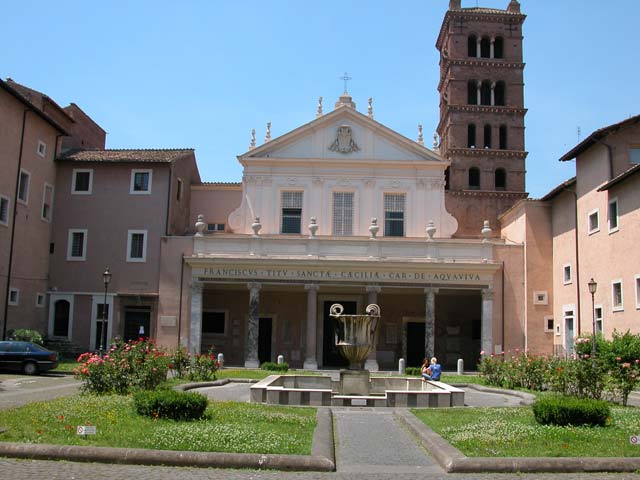
At the end of 1100 or at the beginning of 1200 the BELL TOWER was added (the only one leaning in Rome), as well as the CONVENT, CLOISTER and PORCH
Restorations in the years 1540, 1600 and, more radically, 1724 by Domenico Paradisi and Luigi Barattoni
Other restorations in 1742 and in 1823
CRYPT remade at the end of the nineteenth century
MONUMENTAL ENTRANCE
1741/42 maybe designed by Ferdinando Fuga (1699/1782) for the Cardinal Troiano Acquaviva whose coat of arms above the portal is hold up by two "Putti" by Agostino Corsini
Under the arch on the right "Cippo of urban pomerium" AD 75, the time of Vespasian (69/79), moved here in the XX century
In the center of the COURTYARD ancient roman "Cantaro" (big vase) in marble
On the right monastery of the Franciscan Sisters of Egypt
On the left monastery of Benedictine nuns
On the lintel of the porch "Mosaic strip" from the XII century
PORTICO
On the right "Monument to Cardinal Paolo Emilio Sfondrati" who died in 1618 (nephew of Gregory XIV Sfondrati -1590/91- pope for 10 months) Girolamo Rainaldi (1570/1655). Sculptures designed by Pietro Bernini (1562/1629) with reliefs that recall the discovery of the intact body of St. Cecilia in 1599
CEILING
"Apotheosis of St. Cecilia" about 1727 by Sebastiano Conca (1680/1764)
AFTER THE ENTRANCE
On the right "Tomb of Cardinal Adam Easton of Hartford" who died in 1398 maybe by Giovanni d'Ambrogio (active 1366/1418) or maybe Paolo Taccone aka Paolo Romano (about 1415/77). He was the Cardinal of London belonging to the royal family of the Plantagenets
On the left "Monument to Cardinal Nicolò Forteguerri" who died in 1473 maybe by Mino da Fiesole
RIGHT NAVE
1st RIGHT - CHAPEL of the vestibule
Two detached frescoes end of 1300 or beginning of 1400
CORRIDOR OF THE RIGHT NAVE
Frescoes of "Saints and Landscapes" Paul Brill (1554/1626)
At the bottom of the nave statue of "St. Sebastian" maybe first half of 1500 by Lorenzo Lotti aka Lorenzetto (1490/1541)
On the left "Mystical Marriage of Sts. Valerian and Cecilia" by Guido Reni (1575/1642) where is the CHAPEL OF THE BATH or the caldarium in which, according to tradition, St. Cecilia was left exposed three days before her martyrdom
On the altar "Beheading of St. Cecilia" about 1603 by Guido Reni
2nd RIGHT - PONZIANI CHAPEL (family of St. Francesca Romana)
Paintings, including "God the Father among the Evangelists" about 1470 by Antonio Del Massaro aka Antonio da Viterbo or Pastura (about 1450/1516) a Pinturicchio follower
Between this and the next chapel ALTAR OF St. BENEDICT "St. Benedict" about 1676 by Giuseppe Ghezzi (1634/1721)
3rd RIGHT - CHAPEL OF RELICS
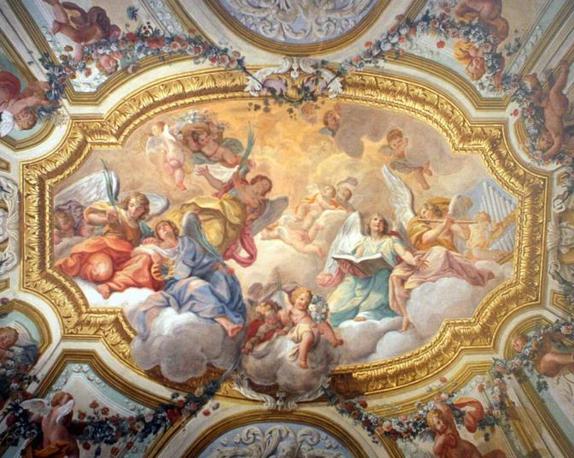
Sumptuous work of Luigi Vanvitelli (1700/73) who also worked on the magnificent altarpiece on the right "Apparition of the Angel to St. Cecilia" and the beautiful frescoes in the vault with "Angels Musicians": these are the only surviving paintings he produced
Further on in the nave ALTAR OF St. MARY MAGDALENE
"St. Mary Magdalene" maybe by Giovanni Baglione (1566/1643) 
4th CHAPEL ON THE RIGHT
Truly spectacular and underrated "Monument of Cardinal Mariano Rampolla del Tindaro" 1929 Enrico Quattrini (1863/1950)
END OF THE RIGHT NAVE
On right wall, ruined twelfth century fresco detached from the porch "St. Cecilia appears to Paschal I"
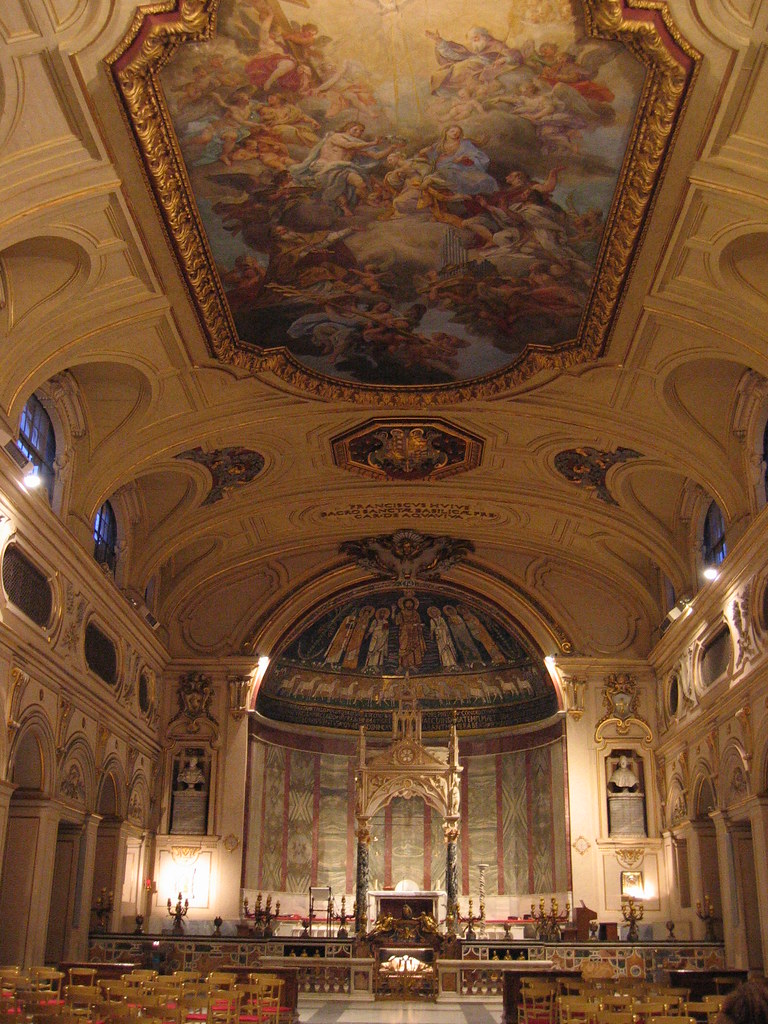
PRESBYTERY
"Ciborium" 1293 masterpiece by Arnolfo di Cambio (about 1245/1302)
"Besides the assimilation of local elements, such as the use of mosaic inlays of different colors, Arnolfo knows how to brilliantly insert the gothic culture, shaped and adapted to his own ends" (Carlo Bertelli, Giuliano Briganti, Antonio Giuliano)
"The artist's last Roman works show his performance increasingly refined: the prophets and evangelists in the spandrels of the ciborium of S. Cecilia, fluent and refined, seem far removed from the angular shape of the ciborium of St. Paul" (Richard Krautheimer)
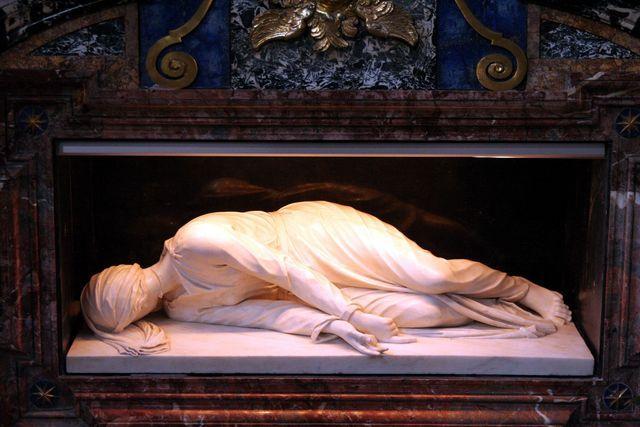
Under the altar "Statue of St. Cecilia" 1600 Stefano Maderno (1560/1636), who portrayed the body of the saint as it was apparently found when the tomb was open
"The small body, caressed by a soft, loose drapery and the natural and composed position, reveal a simple interpretation distant from the complicated patterns of the late sixteenth century. The sculptor, sharing the spirit of the Counter-Reformation creates a poignant and moving image that wants to remind the faithful of the sacrifices of the early Christians: the saint is the holy symbol of faith and an example of perseverance" (Carlo Bertelli, Giuliano Briganti, Antonio Giuliano)
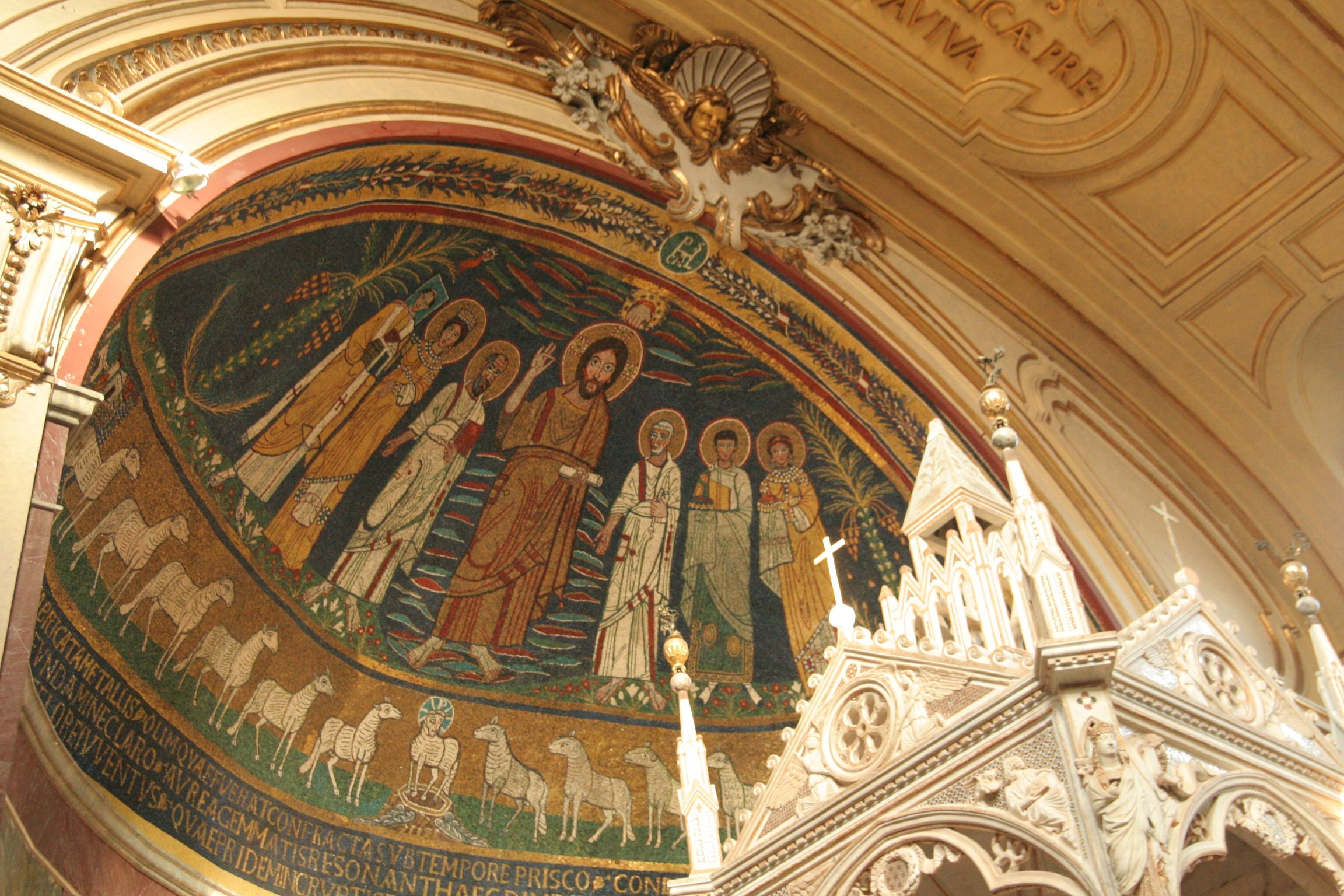
IN THE APSE
Below "Mystic Lamb and two lines of lambs" about 820 for Paschal I
At the sides of the apse in niches on the right "Bust of Pope Clement XI Albani (1700/21)" and on the left "Bust of Pope Innocent XII Pignatelli (1691/1700)" about 1725, maybe by Giuseppe Mazzuoli (1644/1725)
LEFT NAVE
END OF THE LEFT NAVE
"Sts. Peter and Paul" by Giovanni Baglione (1566/1643)
In the plinth on the right "Inscription with letter of Paschal I" copied from a manuscript in the Vatican Library
ON THE WALL OF THE NAVE
"S. Agata" maybe by Paolo Guidotti aka Cavalier Borghese (1560/1629)
"S. Andrea" by Giovanni Baglione
"Tomb of Cardinal Magalotti" who died in 1538 maybe by Guglielmo Della Porta (1515/77)
"Sts. Stephen and Lawrence" 1676 Giuseppe Ghezzi (1634/1721)
VAULT OF THE NAVE painted by Giovanni Zanna and Tarquinio Ligustri (about 1563/1621)
CLOISTER
Twelfth century with lunettes painted by Francesco Vanni (about 1563/1610) and Giovanni Baglione
CHOIR OF THE NUNS
Stairs accessible from outside the church take to the a room from which it is visible at close distance, built against the counter-façade of the church: inside the "Last Judgement" with fragments of "Annunciation", "Jacob's Dream" and "Deception of Isaac" 1289/93 by Pietro de' Cerroni aka Pietro Cavallini (about 1240/1325)
It is a masterpiece crucial for the history of modern painting rediscovered only in the twentieth century
The Roman Cavallini in the eyes of many art historians, including Federico Zeri, has always been underestimated when compared to the more incensed Tuscan Giotto (about 1267/1337) who was active a generation later
"It is plain to see the research for a monumental composition, rendered through the various sections softly modeled by mixtures of deep color. It stands out in a climate where the serenity of the angels and the apostles reigns" (Carlo Bertelli, Giuliano Briganti, Antonio Giuliano)
"The revival of ancient Roman art after 1270 had contributions, from the artists working then both in the Byzantine Empire and in the French Gothic world, thus giving it greater force. Nevertheless, in its essence that Renaissance was, as all the previous, purely based on Roman and late antique monuments existing everywhere in the city. What distinguishes the Roman masters of the end of 1200 from their ancestors of the twelfth century as well as from their predecessors of Reims around 1230 and from Nicola Pisano, is that they embrace a much wider range of antiques and that they are to get confronted with models that are no longer a single head, a boy, a bird, but entire compositions. And in no other place like Rome the late antique large compositions were so easily accessible" (Richard Krautheimer)
UNDERGROUND AREA
1899/1901 by G.B. Giovenale (1849/1934) in neo-byzantine style, after the excavations of 1899
Roman buildings, probably houses, used from the first century BC until the IV AD
In a room of the second century AD there is a very rare example in Rome of a "Circular baptismal font" by total immersion maybe dating back to the fifth century AD. There are remains of paintings on the walls