BASILICA S. CECILIA IN TRASTEVERE
TITULUS CECILIAE, named for the first time in early fifth century. House of S. Valeriano, St. Cecilia's husband martyred, according to tradition, under Marcus Aurelius (161/180) with three strokes on the neck after she escaped unhurt from three days of exposure to hot vapors
Built in about 820 for Paschal I (817/824) who had St. Cecilia's body moved here after it was found in the Catacomb of St. Callisto
St. Cecilia is the patron saint of musicians, even if an explicit link between Cecilia and the music is documented only since the late Middle Ages. This is due to incorrect transcription of the words at the beginning of the mass dedicated to her; the terms candendibus organis were mistakingly changed to cantantibus organis, with the meaning changed from "between the instruments of hot torture" to "singing with the organ"
At the end of 1100 or at the beginning of 1200 the BELL TOWER was added (the only one leaning in Rome), as well as the CONVENT, CLOISTER and PORCH
Restorations in the years 1540, 1600 and, more radically, 1724 by Domenico Paradisi and Luigi Barattoni
Other restorations in 1742 and in 1823
CRYPT remade at the end of the nineteenth century
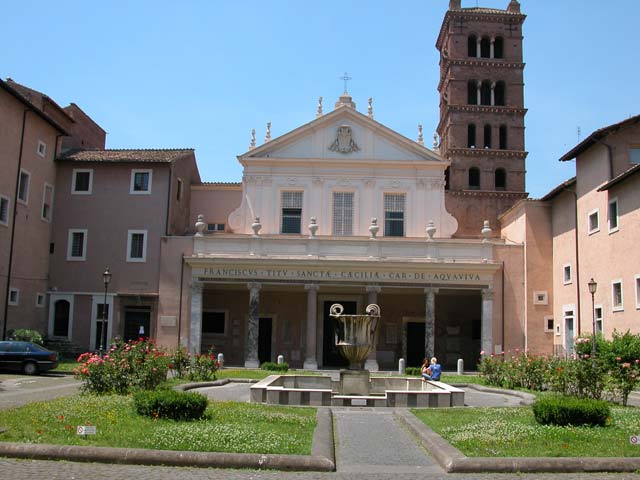
MONUMENTAL ENTRANCE
1741/42 maybe designed by Ferdinando Fuga (1699/1782) for the Cardinal Troiano Acquaviva whose coat of arms above the portal is hold up by two "Putti" by Agostino Corsini
Under the arch on the right "Cippo of urban pomerium" AD 75, the time of Vespasian (69/79), moved here in the XX century
In the center of the COURTYARD ancient roman "Cantaro" (big vase) in marble
On the right monastery of the Franciscan Sisters of Egypt
On the left monastery of Benedictine nuns
On the lintel of the porch "Mosaic strip" from the XII century
PORTICO
On the right "Monument to Cardinal Paolo Emilio Sfondrati" who died in 1618 (nephew of Gregory XIV Sfondrati -1590/91- pope for 10 months) Girolamo Rainaldi (1570/1655). Sculptures designed by Pietro Bernini (1562/1629) with reliefs that recall the discovery of the intact body of St. Cecilia in 1599
CEILING
AFTER THE ENTRANCE
On the right "Tomb of Cardinal Adam Easton of Hartford" who died in 1398 maybe by Giovanni d'Ambrogio (active 1366/1418) or maybe Paolo Taccone aka Paolo Romano (about 1415/77). He was the Cardinal of London belonging to the royal family of the Plantagenets
On the left "Monument to Cardinal Nicolò Forteguerri" who died in 1473 maybe by Mino da Fiesole
RIGHT NAVE
1st RIGHT - CHAPEL of the vestibule
Two detached frescoes end of 1300 or beginning of 1400
CORRIDOR OF THE RIGHT NAVE
Frescoes of "Saints and Landscapes" Paul Brill (1554/1626)
At the bottom of the nave statue of "St. Sebastian" maybe first half of 1500 by Lorenzo Lotti aka Lorenzetto (1490/1541)
2nd RIGHT - PONZIANI CHAPEL (family of St. Francesca Romana)
Paintings, including "God the Father among the Evangelists" about 1470 by Antonio Del Massaro aka Antonio da Viterbo or Pastura (about 1450/1516) a Pinturicchio follower
Between this and the next chapel ALTAR OF St. BENEDICT "St. Benedict" about 1676 by Giuseppe Ghezzi (1634/1721)
3rd RIGHT - CHAPEL OF RELICS
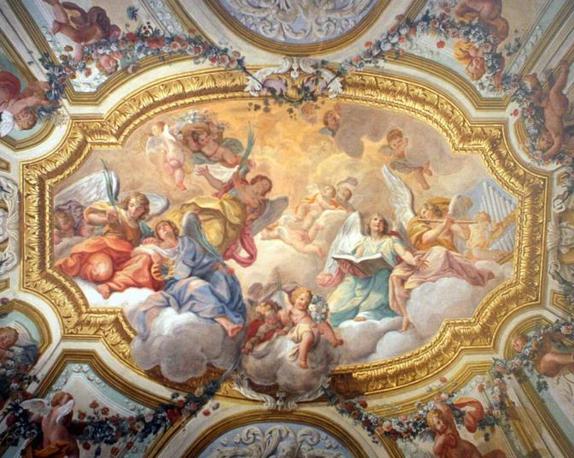
Sumptuous work of Luigi Vanvitelli (1700/73) who also worked on the magnificent altarpiece on the right "Apparition of the Angel to St. Cecilia" and the beautiful frescoes in the vault with "Angels Musicians": these are the only surviving paintings he produced
Further on in the nave ALTAR OF St. MARY MAGDALENE
"St. Mary Magdalene" maybe by Giovanni Baglione (1566/1643)
4th CHAPEL ON THE RIGHT
Truly spectacular and underrated "Monument of Cardinal Mariano Rampolla del Tindaro" 1929 Enrico Quattrini (1863/1950)
END OF THE RIGHT NAVE
On right wall, ruined twelfth century fresco detached from the porch "St. Cecilia appears to Paschal I"
PRESBYTERY
"Ciborium" 1293 masterpiece by Arnolfo di Cambio (about 1245/1302)
"Besides the assimilation of local elements, such as the use of mosaic inlays of different colors, Arnolfo knows how to brilliantly insert the gothic culture, shaped and adapted to his own ends" (Carlo Bertelli, Giuliano Briganti, Antonio Giuliano)
"The artist's last Roman works show his performance increasingly refined: the prophets and evangelists in the spandrels of the ciborium of S. Cecilia, fluent and refined, seem far removed from the angular shape of the ciborium of St. Paul" (Richard Krautheimer)
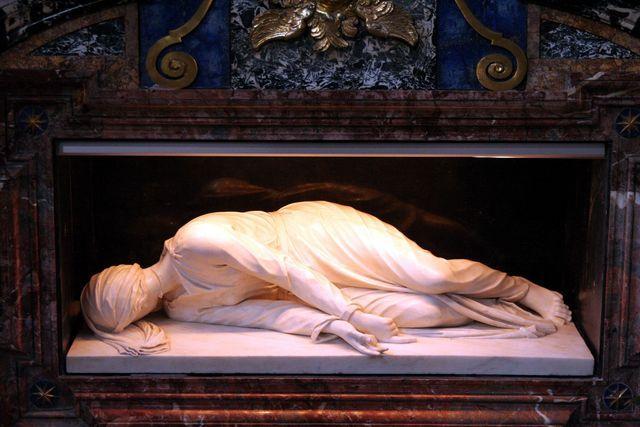
Under the altar "Statue of St. Cecilia" 1600 Stefano Maderno (1560/1636), who portrayed the body of the saint as it was apparently found when the tomb was open
"The small body, caressed by a soft, loose drapery and the natural and composed position, reveal a simple interpretation distant from the complicated patterns of the late sixteenth century. The sculptor, sharing the spirit of the Counter-Reformation creates a poignant and moving image that wants to remind the faithful of the sacrifices of the early Christians: the saint is the holy symbol of faith and an example of perseverance" (Carlo Bertelli, Giuliano Briganti, Antonio Giuliano)
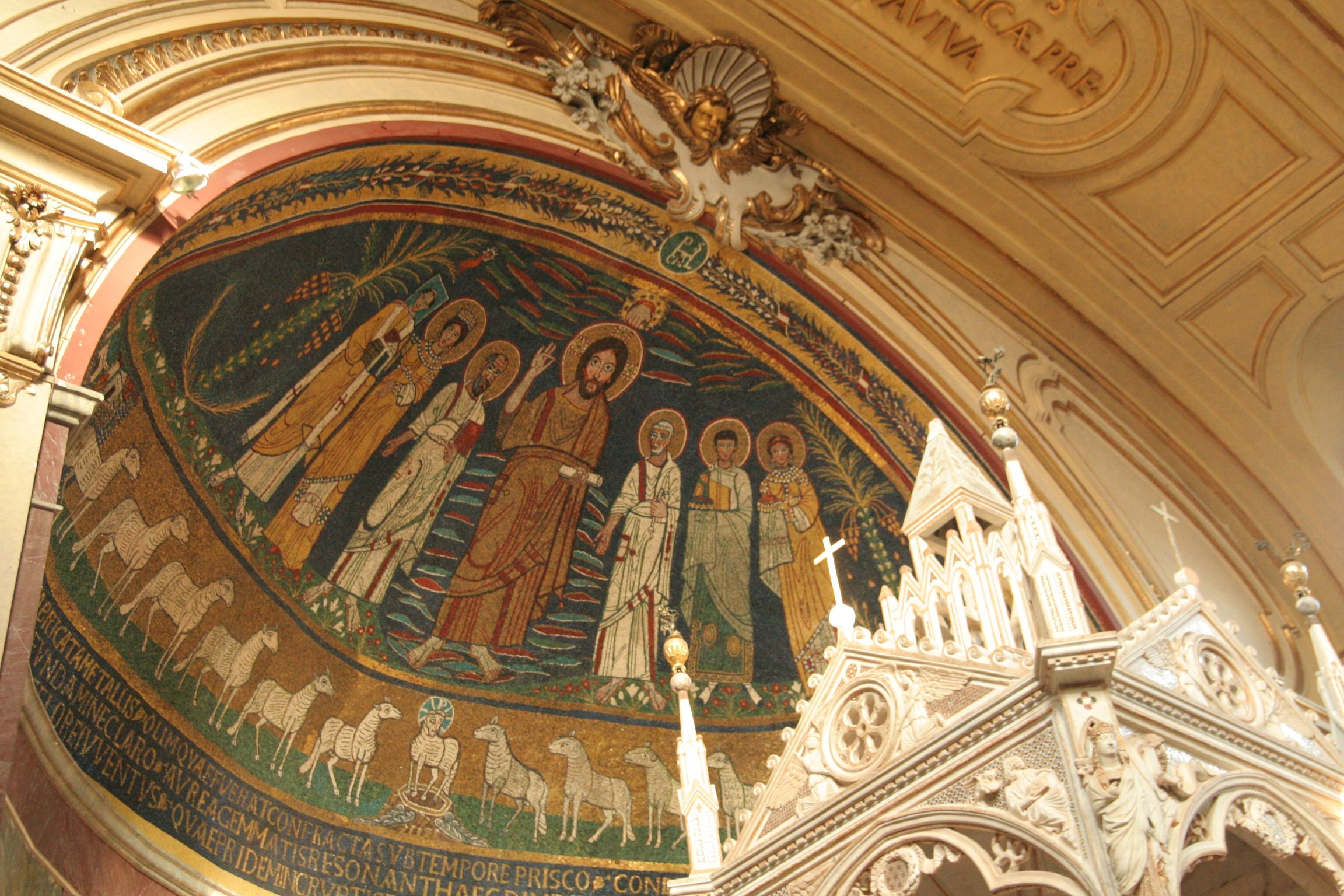
IN THE APSE
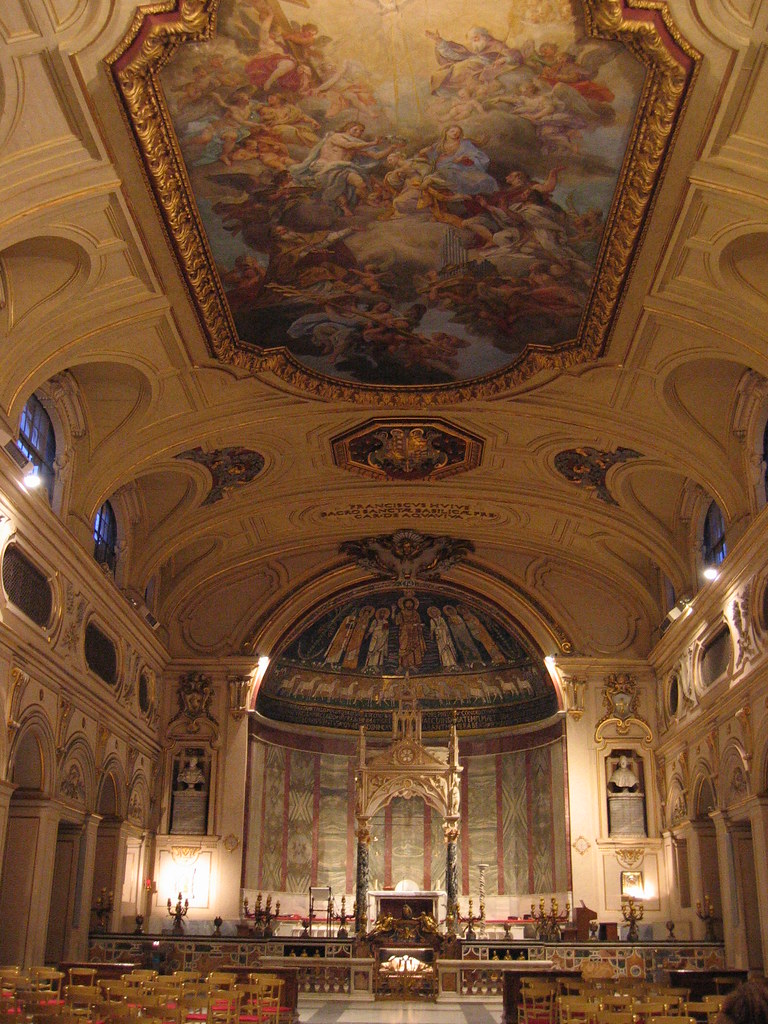
Below "Mystic Lamb and two lines of lambs" about 820 for Paschal I
At the sides of the apse in niches on the right "Bust of Pope Clement XI Albani (1700/21)" and on the left "Bust of Pope Innocent XII Pignatelli (1691/1700)" about 1725, maybe by Giuseppe Mazzuoli (1644/1725)
LEFT NAVE
END OF THE LEFT NAVE
"Sts. Peter and Paul" by Giovanni Baglione (1566/1643)
In the plinth on the right "Inscription with letter of Paschal I" copied from a manuscript in the Vatican Library
ON THE WALL OF THE NAVE
"S. Agata" maybe by Paolo Guidotti aka Cavalier Borghese (1560/1629)
"S. Andrea" by Giovanni Baglione
"Tomb of Cardinal Magalotti" who died in 1538 maybe by Guglielmo Della Porta (1515/77)
"Sts. Stephen and Lawrence" 1676 Giuseppe Ghezzi (1634/1721)
VAULT OF THE NAVE painted by Giovanni Zanna and Tarquinio Ligustri (about 1563/1621)
CLOISTER
Twelfth century with lunettes painted by Francesco Vanni (about 1563/1610) and Giovanni Baglione
CHOIR OF THE NUNS
Stairs accessible from outside the church take to the a room from which it is visible at close distance, built against the counter-façade of the church: inside the "Last Judgement" with fragments of "Annunciation", "Jacob's Dream" and "Deception of Isaac" 1289/93 by Pietro de' Cerroni aka Pietro Cavallini (about 1240/1325)
It is a masterpiece crucial for the history of modern painting rediscovered only in the twentieth century
The Roman Cavallini in the eyes of many art historians, including Federico Zeri, has always been underestimated when compared to the more incensed Tuscan Giotto (about 1267/1337) who was active a generation later
"It is plain to see the research for a monumental composition, rendered through the various sections softly modeled by mixtures of deep color. It stands out in a climate where the serenity of the angels and the apostles reigns" (Carlo Bertelli, Giuliano Briganti, Antonio Giuliano)
"The revival of ancient Roman art after 1270 had contributions, from the artists working then both in the Byzantine Empire and in the French Gothic world, thus giving it greater force. Nevertheless, in its essence that Renaissance was, as all the previous, purely based on Roman and late antique monuments existing everywhere in the city. What distinguishes the Roman masters of the end of 1200 from their ancestors of the twelfth century as well as from their predecessors of Reims around 1230 and from Nicola Pisano, is that they embrace a much wider range of antiques and that they are to get confronted with models that are no longer a single head, a boy, a bird, but entire compositions. And in no other place like Rome the late antique large compositions were so easily accessible" (Richard Krautheimer)
UNDERGROUND AREA
1899/1901 by G.B. Giovenale (1849/1934) in neo-byzantine style, after the excavations of 1899
Roman buildings, probably houses, used from the first century BC until the IV AD
In a room of the second century AD there is a very rare example in Rome of a "Circular baptismal font" by total immersion maybe dating back to the fifth century AD. There are remains of paintings on the walls