Showing posts with label Raffaele De Vico. Show all posts

Monday, June 1, 2020

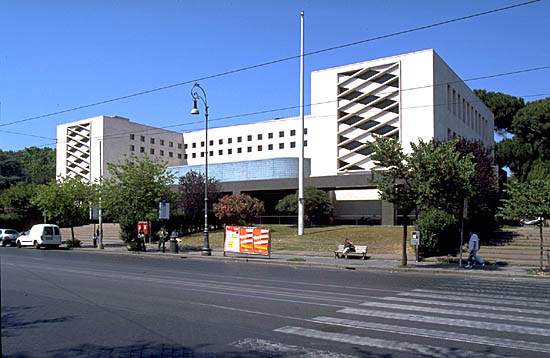
POST OFFICE ON VIA MARMORATA

UFFICIO POSTALE DI VIA MARMORATA
Via Marmorata 4

1935 Adalberto Libera (1903/63) and Mario De Renzi (1897/1967)

1997/2001 restoration by Sergio Poretti assisted by a team from the Rome University of Tor Vergata

It is a remarkable testimony of Rationalist architecture unfortunately very modified in the interior by works that occurred over time

“Adalberto Libera was one of the young architects who, refusing Decorativism, Eclecticism, or a position of revaluation of the 'Roman' tradition, proposed, around the year 1927, through the geometric rigor and typological-functional clarity, the statement of Rationalism, the only kind of architecture responsive to social and functional needs of contemporary civilization, overcoming revivals and provincialism” (Luigi Secondo Gioggi)

“Plans for the Appio, Aventino and Nomentano Post Offices respectively by SamonĂ , Libera and De Renzi and Ridolfi are still one of the most important examples of modern architecture in Rome” (Piero Ostilio Rossi)

Originally, for the sides of the stairway, were designed two suggestive large ornamental pools that were eliminated shortly after installation to prevent accidents

Behind the post office is the PARCO DELLA RESISTENZA DELL'8 SETTEMBRE 1939 (Park of the Resistance on September 8, 1939) arranged in 1939 by Raffaele De Vico (1881/1969)
In 1931 De Vico had also arranged the Monte Testaccio as a public park

Saturday, March 22, 2014

MOUNT TESTACCIO

MONTE TESTACCIO
Artificial hill also known as Monte dei Cocci, Mons Testaceum
It was an ancient Roman specialized landfill consisting of many layers of neatly broken oil amphorae
About 30 m (98 feet) high on the surrounding area and about 54 m (177 feet) above sea level
It has a circumference of 1 km (0.62 miles), covering a total area of 20,000 m² (5 acres), forming a sort of irregular triangle
The amphorae (testae in Latin, hence the name of the mountain) were landed in the nearby river port on the Tiber, and destined to be sold in Rome
It is estimated that there are about 40 million pieces of amphorae
A ramp, probably old, was traveled by wagon, and then bifurcated on the northeast corner
The hill was used for about 300 years, from the late republic to the mid-third century AD but the dating of amphorae found to date ranges between 140 and the third century AD
It is estimated that every inhabitant of Rome consumed on average about 22 kg (48.5 pounds) of oil a year, especially for lighting
In later centuries along the base of the hill caves were dug, used as cellars for the wine of the Castelli Romani (Roman Hills) and stables as well (the so-called grottini), on which houses were built renovated today as restaurants and nightclubs
Still in medieval times carnival was celebrated here, with the cruel and bloody games always dear to the Romans. In fact, bullfighting was held here as well as the popular favorite "Ruzzica de li porci": carts of live pigs were thrown down the hill and when they were dashed to pieces at the bottom, people would hunt the stunned animals
From the fifteenth century when the carnival was moved to the Via Lata by the will of Pope Paul II Barbo (1464/71), the hill became the arrival point for the Via Crucis, the Stations of the Cross on Good Friday, becoming a veritable Golgotha, as shown in the cross still stuck on top. Later it became a favorite destination for the Ottobrate, the typical October Roman feasts, when festively decorated carts were brought to the taverns and wine cellars of Testaccio
In 1931 Raffaele De Vico (1881/1969) structured Monte Testaccio as a public park
The amphorae found during excavations were only the most superficial, mainly from Betica (now Andalusia) and also from Africa with a nearly spherical shape and the trademark on one of the two loops. They are called Dressel 20. The name of the exporter was written with a brush as well as the consular date, and the log of the various controls from start to finish
The deposit was not accidental, it was rather neatly constructed, and it was periodically sprayed with lime to sanitize the decomposition of the organic remains contained in the pieces
From the study of the amphorae in this hill it would be possible to write an economic history of the ancient city of Rome

Friday, November 22, 2013

CAMPO VERANO CEMETERY

CIMITERO MONUMENTALE DEL VERANO
1807/12 begun by Giuseppe Valadier (1762/1839)
Continued by Virginio Vespignani (1808/82) who also designed the great SQUARE PORTICO in 1880
It was enlarged until 1960
The name derives from the Verani family, an ancient Roman patrician family who used to own this area in the Republican period
Statues 1874/78 "Meditation" and "Charity" by Francesco Fabj-Altini (1830/1906), "Hope" by Stefano Galletti (1832/1905) pupil of Pietro Tenerani and "Silence" by Giuseppe Blasetti (1826/1908)
Among the monuments:
"Painter Tommaso Minardi" 1876 by Luigi Fontana (1827/1908)
"General Giacomo Medici" 1884 by Giulio Monteverde (1837/1917)
"Erminia FuĂ  Fusinato" 1876 by Stefano Galletti
On the small hill known as PINCETTO
"Monument to the pontifical soldiers fallen during the Mentana battle against the Italian army" by Vincenzo Luccardi (1808/76)
"Monument to the navy soldiers of the Sebastiano Veniero submarine" 1930 by Publio Morbiducci (1889/1963)
"Monument to the Roman soldier fallen during the First World War in the years 1915/18" 1922/31 by Raffaele De Vico (1881/1969)
CHAPEL OF St. MARY OF MERCY
Built in 1859
"Purgatory's souls" by Tommaso Minardi (1787/1871)

Friday, October 18, 2013

ROME ZOO

BIOPARCO
1911 designed by Carl Hagenbeck (1844/1913), a German animal dealer who had previously designed the zoo in Hamburg
Hagenbeck is considered the father of modern zoos' arrangements
The Bioparco is in the area where the Cardinal Scipione Caffarelli Borghese (1577/1633) used to keep some exotic animals
ENTRANCE by Giulio Barluzzi and Armando Brasini (1879/1965)
AREA IN FRONT OF THE DEERS' PARK, LARGE AVIARY and REPTILE HOUSE 1933/35 Raffaele De Vico (1881/1969)
18 hectares (44.5 acres) of parkland with more than 1,000 animals belonging to 200 different species of mammals, birds and reptiles
In addition there are about 1,000 trees including some rare ones
It was considered for decades one of the most beautiful zoos in Europe
In 1998 it changed name from Giardino Zoologico in Bioparco
With more than 600,000 visitors per year is the tenth place for number of visitors among the Italian tourist attractions