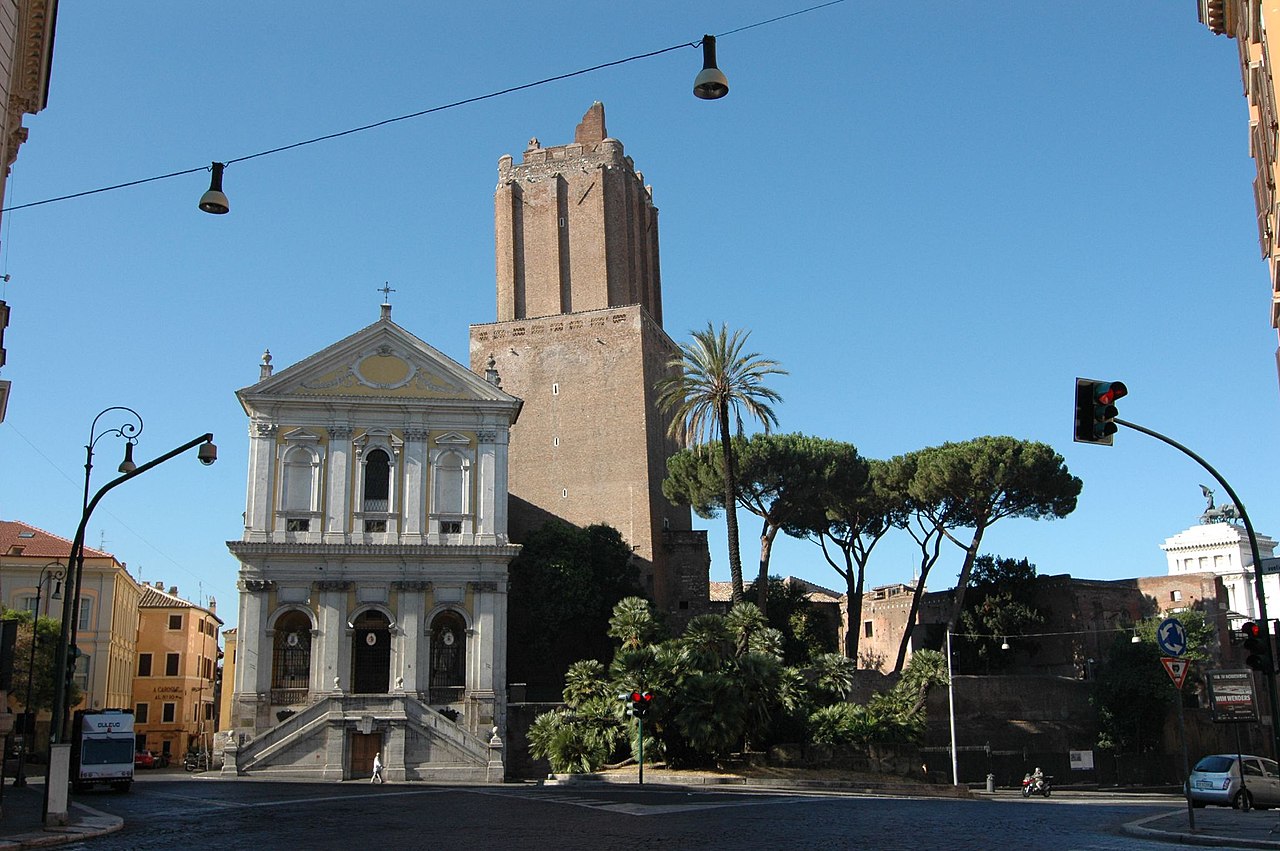
S. CATERINA A MAGNANAPOLI
Largo Magnanapoli
Established
in 1575 for Portia Massimi as the church of the Convent of the Sisters of
St. Catherine who had moved here from the house in Piazza S. Chiara
The
reconstruction of the church began in 1608 by Carlo
Maderno (1556/1629) but it was not completed
It was
finally rebuilt in the years 1628/31 and 1638/41 by G.B.
Soria (1581/1651)
The name
comes from the linguistic deformation of Balnea Pauli, the baths of
Paulus Emilius which were believed to be located nearby, more precisely, under
the church of Sts. Dominic and Sixtus
The convent
was destroyed to bring to light the structures of the Trajan's Market
DOUBLE
STAIRCASE added at the end of the nineteenth century during excavation works in
the area
Under the staircase
VOTIVE
CRYPT OF THE FALLEN
1934
inscribed with the names of the Romans who died in World War I and II and “Bronze
Crucifix” by Romano Romanelli (1882/1968)
PORCH
Plaster
statues “St. Catherine” and “St. Dominic” about 1650 by Giovanni Francesco De Rossi (active 1640/77)
VAULT
“Glory of
St. Catherine” 1700/12 by Luigi Garzi
(1638/1721)
“The work,
considered his masterpiece for the calibrated compositional structure, for the
accurate execution and the uniform color range, constitutes a valid and
original transposition on large areas of the ideas of Carlo Maratta and a vital
link between the Roman decorations of the seventeenth and eighteenth centuries”
(Giancarlo Sestieri)
1st
RIGHT - CHAPEL OF THE MAGDALENE
“Communion
of the Magdalene” 1706/07 by Benedetto Luti
(1666/1724) maybe his first public work in Rome
He also
painted the “Angels in adoration” in the vault, the only fresco he ever painted
“He emerged
as an international ambassador of the Roman Rococo, with his personal pathetic
and naturalistic style. (...) Even in the religious themes this Florentine
painter often obtained convincing results, often marked (...) by an Arcadian
and pastoral taste and a personal expressive sweetness with a Correggio flavor,
particularly influential on the scene of the French Academy of Rome, to which
he was bound by cordial relations” (Giancarlo Sestieri)
2nd
RIGHT - CHAPEL OF ALL SAINTS
“The Virgin
Mary intercedes for St. Catherine and glory of the saints” 1701/02 by Luigi Garzi (1638/1721)
Vault “Marriage
of St. Catherine”, “Christ in Glory” and “Scene of Martyrdom” by Giuseppe Passeri (1654/1714)
3rd
RIGHT - CHAPEL OF St. DOMINIC
“St.
Dominic resurrecting a child” 1706 by Biagio Puccini
(1673/1721)
Vault “St.
Dominic and St. Francis adore the Cross”, “Glory of St. Dominic” and “Lady of
the Rosary” by Giuseppe Vasconio (active half of
1600), a pupil of Guido Reni
DOME
In the
lantern “Eternal God in glory” by Francesco Rosa
(active from 1674/d. 1687)
MAIN ALTAR
Tabernacle
in agate, lapis lazuli and gilt bronze 1787 by Carlo
Marchionni (1702/86)
“St.
Catherine shows a very sensitive spirituality, an almost morbid sensibility, in
comparison to which the works of Bernini appear massive, firm and manly”
(Rudolf Wittkower)
“Caffà is
not 'original'. There is hardly any of his works that is not designed based on
a pattern suggested by previous sculpture. Yet he showed a new concept of
sculpture and a new expressive order in comparison with the older generation.
His style is new. Seen in a broader historical context, he has a part in the
great change of style and taste that occurred in the third quarter of the
seventeenth century and therefore characterizes the beginning of the late
Baroque style” (Rudolf Preimesberger - Dizionario Biografico degli Italiani
Treccani)
Reliefs on
the sides on the right “St. Rose of Lima” and on the left “St. Agnes of
Montepulciano” 1755 by Pietro Bracci (1700/73)
Above the
door of the presbytery two paintings with stories of St. Catherine: “St.
Catherine surprised by her father while praying” and “St. Catherine chooses the
crown of thorns” early 1700s by Giuseppe Passeri
(1654/1714)
3rd LEFT -
BONANNI-PRIMI CHAPEL
Above the
altar “Madonna of the Rosary” 1702/03 masterpiece by Giuseppe
Passeri
“Among the
pupils of Maratta, the most original modernistic ideas, surpassing sometimes
the master himself, were undoubtedly offered by Giuseppe Passeri. (...) While
remaining tied to the dominant Baroque-Classicist style, he highlights a deep
attraction for the materiality of Gaulli's lightness and a deep grasp of the
dynamism of the chiaroscuro lighting technique of Lanfranco, the study of whom
had been recommended to him by Maratta himself” (Giancarlo Sestieri)
At the
sides funerary monuments:
On the left
“Bust of Giuseppe Bonanni” and on the right “Bust of Virginia Primi” by the
great Giuliano Finelli (1602/53)
Vault “Annunciation”,
“Assumption” and “Nativity” by G.B. Speranza
(about 1600/40)
Under the
arch “Saints” by G.B. Ruggieri aka Battistino del Gessi
(1606/40)
2nd CHAPEL
ON THE LEFT
“The three
archangels” by Giuseppe Passeri
“A splendid
example of the transition from baroque classicism to the elegiac atmosphere of
the early eighteenth century” (Laura Mocci)
Vault “Vision
of St. John at Patmos”, “Eternal Father” and “St. Catherine and the Angel” and
arch “Joseph and the Angel”, “Virgin in Glory” and “Liberation of St. Peter”
frescoes about 1654 by Giovanni Paolo Schor
(1615/74), maybe in collaboration with his brother Egidio
Schor
1st LEFT -
CHAPEL OF St. NICHOLAS OF BARI
“Vision of
St. Nicholas of Bari” maybe beginning of 1700s by Pietro
Nelli (active in Rome 1700/50), who maybe also painted the “Glory of
Angels” in the vault
CORRIDOR
BETWEEN CHURCH AND SACRISTY
Fragments
of frescoes of the end of the fifteenth century “St. Bridget” and “St.
Catherine of Alexandria” from the oratorio destroyed in the Thirties