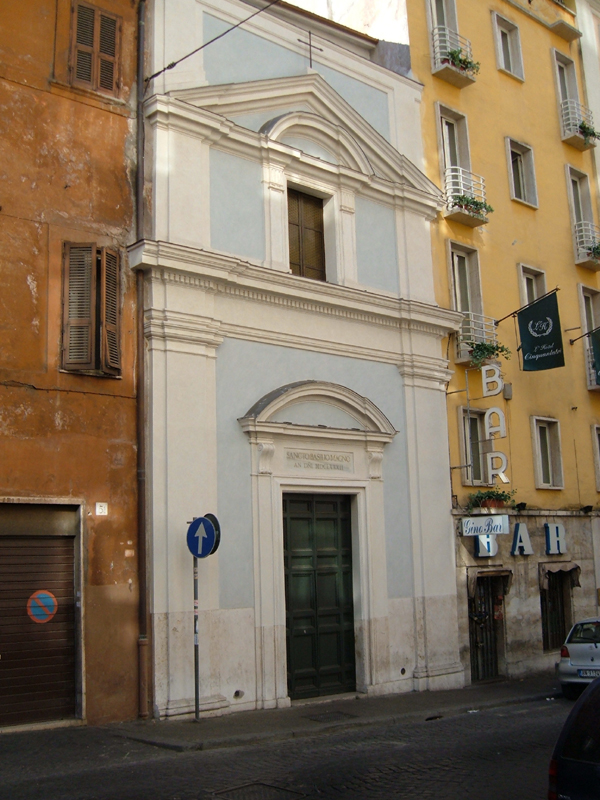
S. BASILIO
Built in the
years 1680/82
Expanded
with the convent in 1692 by Francesco Carlo Bizzaccheri
(1655/1721)
In 1874 the
monastery became the property of the Italian State
It is
dedicated to St. Basil who lived in Turkey between 329 and 379. He defended
orthodoxy against the Arian heresy
It is part of the Italo-Greek Catholic Church
depending on the Abbey of Grottaferrata
It is a
peculiar Catholic church that uses the Byzantine Rite. It is autonomous and its
members are concentrated in Southern Italy and Sicily
NAVE
Paintings
by anonymous artists of the seventeenth century:
On the
right “Death of S. Joseph” and on the left “Virgin Mary and Child with Saints”
where there is the representation of S. Nile offers the model of the Abbey of
Grottaferrata, still run by the Basilian Monks
“Memory of
Cardinal Basilios Bessarion (1403/72)”
“He
contributed to the diffusion in Italy of the study of the Greek language and
especially of the Platonic philosophy, and in defense of Plato (...) he wrote
(...) against Thomistic Aristotelianism. (...) He translated into Latin the
Metaphysics by Aristotle. He left letters, prayers, theological essays, rich in
doctrine, supported by great balance of thought. He strove with great fervor,
with writings and words, with extensive and skillful diplomacy, for a crusade
to win back Constantinople, fallen into the hands of the Turks in 1453. In 1463
the alliance of Venice with Pope Pius II, obtained by Bessarion, seemed to make
the crusade possible, but the death of the pope (1464) brought Bessarion to move
away from the Curia and to continue alone diplomatic relations in Europe. His
rich library of Greek manuscripts, donated to Venice (1468), was the first and
most important collection of the Biblioteca Marciana” (Enciclopedia Treccani)
Huge “Iconostasis”
of the end of 1800s from the church S. Lorenzolo ai Monti destroyed for the
opening of Via dei Fori Imperiali
In all the
churches with Italo-Greek Catholic rite the presbytery reserved for the clergy
is separated from the rest of the church with a large iconostasis or barrier of
dark wood adorned with sacred images
MAIN ALTAR
Canvas
“St. Basil” by an anonymous artist of the
seventeenth-century


_-_S._Basilio_02_Facciata.JPG/768px-Roma_(Q._San_Basilio)_-_S._Basilio_02_Facciata.JPG)