Showing posts with label Via IV Novembre. Show all posts

Monday, May 18, 2020

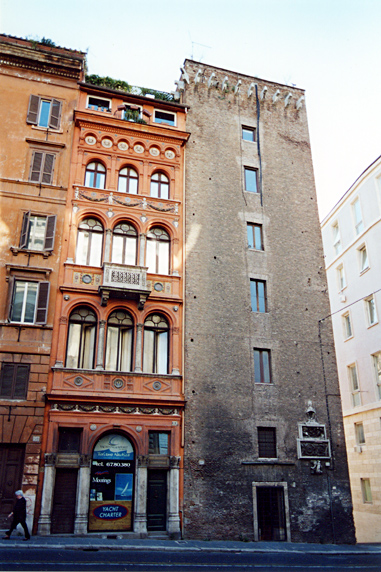
COLONNA TOWER

TORRE DEI COLONNA
Via IV Novembre/Via delle Tre Cannelle 18

End of the twelfth century by Gilido Carbone
It was attached to the defensive system of the Colonna family, later owned by the Annibaldi Molara family

Built in bricks. It was originally a three-storey buiding
The crowning in travertine is modern

In the lower part of the tower are embedded three ancient “Fragments of reliefs” and the emblem of the Colonna family
It was recently restored and reconverted into a luxury hotel with the name RESIDENZA TORRE COLONNA

Monday, November 13, 2017

VALENTINI PALACE

PALAZZO VALENTINI
1583/85 Fra' Domenico Paganelli for Cardinal Michele Bonelli nephew of St. Pius V Ghislieri (1566/72) and known as Palazzo Bonelli
Expanded in the first half of the seventeenth century maybe by Francesco Peparelli (active from about 1626/d. 1641)
In the years 1705/13 it was rented to the Marquis Francesco Maria Ruspoli who opened a theater in the building and hosted musicians such as George Frideric Handel, Alessandro Scarlatti and Angelo Corelli
In 1752 it was bought by Cardinal Giuseppe Renato Imperiali who arranged a rich library with 24,000 volumes also visited by Johann Joachim Winckelmann (1717/78)
From 1827 it belonged to the banker Vincenzo Valentini who had the FAƇADE FACING THE FORUM OF TRAJAN built in about 1830 by Filippo Navone (active first half of XIX century)
The Valentini family had in it a great picture gallery and lived here until 1870
Since 1873 it is the headquarters of the PROVINCE OF ROME, which transformed the courtyard and the interior in 1878 by Luigi Gabet (active 1858/78)
In the COURTYARD there are four ancient statues with modern changes:
“Valentini Aphrodite”
“Man with breastplate and head of Marcus Aurelius” maybe not relevant
“Hermes of Andros with head of Pertinax” not relevant
“Naked man with head of Caracalla” not relevant
The palace houses a collection of ancient statues and paintings which belonged to Vincenzo Valentini with works by artists such as Carlo Cignani and Ludovico Stern (1709/77) as well as many anonymous seventeenth century artists 
ARCHAEOLOGICAL EXPLORATIONS
1,800 square meters (20,000 square feet) residential district comprising
Two richly decorated houses (domus) of the fourth century AD maybe owned by a judge or a senator: walls decorated with polychrome panels and polychrome mosaic floors
Small private baths
The excavations were made from 2006 to 2010
Landfill of the sixteenth century known as BUTTO (throw) where ceramic plates were discovered, as well as everyday objects and even food scraps
Two sculptures of “Togati” of the second century AD without head that had been used as a fill for foundations in the sixteenth century
Stretch of paved Roman road very well preserved
Two “Fragments of huge monolithic columns” in Egyptian granite similar to the one near the Column of Trajan and probably part of the Temple of Trajan, whose exact topographic location is still the focus of academic debate. The columns had to have a minimum height of 15 m (49 feet) and perhaps it was even 20 m (65 feet) high
The area is beautifully accessible with very effective reconstructions using virtual reality and an exciting archaeological trail that goes up to the front of the Trajan's Column
An example that should be imitated in many other archaeological sites, almost a waking dream for those who love Rome, made possible thanks to the initiative of the great popularizer Piero Angela

Wednesday, November 30, 2016

INAIL PALACE

PALAZZO DELL'INAIL
1928/34 Armando Brasini (1879/1965)
“Brasini used the languages of the past, the classical and the baroque in particular, not passively and academically, but, in fact, creatively, considering them not as closed systems to be applied blindly but as open systems to be investigated again, asking them questions that had not been raised previously. Also the Eclecticism of the nineteenth century had been able in many cases to identify the way of creativity facing new functional themes, new dimensions and new technology, but in the use of historical languages it had adopted with few exceptions (Nash, Richardson, Antonelli, Basile) an instrumental attitude. Brasini came out of the eclectic orthodoxy looking for a continuation of styles, a search for an all-out development of the architectural language that would make it suitable for a different climate, a heroic climate, which could then seem credible and rich of future developments. It should not be forgotten that we are in the decades of the true and false revolutions that would have to choose between two types of rhetoric, the one proven by history and one to be invented, the rhetoric of modernity in action. The outcome was gigantism, rhetorical excess, theatricality imposed by the nascent film industry, but also the creation of works blessed by creative restlessness” (Paolo Portoghesi)
INAIL is the Istituto Nazionale per l'Assicurazione contro gli Infortuni sul Lavoro (National Institute for Insurance against Accidents at Work)
Built on the site of the demolished Teatro Drammatico Nazionale (National Dramatic Theatre) by Francesco Azzurri (1831/1901), on the site of which, during the construction in 1888, the Hellenistic bronze statues of the “Boxer” and of the “Hellenistic Prince” had been found
The two masterpieces are now in the Museo Nazionale Romano at Palazzo Massimo

Thursday, February 13, 2014

HOTEL PACE HELVEZIA

HOTEL PACE HELVEZIA
1873/74 Gaetano Koch (1849/1910)
"After 1972, when Koch received his title of architect and engineer, he began a feverish and untiring designer's work, carried out without interruption for three decades, as a 'smooth professionalism with no concerns' (Miano), based on a rigorous compositional use of sixteenth-century repertoire combined with the continued development of the typical features and distribution of buildings, with well thought solutions in the arrangement of courtyards and vertical connections" (F. Di Marco - Dizionario Biografico degli Italiani Treccani)

Thursday, October 24, 2013

RUBBOLI HOUSE

CASA RUBBOLI
1886 Pietro Carnevale (1839/95) for Vincenzo Rubboli
Neorenaissance style decoration with painted tiles inspired by the architecture of the fifteenth century. It sticks out next to the very different Colonna Tower