Tuesday, February 24, 2015

VATICAN MUSEUMS - ROOM OF THE IMMACULATE CONCEPTION


SALA DELL'IMMACOLATA CONCEZIONE
 
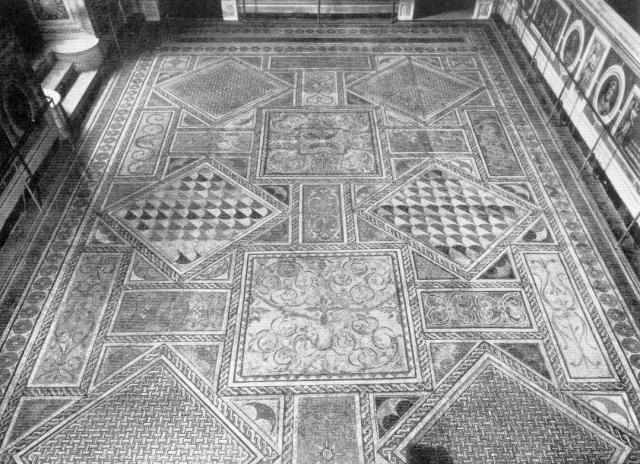
Huge and beautiful floor with “Ancient Roman mosaic” from the so called Imperial Palace in Ostia

“Cycle of frescoes dedicated to Holy Mary” 1856/65 by Francesco Podesti (1800/95) from Ancona for Pius IX Mastai-Ferretti (1846/78) who had pronounced the dogma of the Immaculate Conception on December 31, 1854
The dogma is not the fact that Mary has conceived Jesus as a virgin, as is commonly and erroneously believed, but that she was born without original sin

In the vault, six octagons with “Faith”, “Doctrine” and four episodes of the Old Testament:
“Castaways with the Ark of Noah in the background”, “Jael kills Sisera”, “Esther fainting before Ahasuerus” and “Judith with the head of Holofernes”

In the large wall to the right “Proclamation of the dogma of the Immaculate Conception” with two registers, earthly and heavenly, inspired by the masterpieces of Raphael

On the left into the wall with the windows “Stories and allegorical figures”

Opposite the entrance “Crowning of the image of the Immaculate Coronation” in the Chapel of the Choir of the Basilica of St. Peter's


Francesco Podesti tore down a ceiling with an attic above enlarging in this way the walls of the room
During the discussion that took place for the proclamation of the dogma Podesti drew from life with almost photographic details all participants he would have later painted in his “Discussion”

He included a certain Father Passaglia, who had expressed unorthodox ideas, but Podesti insisted to include him as well, reminding that Judas was included in all representations of the Last Supper despite having done much worse than poor Father Passaglia

“A cultured and civilized work that is, however, outside of history, it floats above history as an anachronism perfect in his own way. Some might say that the Chapel of the Immaculate Conception can be taken as a mirror and metaphor for the long pontificate of Pius IX, also hung between the Old Regime and modernity, between the progressive openings and conservative closings. In a schematic view of history would be easy to argue that also the Mastai-Ferretti pontificate is unresolved and pending on the events of the century in a state of substantial irrelevance, in precarious and stunned balance between the ancient Church which ends with Gregory XVI Cappellari and the modern Church that with Leo XIII and Pius XI, will be a protagonist in the dramatic heart of the twentieth century. In fact, the personality of Pope Pius IX is more nuanced and complex than historiographical stereotypes would allow us to understand. (...) We can say with Micol Forti, that the Hall of Francesco Podesti (...) has an eminently documentary value. It is the valuable testimony of a commission that - not without culture, or ineffectively, it is also fair to say - was trying to counter impending and unavoidable historical events” (Antonio Paolucci)

At the center of the room “Precious cabinet” from Paris made of wood, metal, porcelain and semiprecious stones designed by Emile Auguste Reiber and executed by Charles and Paul Christofle in 1877
In the cabinet there are precious books with translations of the bull Ineffabilis Deus of 1854 in all languages of the Catholic populations of the world, donated to the Pope in 1877

VATICAN MUSEUMS - SOBIESKI'S ROOM


SALA SOBIESKI 
 
Floor with “Ancient Roman mosaic” from the so called Imperial Palace in Ostia

Canvas of 41 m² (441 square feet) “Sobieski gives to the courier the message of victory for the Pope after the liberation of Vienna” 1883 by the Polish Jan Mateiko (1838/93) representing the victory of the Polish King John III Sobieski over the Turks after the siege of Vienna in 1683

It seems that the artist refused his generous compensation to donate the pope the canvas on the two-hundredth anniversary of the battle
The Turkish army of the Ottoman Empire had besieged Vienna for two months with 140,000 men
The battle of the 11th and 12th September 1683 between the Turks and the Austrian-German-Polish army composed of about 75.000/80.000 men commanded by King John III Sobieski of Poland ended the siege and it was decisive for the outcome of the war
The Turks lost about 15,000 men and the Christians about 2,000. The battle not only marked the end of the Ottoman expansionist drive in Europe, but also the beginning of their ouster from the Balkans
According to a popular legend the siege of Vienna would have led to the invention of the croissant by Viennese bakers inspired by the crescent of the Turkish insignia

“Blessed John Sarcander led to the martyrdom” by the Roman Francesco Grandi (1831/91) pupil of Tommaso Minardi

S. Margaret Mary Alacoque (1647/90) was a French nun and mystic who was beatified in 1864 and canonized in 1920
Her alleged private revelations would lead to the development of the worship and feast of the Sacred Heart of Jesus established in 1856
In honor of this cult the famous Basilica of the Sacred Heart in Paris was begun in 1875 and consecrated in 1919

“S. Grata collects the body of St. Alexander” 1887 by the talented painter from Gandino (Bergamo) Ponziano Loverini (1845/1929)
St. Alexander was a Roman legionnaire who was killed in Bergamo during the persecution of 303
A woman called Grata, who was later made saint, would have collected the remains and would see lilies growing out of the shed blood of the martyr

“Martyrs of Gorkum” 1867 by Cesare Fracassini (1838/68) from Orvieto, another pupil of Tommaso Minardi

It was painted on the occasion of the canonization ceremony of the saints and it was such a big success that revealed this young artist who unfortunately died the following year only 29 years old
When this painting was shown for the first time in the studio of the artist, more than 20,000 people flocked to admire it
The martyrs of Gorkum were nineteen Catholic prelates captured in Gorcum and hanged in a barn in Brielle in South Holland by Calvinists in 1572 during the Eighty Years War (1568/1648)
The Dutch United Provinces were rebelling against the domination of Spain and the Peace of Westphalia of 1648 sanctioned the independence and the birth of the Netherlands
"The reviewers praised the perfect amalgam of historical accuracy and intensity achieved by introducing into the pathetic scene details of disturbing realism, which subordinated the usual supernatural apparatus to the focus of an all human ideal. The painting (...) as well as striking the imagination, continued to support the project of artistic propaganda of the Church during the period immediately after the unification of Italy" (Carlo Sisi – Catalogue of the exhibit Divina Bellezza)

Monday, February 23, 2015

VATICAN MUSEUMS - GALLERY OF St. PIUS V


GALLERIA DI S. PIO V GHISLIERI (1566/72)


On the left “Two Flemish tapestries” of the late 1400's by the manufacture of Tournai

On the right “Two tapestries with Coronation of Mary” from cartoons by the Raphael school and “Religion, Justice and Charity” 1525 by Pieter van Aelst's manufacture

SMALL ROOMS OF PIUS V

Two rooms with carved ceilings and paintings by Ventura Salimbeni (1568/1613) and Ferraù Fenzone (1562/1645) and friezes of Flemish artists

Flemish tapestries on the walls “Liberal Arts” in mid-1600 by the manufacture of Bruges and “Series of Cephalus and Procris” of the first half of 1500 by the Flemish manufacture

ROOM I

Collection of medieval and Renaissance ceramics: ancient floor tiles dating from the fourteenth to the eighteenth century. Medieval jugs with geometric patterns and other various Renaissance ceramics

ROOM II

Collection of micro mosaics made with a technique developed in Rome in the second half of 1700s. The micro mosaics were very popular among tourists pleased to take away from Rome souvenirs during the Grand Tour

Among the artists represented here Antonio Aguatti, Giacomo Raffaeli and Michelangelo Barberi
Two paintings “The rooster, a hen and chicks” and “Turkey” by Wenzel Peter (1745/1829)