Showing posts with label Ercole Ferrata. Show all posts

Sunday, February 10, 2019

St. JEROME OF CHARITY

S. GIROLAMO DELLA CARITÀ
A small church was built on the site where, according to tradition, St. Jerome on the year 382, was a guest in the house of the saint matron Paola
Known since 1492
Assigned in 1524 to the Arciconfraternita della Carità (Archconfraternity of Charity)
The church is linked to the figure of S. Filippo Neri (1515/95), known as St. Philip Neri in English
He lived for 33 years in the adjacent convent, in a room where there used to take place frequent meetings between four saints: Filippo Neri, Charles Borromeo, Ignatius of Loyola and Felice da Cantalice
In a barn adjoining the church S. Filippo Neri established the institution of the oratory
A fire in 1631 damaged the church
Rebuilt in the years 1632/37 by Francesco Peparelli (active since 1626/d. 1641)
Restored in the years 1652/60 by Domenico Castelli (1582/1657)

1660 completed by Carlo Rainaldi (1611/91) after the death in 1657 of Domenico Castelli who had already designed in 1647

FLOOR
Made of marble, 1660 by Alessandro Sarti

CEILING
1587 by the master carpenter Andrea Tozzi

1st RIGHT - CHAPEL OF OUR LADY or SPADA CHAPEL
1654 Giovanni Somazzi for Virgilio Spada
It is traditionally attributed to Francesco Borromini (1599/1667), of whom in fact there is only one project for the front of the altar and nothing else

Above the altar
“Madonna and Child” by an anonymous Sienese painter of the fifteenth century

At the sides of the altar
“Two medallions embossed with Sts. Francis and Bonaventure” by Pietro Paolo Naldini (1619/91)

On the right wall
“Tomb of Giovanni Spada” by Cosimo Fancelli (1620/88)

On the left wall
“Tomb of Lorenzo Bernardino Spada” by Ercole Ferrata (1610/86)
“Ferrata proved to be a faithful executor of the drawings supplied to him, showing a remarkable ability to adapt his style to the task requested. It is however acknowledged in him a tendency to tone down excessively dramatic and pathetic images in the name of that idea of Classicism of which he was then the main representative in Rome” (Gerardo Casale - Dizionario Biografico degli Italiani Treccani)

Above the graves
“Six medallions embossed with illustrious ancestors of the Spada family”, three on each side:
“Amadore I with his brother Aleramo Spada” and “Pietro di Cecco and Serrone di Pietro Spada” by Pietro Paolo Naldini
“Amadore with his son Mengo Sword” by Ercole Antonio Raggi (1624/86)
“Amadore II Spada” by Francesco Baratta (about 1590/about 1663)
“Mutio with his nephew Antonello Spada” by Ercole Ferrata
“Ghino di Mengo Spada” by Giuseppe Perone

On the threshold of the chapel
Sculptural group in bloodstone with “Angels kneeling and tending tablecloth for the Eucharist” by Antonio Giorgetti (known from 1660/d. 1669), a pupil of Alessandro Algardi
The angel on the left has movable wooden wings in faux marble used as small door of the chapel
“Borromini had little to do with the project (...) and anything with its execution. The lavish style of the chapel is very different anyway from the one of the architect from Canton Ticino in his late period. It remains a masterpiece of Baroque Roman for the highly theatrical effect and the use of pictorial marquetry and marble slabs with fake damasks” (Olga Melasecchi)

2nd RIGHT - CHAPEL OF THE CROSS
It was remodeled in 1717, the year to which frescos and stuccos date back to
Above the altar “Wooden crucifix” mid-1400s in front of which tradition has it that S. Filippo Neri used to celebrate Mass

RIGHT TRANSEPT
“Tomb of the Earl Asdrubale from Montauto” 1629 Pietro Berrettini aka Pietro da Cortona (1597/1669)
“The baroque style is detectable in the original cyma around the portrait, with the ends curled and the hanging festoons, imitated by Carlo Maratta for his own grave at S. Maria degli Angeli” (Olga Melasecchi)

TO THE RIGHT OF THE MAIN ALTAR
CHAPEL OF St. JOHN THE BAPTIST formerly CASALI CHAPEL and later MARESCOTTI CHAPEL
Altarpiece “Madonna and Child with Sts. Joseph, John the Evangelist and John the Baptist” by Durante Alberti (1538/1616) who also painted the frescoes with “Stories of Jesus” damaged by a fire in 1630 and by some bad restorations in the eighteenth century

MAIN ALTAR
1645/47 Carlo Rainaldi (1611/91) for Fantino Renzi and his nephew Scipione Gisleni who are buried here and whose “Busts” by the school of Algardi are inserted in the walls
“Communion of St. Jerome” 1797 copy by Antonio Corsi from the famous 1614 original by Domenichino which was originally here and is now in the Pinacoteca Vaticana

TO THE LEFT OF THE MAIN ALTAR
ANTAMORO CHAPEL
1707 by the great architect Filippo Juvarra (1678/1736)
“He solved the narrowness of the available space creating movement with the ellipsoidal shape of the plan, opening a large oval window at the end and expanding the stucco decoration in the lantern where it ends in a glory of cherubims. The concave shape of the altar is a counterpoint of the convex part of the steps” (Olga Melasecchi)
Statue of “S. Filippo Neri” by Pierre Legros (1666/1719) perhaps also the author of the reliefs with “S. Filippo Neri in the Catacomb of St. Sebastian” and “S. Filippo Neri sees the souls of his penitents going to heaven” also attributed to Camillo Rusconi (1658/1728)

2nd LEFT - CHAPEL OF St. CHARLES BORROMEO or MALAGOTTI CHAPEL
“Madonna and Child appearing to Sts. Carlo Borromeo and Filippo Neri” by an unknown artist of the first half of the seventeenth century
On the sides “Fake perspectives” and “Annunciation” about 1748 by Girolamo Mengozzi aka Colonna (1688/1774) from Ferrara

1st LEFT - CHAPEL OF St. PETER
“Handing of the keys” maybe by Girolamo Muziano (1532/92)
Prospective frescoes by Girolamo Mengozzi aka Colonna

SACRISTY
Walnut furniture attributed to Filippo Juvarra (1678/1736)
“S. Filippo Neri in adoration of the Madonna and Child” about 1639 maybe by Pietro Barbieri (1684/1730) pupil of Carlo Maratta

CONVENT
In Via S. Girolamo della Carità 63
Rebuilt in the years 1632/37 by Francesco Peparelli (active since 1626/d. 1641)
Paintings with connections to S. Filippo Neri including “S. Filippo Neri in adoration of the Madonna and Child” about 1640 by Emilio Savonanzi (1580/1660) from Bologna

Tuesday, February 27, 2018

St. AGNES IN AGONE

S. AGNESE IN AGONE
In the eighth century a small chapel was built here, on the spot where, according to tradition, St. Agnes was exposed naked and was covered by her hair that had miraculously grown, only to be killed shortly afterwards
In 1123 the chapel was converted into a small basilica by Callistus II (1119/24) with entrance from today's Via dell'Anima
Reconstruction began in 1652 by Girolamo Rainaldi (1570/1655) and his son Carlo Rainaldi (1611/91) for Innocent X Pamphilj (1644/55)
Continued in the years 1653/57 by Francesco Borromini (1599/1667)
“While retaining the Greek cross plan designed by Rainaldi, Borromini demolished the previously built part of the façade and built it on a concave plant pushing it back towards the square. Two towers resting on the two side wings indicate the desire to enhance the light mass of the dome set on a high drum. Since then the type of the dome, the prototype of which dates back to that Michelangelo will see a progressive reduction of mass and a tendency to be thinner and slighter if taller” (Carlo Bertelli, Giuliano Briganti, Antonio Giuliano)
“The viewer feels drawn into the cavity of the façade above which looms the concave mass of the drum. Nobody can overlook the fact that Borromini, while employing the traditional grammar of motives, repeated here the spatial inversion of the façade of S. Ivo” (Rudolf Wittkower)
“In architecture Baroque religious art curved forms, concave and convex, appear more and more often to make communicable feelings and actions such as the bodily presence, the attraction, the embrace” (Paolo Portoghesi)
It was completed in the years 1657/72 by Carlo Rainaldi with advice, especially for the interior, by Gian Lorenzo Bernini (1598/1680) for Donna Olimpia Maidalchini Pamphilj after the death of her husband, the pope's nephew Camillo Pamphilj
It was owned by the Doria Pamphilj family until 1992 when it was granted to the Vicariate of Rome
BELL TOWERS
Antonio Del Grande (about 1625/79) and Giovanni Maria Baratta (known from 1644/d. after 1679) from a design by Francesco Borromini
“Glory of Paradise” 1670/89 by Ciro Ferri (1634/89) for G.B. Pamphilj
Despite the 19 years which he had had to paint it, Ciro Ferri was unable to complete the work and it was finished after his death by his pupil Sebastiano Corbellini
PENDENTIVES
Magnificent “Cardinal Virtues” 1668/71 first frescoes by G.B. Gaulli aka Baciccio (1639/1709):
From the right
Baciccio obtained the commission of the frescoes from the Pamphilj family thanks to Gian Lorenzo Bernini. When they were shown for the first time they were accused of “lust” for the sensuality and the attitude of some of the virtues
ABOVE THE DOORS
Between pairs of pilasters there are “Eight marble bas-reliefs with angels bearing the attributes of saints venerated in the church” 1658/59 by Ercole Ferrata (1610/86) and Domenico Guidi (1625/1701)
RELIEFS AND STATUES ON THE SEVEN ALTARS:
In the apses of the altars stuccos with “Angels and putti with attributes of the saints depicted in the marble reliefs below” by Alessandro Algardi (1598/1654) completed after his death by his pupils Domenico Guidi and Ercole Ferrata from designs by Ciro Ferri
Interestingly, the saints represented in the altars were all chosen from among the youngest martyrs of the Christian church
From the right
“Death of S. Alexius of Rome” in front of Innocent I (401/417) after being recognized by the parents 1660/63 by Giovanni Francesco Rossi (known 1640/77)
Statue of “St. Agnes” 1660 by Ercole Ferrata
Represents the moment when St. Agnes remained miraculously unharmed by the flames
The chapel is lined with ancient green Thessalian marble, which overlaps the ancient yellow marble pilasters with capitals of marble from Carrara. The false perspective is also made with extraordinary marbles such as coral breccia or bardiglio
“It reminds for certain aspects the S. Susanna by Duquesnoy, as also here the dress is relatively smooth and supports the structure of the body, while the head is derived as much from Duquesnoy as from classic Niobids. But no artist who worked in 1660 in the orbit Bernini could return to the classical purity of Duquesnoy in 1630. Following the example of the statues of saints by Bernini, Ferrata represented a transitory moment, we are witnessing a dramatic moment: the power of her prayers makes her immune from the holy fire. It creates a formal and emotional restlessness, in stark contrast with the purist trends of the thirties” (Rudolf Wittkower)
Stuccos with “Musical Angels” 1662/64 by Paolo Landini
In the side walls two pairs of “Alabaster oval medallions with faces of saints and popes” not precisely identified
“Martyrdom of St. Emerentiana” 1668/1709 by Ercole Ferrata who made the lower part. It was finished after his death in 1709 by Leonardo Retti (active 1670/1709)
Emerentiana was the foster sister of St. Agnes and she ended up being stoned to death during the funeral of her sister
“The clear and simple tripartite arrangement seems the result of a dogmatic application of Algardi's principles. While the type of the saint also shows here a careful study of the S. Susanna by Duquesnoy, and while some characters are clearly inspired by the relief of Attila, Ferrata returns for the figures of the attackers and of the mother and child to the most classic of Baroque painters, Domenichino. The sculptural principles applied by Retti in the upper half of the survey are in contrast with those of the lower half” (Rudolf Wittkower)
1720/21 from a design by Carlo Rainaldi executed by Francesco Moderati (about 1680/after 1724) with “Four columns of ancient green marble” maybe from the destroyed Arch of Marcus Aurelius on Via del Corso
“Three putti” by G.B. Maini (1690/1752) holding a cartouche with the phrase Among born of women there is none greater than John for G.B. Pamphilj (Innocent X) who had wanted the main altar to be dedicated to the saint who bore his name
“Angels” in 1856 stucco on the pediment by Antonio Della Bitta (1807/about 1879)
Altar “The two holy families” 1677/83 masterpiece by Domenico Guidi (1625/1701)
Continuing from the high altar towards left:
“Martyrdom of St. Cecilia” visited by Urbano (222/230) 1662/66 by Ercole Antonio Raggi (1624/86)
The relief was originally commissioned in 1660 to Giuseppe Peroni (about 1626/63), a pupil of Algardi who died leaving the life-size model that was taken up by Raggi
“The influence of Algardi is to be located in the middle division and in the differentiation between the calm faith of the pope and the excited crowd on the right. The individual style of Raggi is evident in the extremely elongated proportions of the figures, the slender build, the elegant movements as well as in the fall of drapery, which reveal a restless and nervous temperament. Contrary to Ferrata, Raggi refused the lessons learned by Domenichino. Compared to the terse composition of the relief of St. Emerentiana, the figures in the work of Raggi appear crowded in complicated groups almost confused. It goes to show his indifference for the classical dogma of clarity expressed with a minimum number of figures. On the other hand, the magnificent angel with a palm, absolutely Bernini-like shows the sweetness and tenderness of feelings, characteristic of the art of Raggi” (Rudolf Wittkower)
Statue of “St. Sebastian” 1717/19 by Pietro Paolo Campi (known 1702/40), a student of Pierre Legros
“St. Eustace among the beasts” 1666/69 by Melchiorre Caffà (1636/67)
The poor young Maltese sculptor died shortly after the start of the work which was finished by Ercole Ferrata with Giovanni Francesco Rossi in a rather academic way, a far cry from the plastic feeling of the brilliant Caffà
The model in terracotta of this relief is in Palazzo Venezia
“Caffà can be considered the most important personality of the generation after Bernini, but he died too young to achieve a leading position and to exert a role in the development of Italian sculpture. (...) His teacher, Ercole Ferrata, had introduced him to the style of Algardi, but far more decisive for him was the impression created by the works of Bernini: that character in them of final achievement was certainly of great importance for the process of maturation of the younger artist. Once convinced of the validity of the style now developed, he was bent on perfect it to virtuosity, soften it, refine it in aesthetic terms. (...) Since this, the oldest known of his works, Caffà goes beyond Ferrata, adopting the illusionistic 'bottom to top' typical of Bernini's reliefs. In the apparent recklessness of the model, in which constantly the level of projection changes, and in the dissolution of the constituent links, there is in embryo a new concept - which is late Baroque - of the relief” (Rudolf Preimesberger - Dizionario Biografico degli Italiani Treccani)
RIGHT OF THE ALTAR OF S. SEBASTIAN - CHAPEL OF S. FILIPPO NERI
Restored 1859 by Andrea Busiri Vici (1818/1911) with decorations by Annibale Angelini (1812/84)
Vault “Virgin Mary receives S. Filippo Neri in heaven (known as St. Philip Neri in English)” about 1663 by Francesco Allegrini (1587/1663)
From the chapel it is possible to enter the crypt of the monumental tombs of Pamphilj arranged in 1864 by Andrea Busiri Vici
LEFT OF THE ALTAR OF S. SEBASTIAN - CHAPEL OF St. FRANCES OF ROME
Here, according to tradition, the saint was baptized
Fresco “St. Frances of Rome assumed into heaven” by Francesco Cozza (1605/82)
Altar and baptismal font of St. Agnes consisting of a block of stone from the old oratory. At the sides “Angels” by Andrea Bolgi (1606/56)
Marble relief on the altar “St Frances of Rome shows the rule book flanked by an angel” by an artist of Algardi's school, maybe Domenico Guidi
ABOVE THE ENTRANCE
The Pope's body was buried in the crypt of the Pamphilj to the right of the altar. For days after his death the corpse had been in a warehouse for tools of the Basilica of St. Peter at the mercy of mice to the neglect of the family
Above beautiful “Choir” by Carlo Rainaldi 1659/62 with “Angels caryatids” by Domenico Poli and Isidoro Baratta
Organ of 1914 that replaced the seventeenth century one of which some elements were reused
1658/66, designed by Francesco Borromini
Fresco on the vault “Glory of St. Agnes” 1664 Paolo Gismondi aka Paolo Perugino (1612/85)
Frescoes in the presbytery “Stories of Mary” 1660 by Francesco Allegrini (1587/1663)
Angels and holy water fountain 1666 by Andrea Baratta (about 1595/1666)
CRYPT
Three rooms derived from the Circus of Domitian (81/96) with fornix (from fornix derives the verb fornicate) which is traditionally considered the brothel of the story of St. Agnes
The three rooms were rearranged in 1885 by Andrea Busiri Vici (1818/1911)
It is believed to be the place where, according to tradition, Saint Agnes was killed with a sword thrust in her throat immediately after she revived the young man who had fallen dead during an attempted rape against her
“Roman floor mosaic”
On the walls
“Traces of medieval frescoes” maybe of the thirteenth century, covered in 1893 by Eugenio Cisterna (1862/1933), who imitated the style of early Christian art deemed appropriate in those spaces, and perhaps inspired by the earlier thirteenth-century frescoes
Above the altar
Relief “Miracle of the hair of St. Agnes” designed in 1653 by Alessandro Algardi (1598/1654) and executed in 1663 by Giovanni Buratti

Friday, May 22, 2015

MINERVA'S OBELISK

OBELISCO DELLA MINERVA

About 500 BC, built for Apries, Pharaoh mentioned in the Bible as Ofra (Jer. 44.30)
5.47 m (17.9 feet) High, 12.96 m (42.5 feet) with the base

It was found in 1665 in the area of the Iseum Campensis (Temple of Isis) to the decoration of which it probably belonged

Elephant sculpted in 1667 by Ercole Ferrata (1610/86) on a design and idea by Gian Lorenzo Bernini (1598/1680) inspired by Alexander VII Chigi (1755/67)

It is commonly called “Pulcin della Minerva” (chick of Minerva) for a refined corruption of the original nickname: in the eighteenth century it was called “Porcin della Minerva” (pig of Minerva) for its vague resemblance to a hog and for the Romans' unfamiliarity with elephants at the time

Wednesday, November 20, 2013

NEW CHURCH

CHIESA NUOVA
Original ancient church S. MARIA IN VALLICELLA (S. Mary of the Little Valley) mentioned in the sources from the twelfth century and dedicated to the Nativity of Our Lady
It was assigned to S. Filippo Neri (1515/95) - St. Philip Neri in English - founder in 1551 of the nearby Oratory and the Congregation of the Philippines
It was rebuilt and therefore called CHIESA NUOVA (New Church) in the years 1575/85 by Matteo Bartolani da Città di Castello (c.1527/c.1598) imitating the Chiesa del Gesù (Church of the Gesu) for Pope Gregory XIII Boncompagni (1572/85) and Cardinal Alessandro de' Medici
In digging the foundations a long ancient wall was discovered, a paries (in latin "large wall"), on which an entire side of the church sits. It gave its name to the whole district even now known as Parione
In 1585 Giacomo della Porta (1533/1602) succeeded
Finally in the years 1586/90 Martino Longhi the Elder (1534/91) added the five side chapels on each nave and erected apse, transept and dome
The church was consecrated on the year 1599
1594/1606 by Fausto Rughesi for the bishop Angelo Cesi in Todi, whose name is engraved on the façade
The construction of the church therefore lasted 31 years
The DRUM of the dome was maybe designed by Carlo Maderno (1556/1629)
In the NICHES of the facade on the right "St. Jerome" and on the left "St. Gregory the Great" Giovanni Antonio Parracca aka Valsoldo (?/1642-46)
BELL TOWER
1666 by Camillo Arcucci (active since 1646/d. 1667)
RIGHT END SIDE OF THE CHURCH
Brick curtain of the years 1673/75 by Carlo Rainaldi (1611/91)
VAULT "Miracle of the Virgin during the construction of the church" 1664/65 inspired by the miracle of 1576 when St. Philip Neri had a dream of the collapse and warned the builders found a beam suspended in the air
APSE "Assumption" 1655/60
PEDIMENTS "Prophets" 1659/60 all masterpieces of Pietro Berrettini aka Pietro da Cortona (1597/1669)
Stucco pieces designed by Pietro Da Cortona himself and executed by Cosimo Fancelli (1620/88) and Ercole Ferrata (1610/86)
"While the sophistication, elegance, delicacy, and the decorative profusion of the Pamphilj ceiling attracts the refined taste of the few, the work of the church speaks to the masses with a sweeping motion, the dazzling multitude of figures and the powerful emphasis, with references to Lanfranco and Correggio. He did not attempt to transplant in the church his old style of secular decoration, nor he used the illusionistic magic used in Bernini and Gaulli's circle and in the Quadratura's (illusionistic ceiling painting) circle. Faithful to his old ways, he insisted on a clear division between painted areas and areas with decorations" (Rudolf Wittkower)
In the COUNTER FAÇADE allegories in the stucco "Contempt of the World" and "Silence" by Ercole Ferrata
Fourteen paintings "Stories from the Old and New Testament" 1697/1700 by some of the most important painters active in Rome at the end of the seventeenth century: Giuseppe Ghezzi (1634/1721), Daniele Seiter (1649/1705), Giuseppe Passeri (1654/1714), Lazzaro Baldi (about 1624/1703) and Domenico Parodi (1672/1742), with sculptures of the frames by Camillo Rusconi (1658/1728)
RIGHT SIDE
1st RIGHT - CHAPEL OF THE CROSS
"Crucifixion" about 1586 Scipione Pulzone (about 1550/98)
In the vault "Crowning with Thorns", "Flagellation" and "Agony in the Garden" 1621 by Giovanni Lanfranco (1582/1647)
In the ceiling "Pieta" and "Two prophets" 1612 by Angelo Caroselli (1585/1652)
Until 1797 the painting "Deposition" 1602/04 by Michelangelo Merisi called Caravaggio was located here. It ended up at the Vatican Museums after being returned by the French in 1817 and it was replaced here by a copy of the end of 1700s by Michael Köck
3rd RIGHT - ASCENSION CHAPEL
"Ascension" about 1586 by Girolamo Muziano (1532/92)
4th RIGHT - CHAPEL OF THE HOLY SPIRIT
"Pentecost" 1689 by Giovanni Maria Morandi (1622/1717)
5th RIGHT - CHAPEL OF THE ASSUMPTION
"Assumption" about 1643 by Giovanni Domenico Cerrini (1609/81)
Frescoes "Stories of Mary" and "Six episodes of the infancy of Christ" by Aurelio Lomi (1556/1622)
RIGHT TRANSEPT
"Coronation of Mary" 1615 Giuseppe Cesari aka Cavalier d'Arpino (1568/1640)
Statue at the sides "St. John the Baptist" and "St. John the Evangelist" about 1595 by Flaminio Vacca (1538/1605)
Begun in 1662 by Camillo Arcucci (active since 1646/d. 1667) and finished in 1667 by Carlo Rainaldi
Stuccos "Gloria", "Angels" and four medallions with "Stories of St. Charles Borromeo" 1667 by Giovanni Francesco De Rossi (active 1640/77)
On the altar "Madonna and Child with Saints Charles and Ignatius" 1675 by Carlo Maratta (1625/1713)
"What made more impression on his contemporaries was that he restored the sense of dignity of the human figure seen in large, simple plastic shapes and reproduced with a sincerity and moral conviction unmatched at that time. By the mid-seventies, nor the followers of Gaulli nor those of Cortona had any serious chance and at the end of the century Rome had virtually surrendered to the style of Maratta. At his death his students controlled the situation in full" (Rudolf Wittkower)
WOODEN CHOIR 1698 designed by Camillo Rusconi (1658/1728)
1596/99 G.B. Guerra probably from a design of his brother Giovanni Guerra (1544/1618)
"Virgin and Child" on copper with a mechanical mechanism that covers the miraculous fresco of the fifteenth century "Madonna of the Vallicella and Child with angels on crescent moon"
It was originally located outside a building used as a public bath. In 1535 it bled after being hit by a stone thrown by a sacrilegious passerby
It is surrounded by "Angels" with on the right "Sts. Domitilla, Nereus and Achilleus" and on the left "Sts. Gregory, Maurus and Papias" on a blackboard 1606/08 works of a young and extraordinary Peter Paul Rubens (1577/1640)
"This work constituted the most significant message that the artist expressed regarding the concept of space. The arrangement of the paintings placed within the frames of stucco in the presbytery creates a perfect balance between architecture and painting and a visual and tangible unity of the phisical space. The new Rubens' way of understanding space in its deceptive and spectacular elements derived from an attitude toward the sentimental representation that will be typical of the 1630's generation of Baroque artists. Rubens anticipated their ideas and their figurative ideals, their judgments critical of the tradition. Therefore the work of the Flemish artist, who never returned to Italy, can be considered the archetype of the Baroque. A spiritual and visual congeniality worth more than any direct teaching" (Carlo Bertelli, Giuliano Briganti, Antonio Giuliano)
Beautiful "Tabernacle" 1684 designed by Ciro Ferri (1634/89) and executed by Carlo Marcellini and Francesco Nuvolone with relics of the saints represented by Rubens except St. Gregory the Great, transferred here in the late 1500s
Under the altar bronze "Crucifix" by Guillaume Berthelot (about 1570/1648)
LEFT SIDE
1600/04 begun by Onorio Longhi (1568/1619) and finished by Paolo Marucelli (1594/1649) with an extraordinary marble revetment
In the bronze urn there are the remains of St. Philip Neri
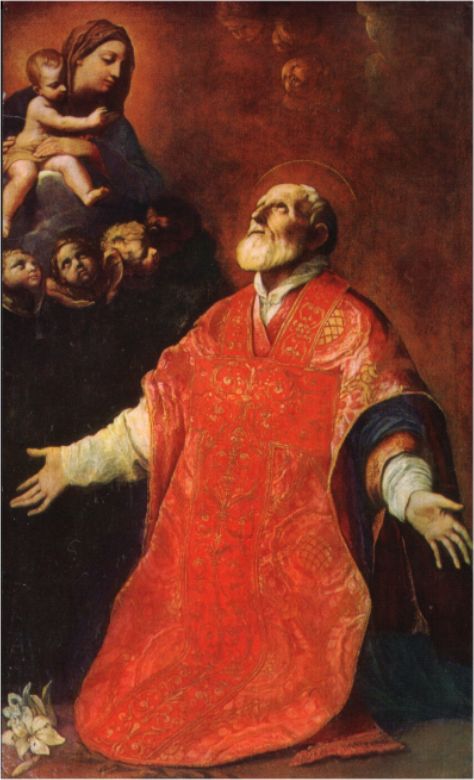
On the altar "St. Philip and the Virgin" copy in mosaic of the 1774 original by Guido Reni, now in the Upper Chapel of the Sanctuary
On the walls "Stories of St. Philip Neri" 1596/99 by Cristoforo Roncalli aka Pomarancio (1552/1626)
LEFT TRANSEPT
On the altar "Presentation of Mary in the Temple" 1603 masterpiece by Federico Fiori aka Barocci (1535/1612)
"He invented a painting style of great emotional significance, in which the expressive power of feelings melts into delicate effects of 'sfumato' (low contrast) nuances, with a changing palette that uses colors as vehicles of light, dynamic and evanescent substance of forms" (Carlo Bertelli, Giuliano Briganti, Antonio Giuliano)
"The masterpieces by Barocci were the most important and influential prototypes in the painting of altarpieces in Rome: their fame radiated far beyond the borders of central Italy, even beyond the Alps. They were the true expression of the ideality of the Counter-Reformation spirit: radiant visions of a heavenly world, witnesses of delicate inner fantasies or rapture. In their sensibility, and no less in their free formal structure, they show very clearly both a departure from the ideal of the ancients, which had dominated the Renaissance, and both the need for a new freer and grander form" (Hermann Voss)
Statues at the sides "St. Peter" and "St. Paul" 1592 Giovanni Antonio Parracca aka Valsoldo (?/1642-46)
ORGAN of 1610 still functioning and WOODEN CHOIR 1698 designed by Camillo Rusconi (1658/1728)
5th LEFT - CHAPEL OF THE ANNUNCIATION
"Annunciation" about 1591 by Domenico Crespi aka Passignano (1559/1638)
4th LEFT - CHAPEL OF THE VISITATION
"Visitation" 1586 by Federico Fiori aka Barocci
"In the altarpieces by Barocci one can recognize very clearly that tendency to rhythmicity and the dynamism which in its most extreme consequences would lead to the Baroque style. The concept of painting tends more and more towards a continuous movement and a constant dynamic tension. If with Michelangelo and his followers a residue of statuary isolation of every single figure was left, now the single sculptural theme stops definitively to have importance for himself. The tension of each movement toward one of the three dimensions automatically causes the counter-diagonal reaction of another figure or of another figurative element, so that the whole composition appears to be, in a certain way, in a continuous state of becoming" (Hermann Voss)
In the vault "Sts. Matthew, John the Baptist and John the Evangelist" 1619 by Carlo Saraceni (1579/1620)
3rd LEFT - CHAPEL OF THE NATIVITY
"Adoration of the Shepherds" 1582 by Durante Alberti (1538/1616)
In the vault "Sts. Agnes, Catherine and Cecilia" by Cristoforo Roncalli aka Pomarancio (1552/1626)
2nd LEFT - CHAPEL OF THE MAGI or CEVA'S CHAPEL
1578 "Adoration of the Magi" by Cesare Nebbia (1536/1614)
On the ceiling 1625 oil paintings maybe by Baccio Ciarpi (1574/1654)
1st LEFT - CHAPEL OF PURIFICATION
"Purification of the Virgin" 1627 Giuseppe Cesari aka Cavalier d'Arpino, oil on canvas with Mary presenting the Child Jesus to Simeon
1629 Paolo Marucelli (1594/1649)
ALTAR project of Paolo Marucelli finished by Taddeo Landi with the help of Francesco Borromini (1599/1667)
Splendid marble group "St. Philip Neri and an Angel" 1640 and "Bronze bust of Pope Gregory XV Ludovisi (1621/23)" by Alessandro Algardi (1598/1654)
St. Gregory XV canonized Philip Neri in 1622
"On the pages of the book the words of Psalm 118 are inscribed, alluding to the expansion to which the heart of St. Philip was said to have been subjected for his deep faith, so much that it caused him a broken rib. Nothing miraculous or marvelous is represented in the marble group and even the sweet and calm movements of the hands of the saint are to indicate a real profound religiousness, never shown off. Really no other artist better than Algardi could have interpreted as effectively the serene sweetness and intensely spiritual nature of the Oratory Faith. In particular, then, the figure of the angel fruit of an ingenious invention, with his naturally sweet gesture and expression, would have long been a point of reference for art in the seventeenth century in Rome" (Alessandro Angelini)
At the sides of the altar "Ecce Homo" and "Our Lady with the instruments of the Passion of Christ" by Francesco Trevisani (1656/1746)
In the VAULT "St. Michael and Angels" with instruments of the Passion about 1638 by Pietro da Cortona, his first work in this church
In the cabinets precious priests' robes in silk
SANTUARIO TERRENO (Lower Sanctuary)
RED ROOM
In the vault "Stories of St. Philip Neri" 1643 by Niccolò Tornioli (1598/1651) and "Pentecost in the catacombs of St. Philip Neri" 1652 Ciro Ferri (1634/89)
"Bust of St. Philip Neri" by Alessandro Algardi
INTERNAL CHAPEL
"St. Philip and an angel" by Giovanni Francesco Barbieri aka Guercino (1591/1666)
SANTUARIO SUPERIORE (Upper Sanctuary)
Connected to the Lower Sanctuary with a spiral staircase 1638/39 by Francesco Borromini
ANTECHAMBER
On the altar famous "St. Philip and the Virgin" 1615 by Guido Reni (1575/1642)
In the vault "Ecstasy of St. Philip" and on the right wall "Madonna and Child with St. Martina" by Pietro da Cortona
On the walls "Madonna and Child with Sts. Philip and Ignatius" and "Miracle of St. Philip for Cardinal Vincenzo Maria Orsini" by Pier Leone Ghezzi (1674/1755)
PRIVATE CHAPEL OF St. PHILIP
1635 almost certainly by Paolo Marucelli (1594/1649) with intervention in 1639 by Francesco Borromini
"San Lorenzo" Cecco del Caravaggio
"St. Philip in the catacombs" by Cristoforo Roncalli aka Pomarancio (1552/1626)