Showing posts with label Marcus Aurelius. Show all posts

Wednesday, December 20, 2017

CAPITOLINE HILL SQUARE

Designed by Michelangelo Buonarroti (1475/1564) and completed for the most part only after his death
“The new layout of the square was founded on three basic principles: alignment, symmetry and convergence, which combined to give the Capitoline new square a coherent unit both architectural and spatial. Michelangelo aimed to achieve a unified whole, extending the unprecedented solution of the giant order with Corinthian pilasters to the façades of all three buildings, characterized by a common horizontal emphasis, for the use of massive cornices and architraves structures” (Carlo Bertelli, Giuliano Briganti, Antonio Giuliano)
RAMP
Modified 1578 by Giacomo Della Porta (1533/1602) and shortened in 1929 for the opening of the Via del Mare
Original “Egyptian Lions” in black basalt of Numidia from the Iseo Campensis transformed into fountains in 1588 on the 1582 “Bases” by Giacomo Della Porta
During special celebrations, such as those after the election of a pope, white and red wine flowed from the mouths of the lions
GARDEN AT THE SIDES OF THE RAMP
On the left “Monument to Cola di Rienzo” in 1887 with a statue that the Florentine Girolamo Masini (1840/85) had carved in the years 1869/71. It is placed on a base composed of fragments of sculptures and various epigraphs designed by architect Francesco Azzurri (1831/1901)
Cola di Rienzo was maybe killed here or, more likely, in front of the Senatorial Palace in 1354
To the right there are rocks that were part of the Republican Walls
Modified 1585 by Giacomo Della Porta
“Dioscuri” of late imperial age from the area of Monte Cenci where there was a temple dedicated to them. They were moved here in 1585
So-called “Trophies of Marius (159/86 BC)” which actually dates back to the Domitian (81/96) period from the castle of the Aqua Iulia in Piazza Vittorio. They were moved here in 1590
“Statues of Constantine (306/337) and of his son Constans II (337/350)” from the Baths of Constantine. They were moved here in 1653
“Two milestones (1st and 7th miles) from the old Appian Way”
IN THE CENTER OF THE PIAZZA
Copy of the “Equestrian Statue of Marcus Aurelius” from the Lateran (the original is in the Capitoline Museums) moved here in 1538 on “Pedestal” by Michelangelo Buonarroti who used marble taken from the Temple of Castor and Pollux in the Roman Forum
It was one of the few things made during the artist's lifetime together with the “Access door to the Council Chamber” and the “Two ramps staircase” 1547/54 of the Senatorial Palace, even if the project also included a pillared canopy that was never made
IN THE NICHE
“Fountain of Goddess Rome” 1588/89 by Matteo Bartolani da Città di Castello (about 1527/about 1598) with “Porphyry and marble statue of Minerva” of the Domitian period transformed into goddess Roma
Matteo Bartolani had won the competition for the job although he had previously failed as an architect with the Felice Aqueduct and the fallen Bridge St. Maria, today's “Broken Bridge”
AT THE SIDES OF THE NICHE
“Two statues representing the Tiber (originally Tigris) and the Nile Rivers” from the Baths of Constantine but originally in the corners of the pediment of the Temple of Serapis moved here in 1518. They are hollow inside in order to be lighter
PATTERN OF THE PAVEMENT
Designed in 1940 by Antonio Muñoz (1884/1960) who followed roughly Michelangelo's design according to a posthumous engraving of 1567
The square is represented on the Italian coinage of the 50 euro cents coin
On 20 April 1979, a high potential bomb exploded in Piazza del Campidoglio causing serious damage. The attack did not cause a massacre only for a chance
An hour before the outbreak of the bomb, in fact, a session of the municipal council had just finished, while the square, usually crowded with tourists, was empty due to a storm
The bomb, consisting of four pounds of TNT and placed under the portal of the Palace of Senators, at the time of the explosion tore the portal, the arch and the columns on the left, damaging also the base of the equestrian statue of Marcus Aurelius and the statue itself
Those responsible for the attack were never identified with certainty

Sunday, December 8, 2013

COLUMN OF MARCUS AURELIUS

COLONNA DI MARCO AURELIO
About 180/196 for Commodus (180/192) son of Marcus Aurelius (161/180)
Built in Carrara marble, 29.6 m (97 feet) high. It is 42 m (138 feet) high including the base
 Inside there is a spiral staircase with 190 steps
115 DIFFERENT SCENES one after the other as if in a scroll to celebrate Marcus Aurelius' victories
From the lower part of the column:
GERMAN CAMPAIGN
172/173 against the GERMANS from scene 1 to 42 in what is now Germany
Against the MARCOMANNI from scene 43 to 55 in what is now the Czech Republic
In the middle there is an "Allegorical representation of Victory" writing on a shield and, in the upper part
SARMATIC CAMPAIGN
174/175 against the QUADI from scene 56 to 77 in what is now Eastern Austria and Slovakia
Against the SARMATI from scene 78 to 115 in what is now Ukraine
Under Commodus there were less skilled Greek workers in Rome than in the past and the jobs to build and decorate official monuments were given to Roman architects and artists who had worked in the past for Greek masters. So that trend toward a disorganized expression typical of the Etruscan, Latin and Italic figurative culture creeps up again, having been tamed and camouflaged up to this point by the classic Greek naturalism
A document of the Christian apologist Apollinaris describes interestingly in the years 176/177 the event occurred in 174 known as the "miracle of the rain" and later represented in the column with the personification of rain as an old bearded man with his arms spread out: following the prayers of the Christian soldiers belonging to the XII Legion Fulminata the rain finally fell and it both gave water to drink to the thirsty Roman legion and flooded with water and hit by lightning the Roman enemy, the Quadi
"Stylistically the relief loses its qualities of a refined composition, of complex levels and backgrounds which in the Column of Trajan were an obvious legacy of the Hellenistic tradition. There is a tendency toward simplification and schematization. The drill digs deeply into the more substantial and detached marble figures, animating surfaces with violent luminosity contrasts: it is a kind of sculpture that could be described as expressionistic and it already anticipate the violently dramatic style which will be widely common in the III century" (Filippo Coarelli)
Domenico Fontana (1543/1607) in the years 1588/89 for Sixtus V Peretti (1585/90) designed the base and placed the "Statue of St. Paul" by Leonardo Sormani (before 1530/after 1589) and Tommaso Della Porta (about 1550/1606)
Some of the marble relief in the middle and the upper part were restored and remade by Matteo Bartolani da Città di Castello (c.1527/c.1598) and Giacomo Longhi Silla (active since 1568/d. 1619)
Probably in the area where Palazzo Wedekind is now there used to be the TEMPLE OF MARCUS AURELIUS and maybe nearby one ARCH OF MARCUS AURELIUS from which possibly came the reliefs in the Arch of Constantine

Thursday, September 19, 2013

ARCH OF COSTANTINE

ARCO DI COSTANTINO
Built to celebrate the triumph of Constantine (306/337) over Maxentius (306/312) after the battle of Ponte Milvio on 28 October 312 and dedicated to Constantine by the Senate on 25 July 315 in memory of the victory and on the occasion of his tenth year in power
The inscription on the central arch shown on both sides is:
In the third line the words instinctu divinitatis should be noticed: they have been connected to the appearance of the cross to Constantine before the Milvian Bridge battle
It underwent renovations and several studies since the end of 1400 and in 1733 has had considerable work to integrate the missing parts

According to Federico Zeri many of the missing heads were destroyed in the sixteenth century, perhaps by the Landknechts, the German mercenary soldiers of Charles V, during the sack of Rome in 1527 

It is the largest remaining arch with three archways. The central one, the largest, is 6.5 m long (21 feet) and 11.45 (37.5 feet) high
The attic is 25 m (82 feet) high
It is decorated with sculptures and architectural elements mostly taken from monuments belonging to earlier periods: Trajan (98/117), Adriano (117/138) and Commodus (180/192)
According to Maria Letizia Conforto the arch itself dates back to Hadrian's time and it was only modified in 315
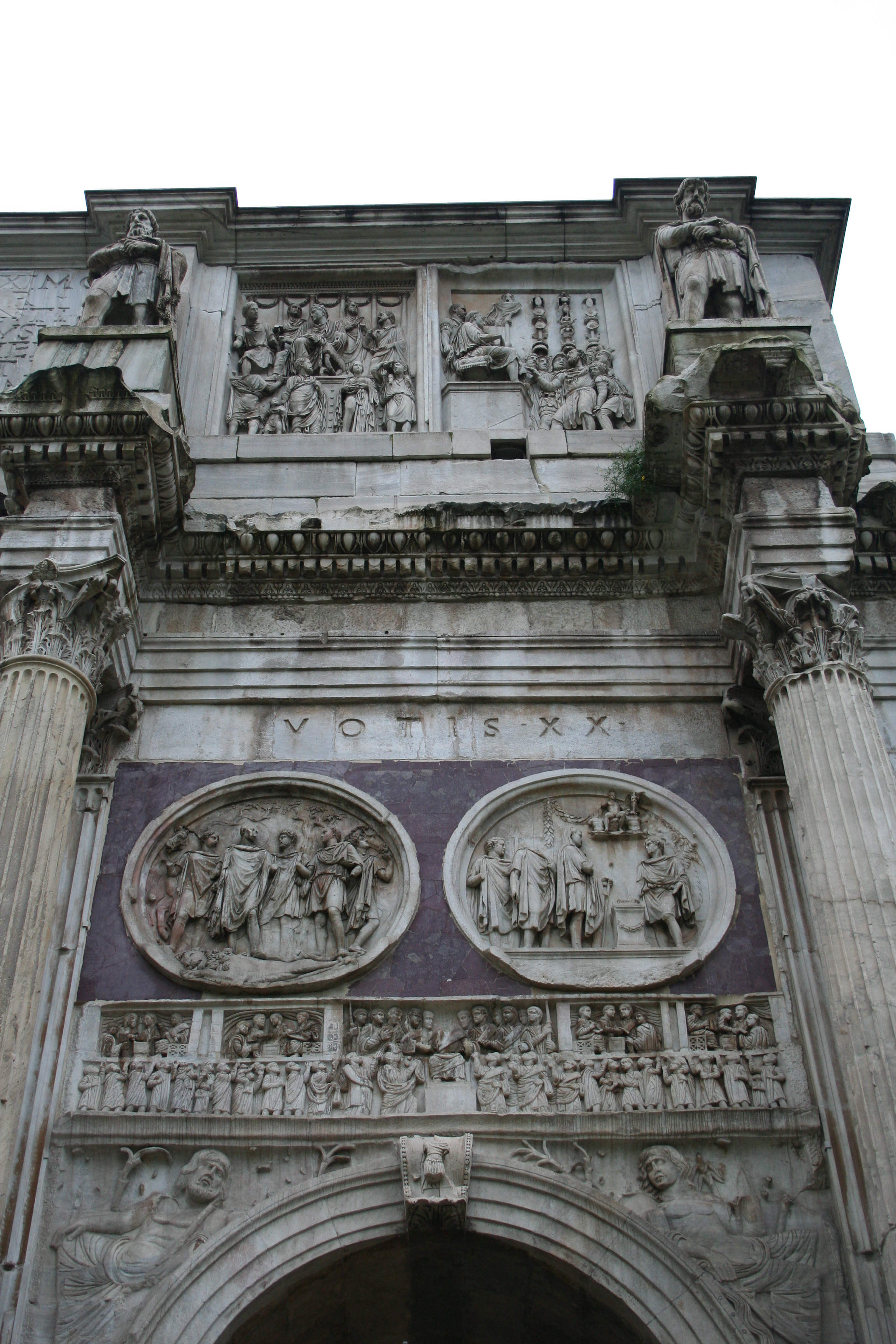
Plinths carved on three sides of the columns representing "Victories"
On the spandrels of the main fornix there are also "Victories"
In the spandrels of the lower arches "River gods"
In the keystones "Allegorical figures" unfortunately damaged
In the inner walls of the smaller arches "Eight large busts of emperors", also very damaged
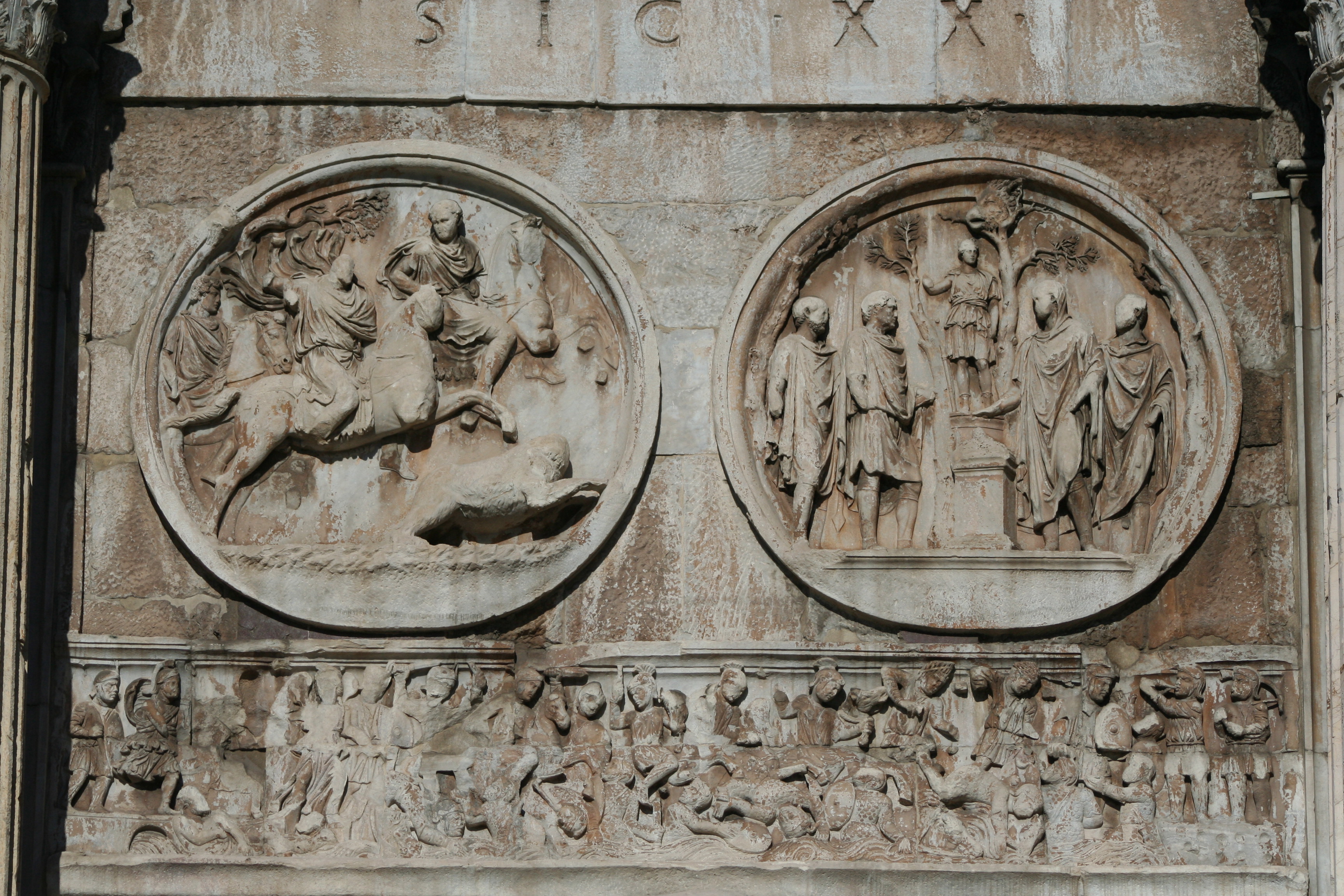
Over the small arches and, at the same height, on the two short sides, SIX LONG PANELS that illustrate the campaign against Maxentius
In these, starting at the short westside, towards the Palatine, there are the following episodes:
"Departure of the army of Constantine from Milan"
"Battle of Ponte Milvio"
"Constantine speech from the Rostra in the Roman Forum"
"Distribution of money to the people in the Forum of Caesar"
"The formal appearance in Roman art is linked not only to the force of habit, but also to research the most effective communication" (Gian Luca Grassigli - TMG)
On the two short sides are also from Constantinian period two round reliefs with the allegorical representation of the "Moon", on the west side, and the "Sun", on the east side
"Classically inspired, however manneristic and made more descriptive rather than adhering to the substance of the models" (Gian Luca Grassigli - TMG)
Elements from the Forum of Trajan:
"Eight statues of Dacian prisoners" with heads remade in the eighteenth century, on the plinths in the attic above the columns
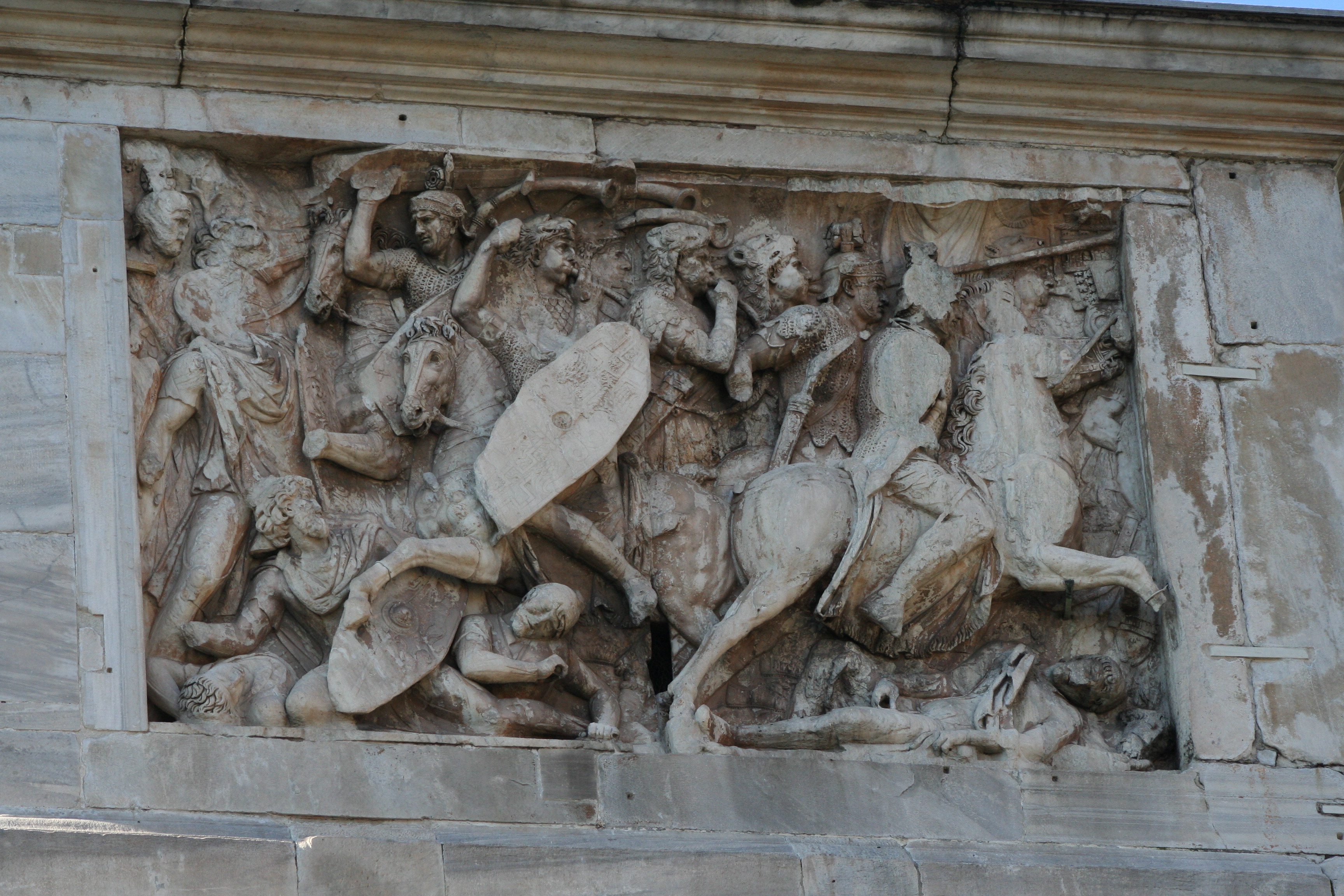
FOUR MASSIVE PANELS, two on the smaller sides of the attic with "Battle scenes" and other two also with "Battle scenes" within the central archway
All four were originally part of a single large frieze (about 3 m - 10 feet - high and originally more than 35 m - 115 feet - long) that maybe used to decorate the attic of the Basilica Ulpia in the Forum of Trajan
EIGHT ROUND RELIEFS taller than 2 meters (6.6 feet) maybe from a four-sided arch
On the south façade:
On the north façade:
In these reliefs, which must refer to real events, Antinous is represented as a young boy and the heads of Hadrian have been reworked during the construction of the arch and turned into portraits of Constantine in the hunting scenes and of his colleague Licinius in the scenes of sacrifice
The last two reliefs are still framed by porphyry slabs that are lost around the others
"In terms of ideology and propaganda it is an explicit reference to Alexander the Great, in particular, and in general to a model of oriental-style imperial sovereignty, in which the heroism of the ruler and his praise is expressed not through a public activity but a private one. The formal language of classicism in general typical of the official art, uses iconographic patterns, simple natural settings and compositional variety of obvious Hellenistic derivation" (Gian Luca Grassigli - TMG)
EIGHT PANELS IN THE UPPER PART (taller than 3 m - 10 feet) on either side of the inscription representing episodes relating to reign of Marcus Aurelius, with the heads of the emperor reworked in the eighteenth century
Maybe they were originally on an honorary arch dedicated to Marcus Aurelius along with three others who are in the Palazzo dei Conservatori
On the south façade:
On the north façade:
"New design language canons of late antiquity are defined, in which the symbolism prevails over naturalistic representation of figures and events: so we see the linear design dominating, the heavy usage of the drill in the rendering of the drapery, the overturned perspective, the rigid frontality of the Emperor and the hierarchical proportions" (Gian Luca Grassigli - TMG)