Showing posts with label Milvian Bridge. Show all posts

Saturday, December 30, 2017

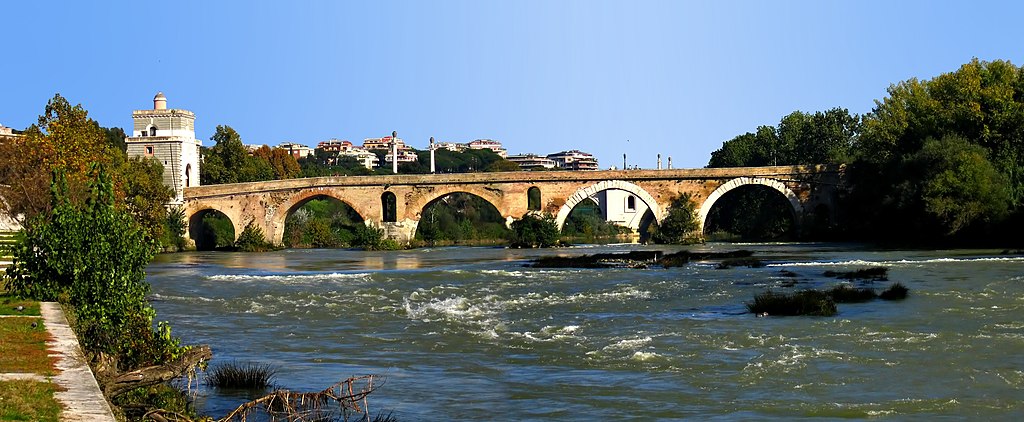
MILVIAN BRIDGE

PONTE MILVIO
109 BC for the censor Marcus Aemilius Scaurus who wanted to replace a wooden bridge that had been built at the end of the third century BC
It was originally called Mulvius and the name was corrupted in the Middle Ages to MOLLE (soft)
There are only few traces of the original bridge left in the two arches closer to the left bank
Near the bridge took place on October 28, 312 AD the famous BATTLE OF THE MILVIAN BRIDGE between the pretenders to the Roman imperial throne Constantine (306/337) and Maxentius (306/312), after which the Christian religion was legalized by Constantine who had won
Present bridge arranged in 1805 by Giuseppe Valadier (1762/1839) for the return to Rome of Pius VII Chiaramonti (1800/23)
Pius VII in 1804 had crowned Napoleon Emperor in Paris. He was arrested in the Quirinal Palace in 1809 and taken to France. He returned to Rome again in 1814 when he reestablished the order of the Jesuits in the world
One of the arches of the bridge was blown up by supporters of Garibaldi in 1849 to try to delay the entry of the French army
Restored in 1850 and in 1871 by Francesco Azzurri (1831/1901) for Pius IX Mastai-Ferretti (1846/78)
Statues on the southern end:
On the left “St. John of Nepomuk” protector of the dangers of drowning by Agostino Cornacchini 1731 (1683/1740)
On the right “Immaculate” 1840 by Domenico Piggiani
St. John of Nepomuk was a Bohemian priest who in 1393 in Prague was tortured, throwed off a bridge and drowned by order of King Wenceslaus of Bohemia
He was the confessor of the queen and it seems that he had refused to reveal the secrets that she had confessed. He was canonized in 1729 and is the patron saint of the dangers of drowning
Statues on the northern end:
Group of two statues “St. John the Baptist baptizing Jesus” 1633/44 by Francesco Mochi (1580/1654)
It was originally carved for S. Giovanni dei Fiorentini but it was never placed there and was moved here instead. It was moved again in 1956 to the Museo di Roma at Palazzo Braschi and replaced with a copy
After the success of the 2006 book for teens Ho voglia di te (I want you) written by Federico Moccia and the eponymous film of 2007 it became customary for young lovers to put a pad lock on the lampposts of the bridge and throw the keys into the Tiber in imitation of a scene from the movie
In July 2007, after the collapse of the lamps due to the excessive weight given the enormous quantity of padlocks, the municipality of Rome has installed some pillars adjacent to each lamp to which some chains for the padlocks have been attached, safeguarding the integrity of the street lamps
In 2012, in preparation for a celebration on the anniversary of the Battle of the Milvian Bridge the municipality of Rome decided to remove the padlocks and set up a garrison of guards against the lovers with padlocks
Love however won again and many young lovers managed to circumvent the defense and fix their padlocks all the same
Thursday, September 19, 2013

ARCH OF COSTANTINE

ARCO DI COSTANTINO
Built to celebrate the triumph of Constantine (306/337) over Maxentius (306/312) after the battle of Ponte Milvio on 28 October 312 and dedicated to Constantine by the Senate on 25 July 315 in memory of the victory and on the occasion of his tenth year in power
The inscription on the central arch shown on both sides is:
In the third line the words instinctu divinitatis should be noticed: they have been connected to the appearance of the cross to Constantine before the Milvian Bridge battle
It underwent renovations and several studies since the end of 1400 and in 1733 has had considerable work to integrate the missing parts

According to Federico Zeri many of the missing heads were destroyed in the sixteenth century, perhaps by the Landknechts, the German mercenary soldiers of Charles V, during the sack of Rome in 1527 

It is the largest remaining arch with three archways. The central one, the largest, is 6.5 m long (21 feet) and 11.45 (37.5 feet) high
The attic is 25 m (82 feet) high
It is decorated with sculptures and architectural elements mostly taken from monuments belonging to earlier periods: Trajan (98/117), Adriano (117/138) and Commodus (180/192)
According to Maria Letizia Conforto the arch itself dates back to Hadrian's time and it was only modified in 315
Plinths carved on three sides of the columns representing "Victories"
On the spandrels of the main fornix there are also "Victories"
In the spandrels of the lower arches "River gods"
In the keystones "Allegorical figures" unfortunately damaged
In the inner walls of the smaller arches "Eight large busts of emperors", also very damaged
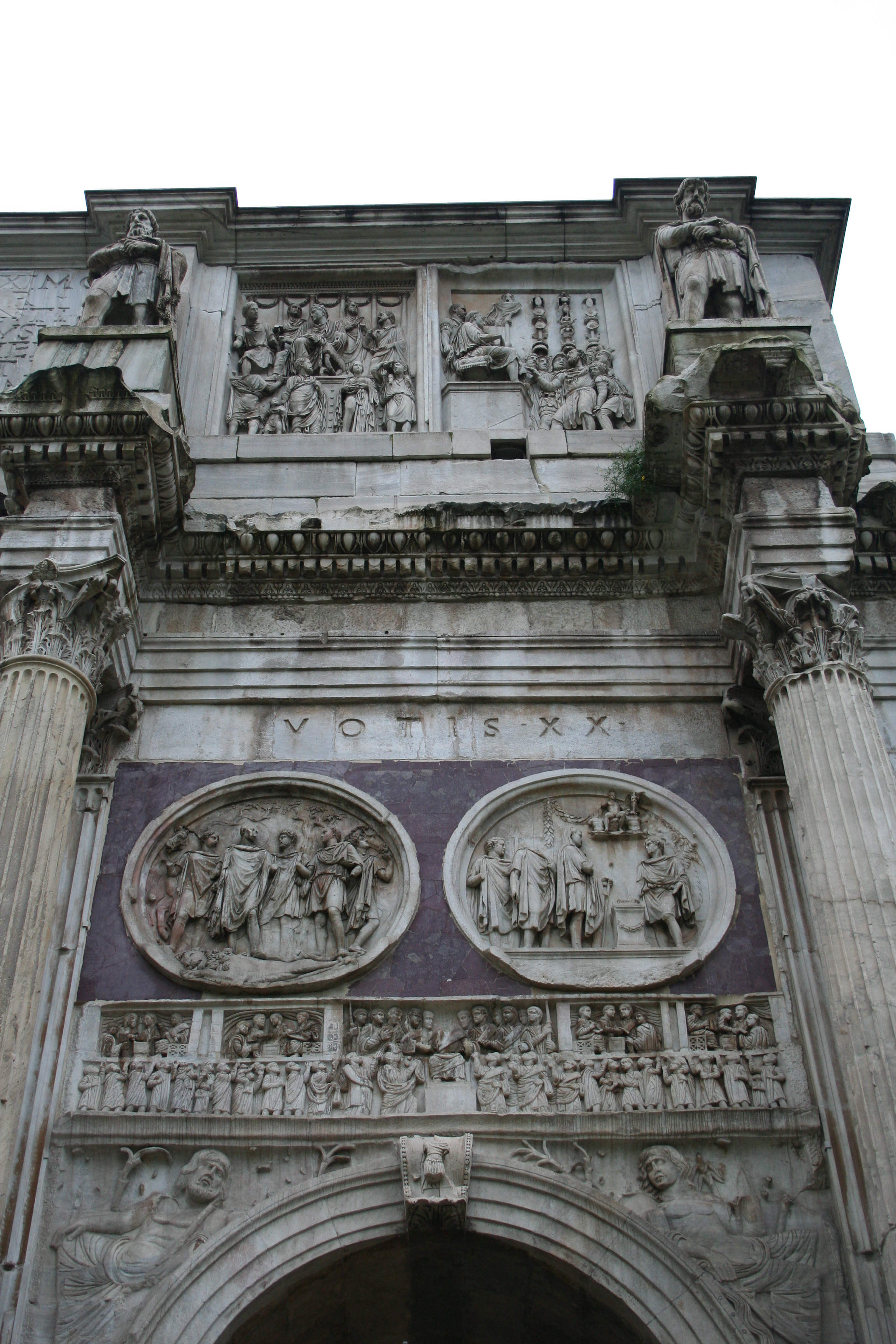
Over the small arches and, at the same height, on the two short sides, SIX LONG PANELS that illustrate the campaign against Maxentius
In these, starting at the short westside, towards the Palatine, there are the following episodes:
"Departure of the army of Constantine from Milan"
"Battle of Ponte Milvio"
"Constantine speech from the Rostra in the Roman Forum"
"Distribution of money to the people in the Forum of Caesar"
"The formal appearance in Roman art is linked not only to the force of habit, but also to research the most effective communication" (Gian Luca Grassigli - TMG)
On the two short sides are also from Constantinian period two round reliefs with the allegorical representation of the "Moon", on the west side, and the "Sun", on the east side
"Classically inspired, however manneristic and made more descriptive rather than adhering to the substance of the models" (Gian Luca Grassigli - TMG)
Elements from the Forum of Trajan:
"Eight statues of Dacian prisoners" with heads remade in the eighteenth century, on the plinths in the attic above the columns
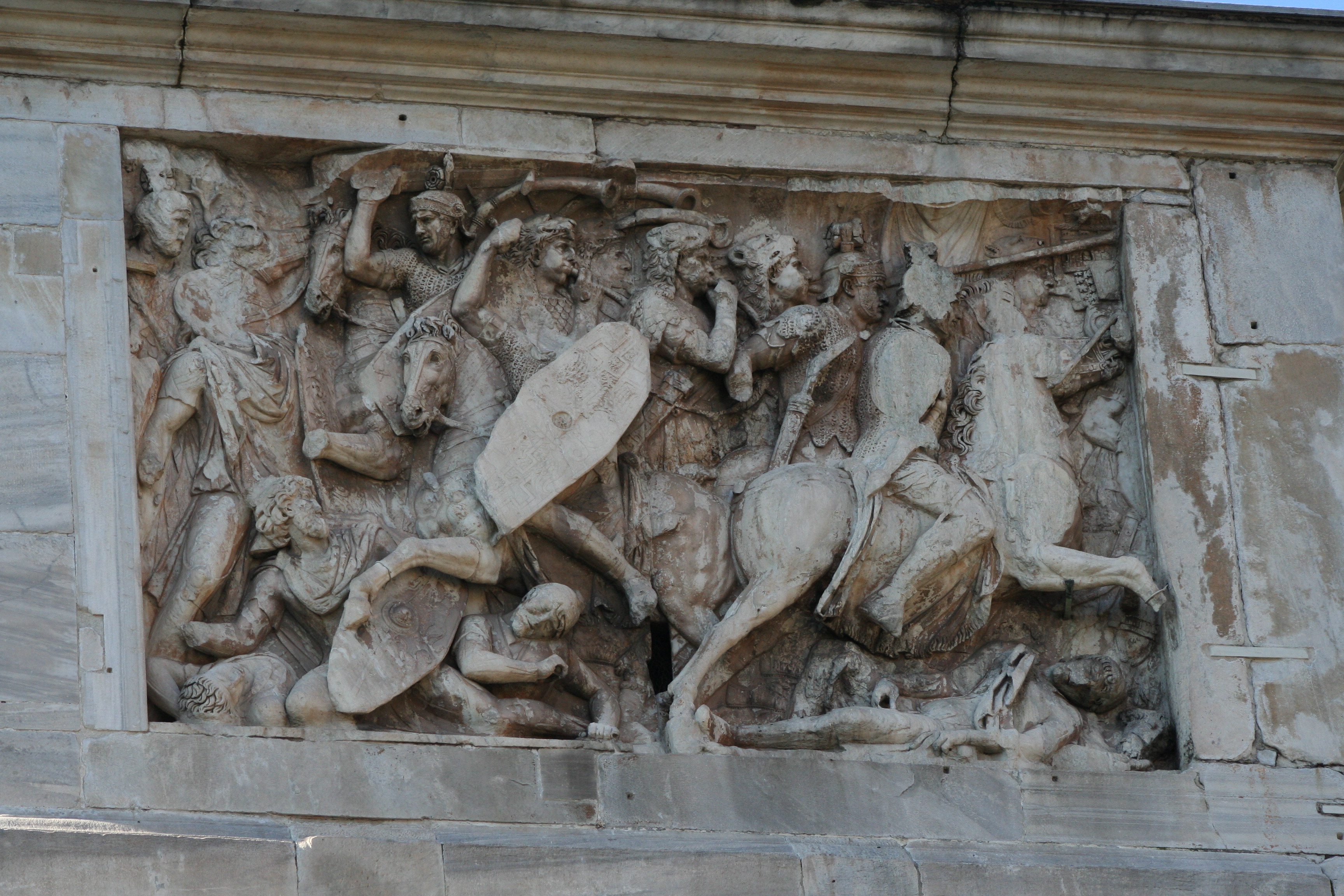
FOUR MASSIVE PANELS, two on the smaller sides of the attic with "Battle scenes" and other two also with "Battle scenes" within the central archway
All four were originally part of a single large frieze (about 3 m - 10 feet - high and originally more than 35 m - 115 feet - long) that maybe used to decorate the attic of the Basilica Ulpia in the Forum of Trajan
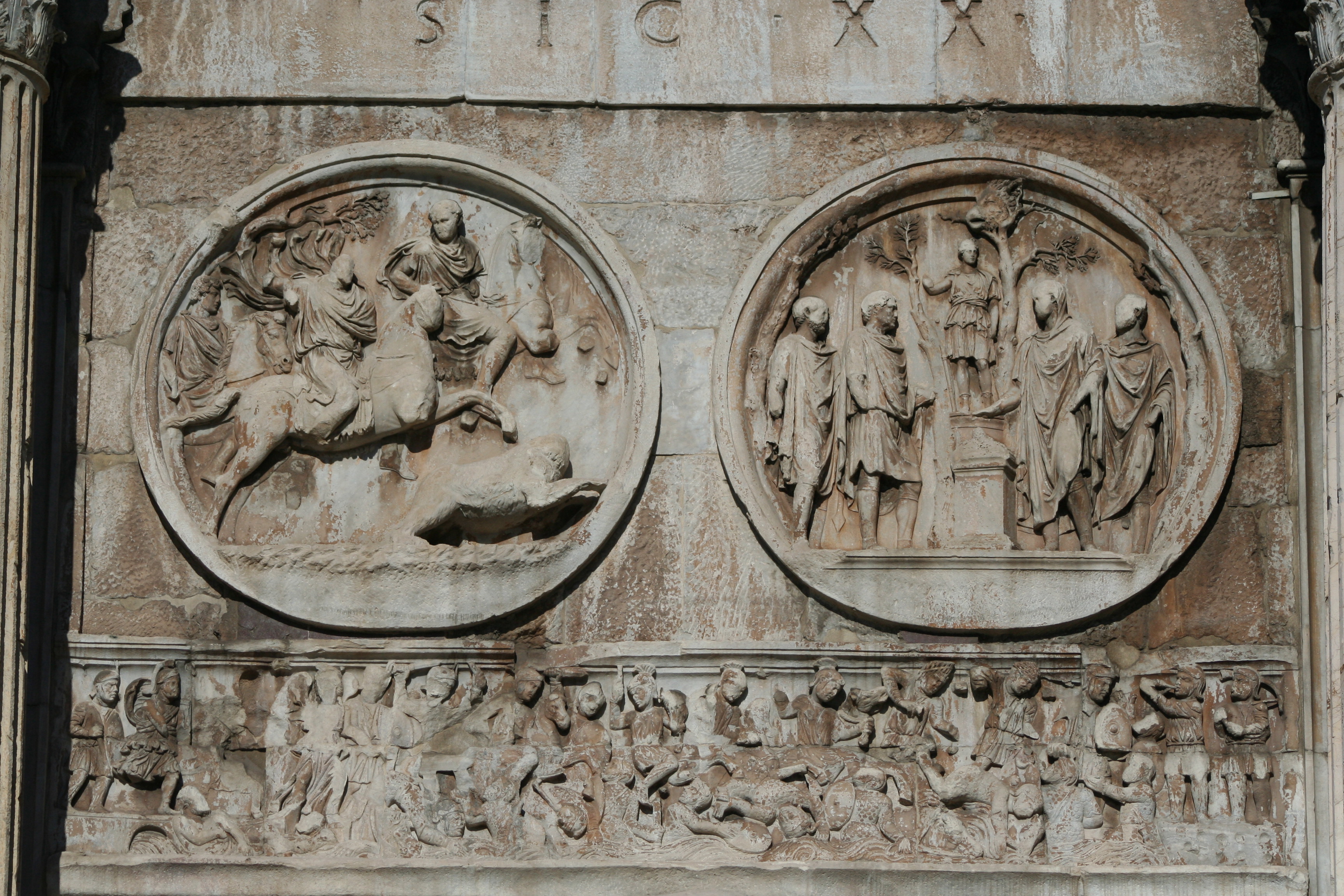
EIGHT ROUND RELIEFS taller than 2 meters (6.6 feet) maybe from a four-sided arch
On the south façade:
On the north façade:
In these reliefs, which must refer to real events, Antinous is represented as a young boy and the heads of Hadrian have been reworked during the construction of the arch and turned into portraits of Constantine in the hunting scenes and of his colleague Licinius in the scenes of sacrifice
The last two reliefs are still framed by porphyry slabs that are lost around the others
"In terms of ideology and propaganda it is an explicit reference to Alexander the Great, in particular, and in general to a model of oriental-style imperial sovereignty, in which the heroism of the ruler and his praise is expressed not through a public activity but a private one. The formal language of classicism in general typical of the official art, uses iconographic patterns, simple natural settings and compositional variety of obvious Hellenistic derivation" (Gian Luca Grassigli - TMG)
EIGHT PANELS IN THE UPPER PART (taller than 3 m - 10 feet) on either side of the inscription representing episodes relating to reign of Marcus Aurelius, with the heads of the emperor reworked in the eighteenth century
Maybe they were originally on an honorary arch dedicated to Marcus Aurelius along with three others who are in the Palazzo dei Conservatori
On the south façade:
On the north façade:
"New design language canons of late antiquity are defined, in which the symbolism prevails over naturalistic representation of figures and events: so we see the linear design dominating, the heavy usage of the drill in the rendering of the drapery, the overturned perspective, the rigid frontality of the Emperor and the hierarchical proportions" (Gian Luca Grassigli - TMG)