Showing posts with label Francesco Azzurri. Show all posts

Saturday, December 30, 2017

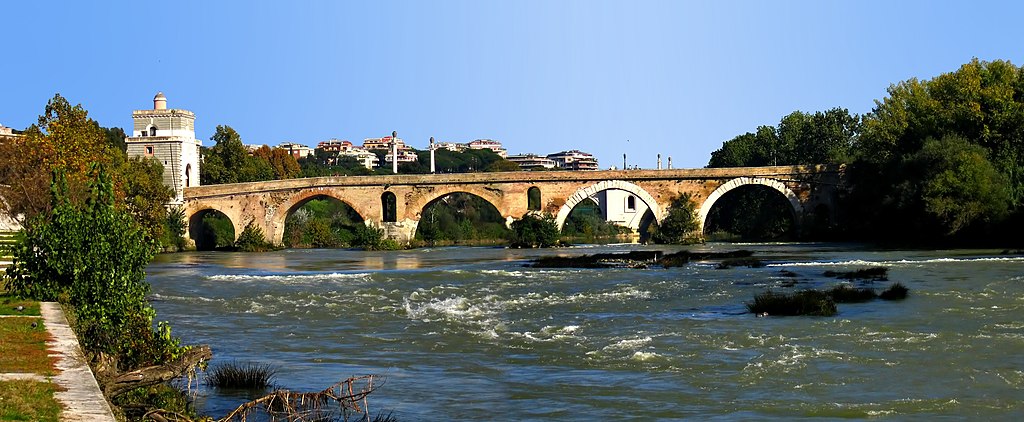
MILVIAN BRIDGE

PONTE MILVIO
109 BC for the censor Marcus Aemilius Scaurus who wanted to replace a wooden bridge that had been built at the end of the third century BC
It was originally called Mulvius and the name was corrupted in the Middle Ages to MOLLE (soft)
There are only few traces of the original bridge left in the two arches closer to the left bank
Near the bridge took place on October 28, 312 AD the famous BATTLE OF THE MILVIAN BRIDGE between the pretenders to the Roman imperial throne Constantine (306/337) and Maxentius (306/312), after which the Christian religion was legalized by Constantine who had won
Present bridge arranged in 1805 by Giuseppe Valadier (1762/1839) for the return to Rome of Pius VII Chiaramonti (1800/23)
Pius VII in 1804 had crowned Napoleon Emperor in Paris. He was arrested in the Quirinal Palace in 1809 and taken to France. He returned to Rome again in 1814 when he reestablished the order of the Jesuits in the world
One of the arches of the bridge was blown up by supporters of Garibaldi in 1849 to try to delay the entry of the French army
Restored in 1850 and in 1871 by Francesco Azzurri (1831/1901) for Pius IX Mastai-Ferretti (1846/78)
Statues on the southern end:
On the left “St. John of Nepomuk” protector of the dangers of drowning by Agostino Cornacchini 1731 (1683/1740)
On the right “Immaculate” 1840 by Domenico Piggiani
St. John of Nepomuk was a Bohemian priest who in 1393 in Prague was tortured, throwed off a bridge and drowned by order of King Wenceslaus of Bohemia
He was the confessor of the queen and it seems that he had refused to reveal the secrets that she had confessed. He was canonized in 1729 and is the patron saint of the dangers of drowning
Statues on the northern end:
Group of two statues “St. John the Baptist baptizing Jesus” 1633/44 by Francesco Mochi (1580/1654)
It was originally carved for S. Giovanni dei Fiorentini but it was never placed there and was moved here instead. It was moved again in 1956 to the Museo di Roma at Palazzo Braschi and replaced with a copy
After the success of the 2006 book for teens Ho voglia di te (I want you) written by Federico Moccia and the eponymous film of 2007 it became customary for young lovers to put a pad lock on the lampposts of the bridge and throw the keys into the Tiber in imitation of a scene from the movie
In July 2007, after the collapse of the lamps due to the excessive weight given the enormous quantity of padlocks, the municipality of Rome has installed some pillars adjacent to each lamp to which some chains for the padlocks have been attached, safeguarding the integrity of the street lamps
In 2012, in preparation for a celebration on the anniversary of the Battle of the Milvian Bridge the municipality of Rome decided to remove the padlocks and set up a garrison of guards against the lovers with padlocks
Love however won again and many young lovers managed to circumvent the defense and fix their padlocks all the same
Wednesday, September 13, 2017

ROCCI PALLAVICINI PALACE

PALAZZO ROCCI PALLAVICINI
Beginning of the seventeenth century by Carlo Maderno (1556/1629) for the Rocci family from Cremona
From 1759 it belonged to the Discalced Carmelites who had their headquarters here with the church Sts. Teresa and John of the Cross
In the nineteenth century they moved to S. Maria della Vittoria, the church was demolished and the palace became property of the Pallavicini family
It was restored by Francesco Azzurri (1831/1901)

Wednesday, April 5, 2017

GAMBIRASI PALACE

PALAZZO GAMBIRASI

1659 Giovanni Antonio De Rossi (1616/95) for the Confraternity of S. Giacomo agli Spagnoli, today church of Nostra Signora del Sacro Cuore in Piazza Navona
De Rossi followed the directions of Pietro Berrettini aka Pietro da Cortona (1597/1669) who was renovating the nearby S. Maria della Pace and rearranging the open space in front of it
It passed in the eighteenth century to the Gambirasi family that had the roof terrace built
It became later property of the Institute of S. Maria dell'Anima who still owns it and largely rents it out
The architect Francesco Azzurri (1831/1901) lived and died here. He designed the Palace of the Republic of San Marino, the restoration of the Milvian Bridge and many other buildings in Rome
The 1961 movie Fantasmi a Roma (Ghosts in Rome) was shot here, directed by Antonio Pietrangeli with Vittorio Gassman, Marcello Mastroianni and Eduardo De Filippo. The definitely spooky building adapted well to a story that had ghosts as chief characters

Wednesday, December 30, 2015

BARBERINI PALACE (first part)

PALAZZO BARBERINI
Built by incorporating the existing villa of Cardinal Rodolfo Pio da Carpi, later property of the Sforza family and known as Villa Sforza
Cardinal Francesco Barberini bought it from the Sforza family in 1625 and Carlo Maderno (1556/1629) began the construction of the palace in the years 1625/29 by
After the death of Carlo Maderno, Gian Lorenzo Bernini (1598/1680) took over the direction of the work in the years 1629/1633 and retained the original design conceiving, however, the central hall, the windowed loggia and the large square staircase
Francesco Borromini (1599/1667) participated in the works designing two windows in the central part of the top floor, the side wings, some decorative elements and the SPIRAL STAIRCASE
The actual Borromini's contribution to the works led by Bernini, however, is still the subject of academic debate
“The derivation from the windows in the attic of Maderno's façade of St. Peter's is obvious, but the ears-shaped wavy streamers attached to them, as well as the segmented upper part with ends pointing outward with an angle of 45 degrees are characteristic of Borromini's dynamic interpretation of details. Here it is already possible to see the creative force that imparts an inexplicable strength to any shape and configuration” (Rudolf Wittkower)
RAILING 1864 Francesco Azzurri (1831/1901) with TELAMONS by Adamo Tadolini (1788/1868)
The FOUNTAIN in front of the palace is by Francesco Azzurri
In the area of the building the ancient TEMPLE OF QUIRINUS was situated
At the end of the rear ramp “Ruined Bridge” by Gian Lorenzo Bernini and “Bertel Thorvaldsen Monument” (1770/1844) who had his study on the top floor of the former theater from 1822 to 1834
Top floor home of the ISTITUTO ITALIANO DI NUMISMATICA (Italian Institute of Coins)

Villa Savorgnan de Brazzà
1936 Gustavo Giovannoni (1873/1947) and Marcello Piacentini (1881/1960)
Under the villa ruins of rooms of the second century AD in bricks including MITHRAEUM with fresco (the only one painted in Rome together with the one of S. Prisca) with “Mithra slaying the bull” and smaller panels on the sides with scenes of the god's myth


At n°18 in Via Barberini former BARBERINI THEATREThe original theater built in 1634 with a façade by Pietro Da Cortona was destroyed and rebuilt in 1932 by Marcello Piacentini using some original architectural elements

Monday, July 13, 2015

DO WELL BROTHERS HOSPITAL

OSPEDALE FATEBENEFRATELLI


1582/84 founded by the Congregazione di S. Giovanni di Dio (Congregation of St. John of God)
Its members used to say “You do well brothers!” when begging

The congregation was founded by the Portuguese Juan Ciudad (1495/1550) who became a saint by the name of John of God

After a dissolute and wandering existence, he was converted and founded the Order of Brothers Hospitallers. He dedicated his life to the care of the sick with a modern vision of hospital care and hospitality

Patients were accepted on the basis of disease and every one of them was treated and assisted with an individual attention absolutely new for that time

St. John of God is therefore regarded as the inventor of the modern idea of a hospital

Beginning of 1700 expanded by Romano Carapecchia (1668/1738)

1867 rebuilt by Francesco Azzurri (1831/1901)

1930/34 completely renovated by Cesare Bazzani (1873/1939)

It occupies more than half of the Tiber Island continuing the functions of the place, formerly sacred to the god of medicine Aesculapius

In the eleventh century it was occupied by a shelter-shrine for sick dedicated to St. Bartholomew and managed by a community of Benedictine Sisters

Sunday, February 2, 2014

HOTEL BERNINI BRISTOL

HOTEL BERNINI BRISTOL
1874 Francesco Azzurri (1831/1901) who also designed the Palace of the Republic of S. Marino
It is one of the oldest hotels in Rome
Rebuilt in 1943 by Ettore Rossi (1894/1968) one of the architects of the EUR district, in rationalist style contrasting greatly with the other buildings in Piazza Barberini and generating quite a lot of negative criticism
As soon as it was rebuilt it was immediately occupied by the Nazis and then by the American Red Cross until 1946, when its hotel function was restored

Friday, October 18, 2013

PARRASIO WOODS

BOSCO PARRASIO
Complex built in 1725 by Antonio Canevari (1681/1759) with a donation of King John V of Portugal for the ACCADEMIA DELL'ARCADIA (Academy of Arcadia)
Restored 1760 by Clemente Orlandi (1694/1775) a pupil of Luigi Vanvitelli
The Academy of Arcadia had been founded in 1690 with the singular aim of "killing the bad taste and clean up the Italian poetry of barbarism". It exerted great influence in the first half of the eighteenth century with the work of Pietro Metastasio
In 1926 it was transformed into ACCADEMIA LETTERARIA ITALIANA (Italian Literary Academy)
It is also known as TEATRO DEGLI ARCADI (Theater of the Arcadians)
The NEOCLASSICAL BUILDING made in 1850 by Francesco Azzurri (1831/1901) is the background of a small amphitheater used for meetings