TEATRO DI BALBO
Via delle Botteghe Oscure/Via
Paganica/Via dei Funari
13 BC for
Lucius Cornelius Balbus the Younger
The theater
was built with the proceeds of his triumph over the Garamantes (Africans) of
the year 19 BC
Lucius
Cornelius Balbus the Younger was the last one not of imperial family to
celebrate a triumph
The theater
was damaged by the fire of the year 80 AD
It is the
third and smallest theater in the Campus Martius
According
to the Regional Catalogues it contained
11,510 spectators
The
diameter is 90 m (295 feet)
In the
middle there was a temple, maybe the TEMPLE OF VOLCANO IN THE CAMPUS MARTIUS
The space
behind the stage was occupied by Balbi’s
Crypt
Showing posts with label Via delle Botteghe Oscure. Show all posts
Showing posts with label Via delle Botteghe Oscure. Show all posts
Tuesday, January 21, 2020


Tuesday, December 17, 2019
St. STANISLAUS OF THE POLISH PEOPLE
S. STANISLAO DEI POLACCHI
Via delle Botteghe Oscure 15
Originally built in the twelfth century as S. Salvatore Pensilis de Surraca on BALBO'S CRYPTOPORTICUS
In Pensilis means “in the midst of the furnaces” and it was in fact in the area of theCalcarario, where the furnaces used to transform marble into lime
Surraca may have been referring to a family by that name who lived in the area
It was rebuilt in the years 1580/82 after it was granted in 1578 to the Polish Cardinal Stanislaw Hozjusz to build a small home for the Poles on a pilgrimage to Rome
Consecrated in 1598 and dedicated to the Bishop of Krakow St. Stanislaus martyred in 1079 and patron saint of Poland
Restored in the years 1729/35 by Francesco Ferrari (active in Rome 1721/44) and Luigi Barattoni (active in the first quarter of the eighteenth century)
It is the only National Polish church in Italy
For celebrations where it is expected a large turnout the Polish priests of St. Stanislaus celebrate mass in the larger church of St. Mary of Consolation
VAULT
“Glory of St. Stanislaus” 1774/77 by Ermenegildo Costantini (1731/91)
“The collaboration of Costantini with Kuntz (...) shows an affinity of style between the two artists which is indicative of the formal scope in which Costantini operated. Kuntz is in fact the painter who 'definitively concluded the Roman rococo' (Schleier). So, while working in St. Catherine alongside artists such as Lapis, Monosilio, Corvi, La Piccola, transitional painters who were making their first neoclassical experiences, Costantini did not draw from this closeness any incentive for a formal updating of his style, remaining an isolated representative of a decorative language substantiated by the Rococo grace” (Marina Coccia - Dizionario Biografico degli Italiani Treccani)
1st CHAPEL ON THE RIGHT
Above the altar “Prince Casimir appears during the siege of Polock” about 1765 Franciszek Smuglewicz (1745/1807)
2nd CHAPEL ON THE RIGHT
Above the altar “St. Stanislaus resurrects Piotrowin” about 1755 by Tadeusz Kuntze aka Taddeo il Polacco (1732/93)
MAIN ALTAR
“Christ with Angels, St. Stanislaus with a bishop and, below, St. Hyacinth” about 1594, first Roman work of the Sienese Antiveduto Grammatica (about 1572/1626)
In the upper part round panel with “God the Father” 1774/77 by Ermenegildo Costantini
LAST PILLAR OF THE LEFT NAVE
“Funerary Monument of the artist Giacomo Raffaelli” 1863
He became very famous for having executed in the years 1810/17 a real size copy in mosaic of the Last Supper by Leonardo da Vinci commissioned by Napoleon Bonaparte, who had not been able to detach the original masterpiece from the wall. Since 1818 the mosaic is in the Minoritenkirche Church in Vienna
2nd CHAPEL ON THE LEFT
Above the altar “St. Hedwig adores the Cross” 1725 by Szymon Czechowicz (1689/1775)
1st CHAPEL ON THE LEFT
Above the altar “St. John of Kanty (St. Jan Kanty) distributes goods to the poor” 1767 by Salvatore Monosilio (active since 1744/d. 1776)
Oval panel “Communion given by the angels to St. Stanislaus Kostka” by Szymon Czechowicz (1689/1775)
SACRISTY
Three paintings with “Stories of St. Stanislaus” maybe by Franciszek Smuglewicz (1745/1807)

Via delle Botteghe Oscure 15
Originally built in the twelfth century as S. Salvatore Pensilis de Surraca on BALBO'S CRYPTOPORTICUS
In Pensilis means “in the midst of the furnaces” and it was in fact in the area of theCalcarario, where the furnaces used to transform marble into lime
Surraca may have been referring to a family by that name who lived in the area
It was rebuilt in the years 1580/82 after it was granted in 1578 to the Polish Cardinal Stanislaw Hozjusz to build a small home for the Poles on a pilgrimage to Rome
Consecrated in 1598 and dedicated to the Bishop of Krakow St. Stanislaus martyred in 1079 and patron saint of Poland
Restored in the years 1729/35 by Francesco Ferrari (active in Rome 1721/44) and Luigi Barattoni (active in the first quarter of the eighteenth century)
It is the only National Polish church in Italy
For celebrations where it is expected a large turnout the Polish priests of St. Stanislaus celebrate mass in the larger church of St. Mary of Consolation
VAULT
“Glory of St. Stanislaus” 1774/77 by Ermenegildo Costantini (1731/91)
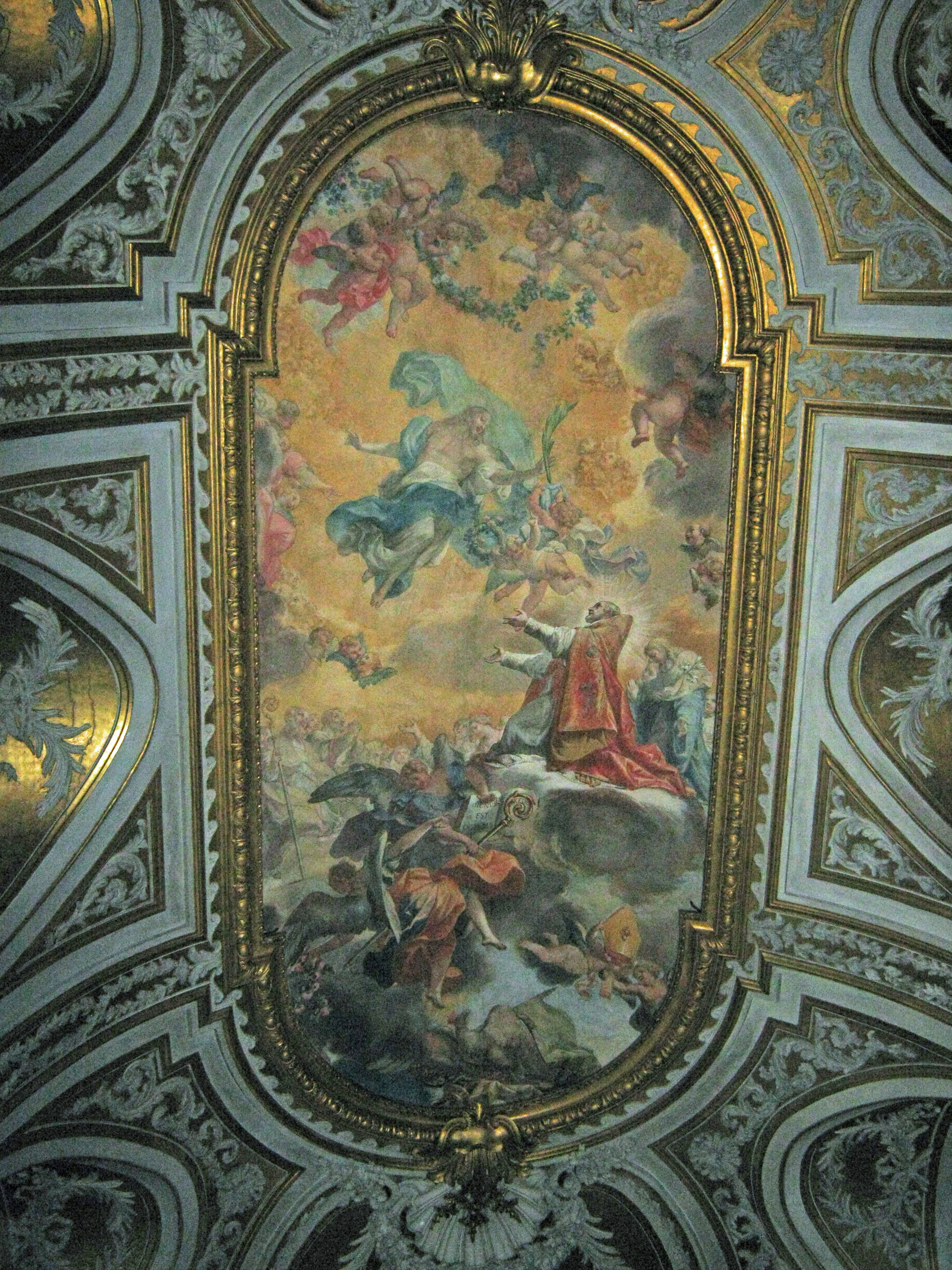
“The collaboration of Costantini with Kuntz (...) shows an affinity of style between the two artists which is indicative of the formal scope in which Costantini operated. Kuntz is in fact the painter who 'definitively concluded the Roman rococo' (Schleier). So, while working in St. Catherine alongside artists such as Lapis, Monosilio, Corvi, La Piccola, transitional painters who were making their first neoclassical experiences, Costantini did not draw from this closeness any incentive for a formal updating of his style, remaining an isolated representative of a decorative language substantiated by the Rococo grace” (Marina Coccia - Dizionario Biografico degli Italiani Treccani)
1st CHAPEL ON THE RIGHT
Above the altar “Prince Casimir appears during the siege of Polock” about 1765 Franciszek Smuglewicz (1745/1807)
2nd CHAPEL ON THE RIGHT
Above the altar “St. Stanislaus resurrects Piotrowin” about 1755 by Tadeusz Kuntze aka Taddeo il Polacco (1732/93)
MAIN ALTAR
“Christ with Angels, St. Stanislaus with a bishop and, below, St. Hyacinth” about 1594, first Roman work of the Sienese Antiveduto Grammatica (about 1572/1626)
In the upper part round panel with “God the Father” 1774/77 by Ermenegildo Costantini
LAST PILLAR OF THE LEFT NAVE
“Funerary Monument of the artist Giacomo Raffaelli” 1863
He became very famous for having executed in the years 1810/17 a real size copy in mosaic of the Last Supper by Leonardo da Vinci commissioned by Napoleon Bonaparte, who had not been able to detach the original masterpiece from the wall. Since 1818 the mosaic is in the Minoritenkirche Church in Vienna

2nd CHAPEL ON THE LEFT
Above the altar “St. Hedwig adores the Cross” 1725 by Szymon Czechowicz (1689/1775)
1st CHAPEL ON THE LEFT
Above the altar “St. John of Kanty (St. Jan Kanty) distributes goods to the poor” 1767 by Salvatore Monosilio (active since 1744/d. 1776)
Oval panel “Communion given by the angels to St. Stanislaus Kostka” by Szymon Czechowicz (1689/1775)
SACRISTY
Three paintings with “Stories of St. Stanislaus” maybe by Franciszek Smuglewicz (1745/1807)
Monday, January 15, 2018
PORTICO MINUCIA FRUMENTARIA
PORTICUS MINUCIA FRUMENTARIA

Arcaded
square of 150 x 115 m (492 x 377 feet) probably built under Domitian (81/96)
for the free distribution of grain to the people of Rome in an area previously
occupied by the Villa Publica
“It was not
till the year 123 BC, that the first legal provision was made for
supplying the poor at Rome with corn at a price much below its market value. In
that year C. Sempronius Gracchus brought forward the first Lex
Frumentaria, by which each citizen was entitled to receive every month a
certain quantity of wheat (triticum) at the price of 6 ⅓ asses for
the modius, which was equal to 1 gallon and nearly 8 pints English
(8.2 liters). (...) This was only a trifle more than half the market price
(...). It must not be supposed that each person was allowed to receive as much
as he pleased every month; the quantity must of course have been fixed, and was
probably five modii monthly, as in later times. This quantity was only given to
fathers of families; but it was not confined to the poor, as
Plutarch would imply, for every citizen had a right to it, whether he were
rich or poor (...); and even Piso, who had been consul, applied for his share
at the distribution. It appears, however, from the anecdote which Cicero
relates about Piso, that each citizen had to apply in person, a regulation
which would of itself deter most of the rich” (William Smith)
The square
included a preexisting TEMPLE OF THE REPUBLICAN PERIOD discovered in 1938,
probably the Temple of the Nymphs, of which there are two columns of
stuccoed lava stone and the brick wall of the cella that belongs to a restoration of
the time of Domitian (81/96) after the fire of the year 80 AD
Sunday, May 1, 2016
CAETANI PALACE
PALAZZO CAETANI

1564 maybe Annibale Lippi
(active in Rome in the second half of the XVI century), son of Giovanni Lippi
aka Nanni di Baccio Bigio, or Bartolomeo Ammannati
(1511/92) for Alessandro Mattei
“The news
about the life and the artistic activity of Annibale Lippi are fragmentary; the
historiographical debate is also about the question concerning its involvement
in many paternal works. Annibale, as the father Nanni, adhered fully to the
style derived from the production of Antonio Cordini da Sangallo the Younger,
and this has complicated the problem of attribution related to many of his
works” (Maria Grazia Ercolino - Dizionario Biografico degli Italiani Treccani)
The
building was part of the so-called ISOLA MATTEI (Island Mattei),
together with the other palaces of Giacomo Mattei, Mattei di Giove and Mattei
Paganica
From the
Mattei family in 1683 the building's property passed to the Negroni family, in
1753 to the Marquis Durazzo, in 1760 to Cardinal Serbelloni and finally, in
1776, to the Caetani family, dukes of Sermoneta and princes of Teano, to whom
it still belongs today
Two
courtyards with ancient fragments of sculptures
In some
rooms there are frescoes including “Calumny of Apelles” by the school of Federico Zuccari (about 1542/1609) and Taddeo Zuccari (1529/66)
CAETANI ARCHIVE
Including over
5000 scrolls and about 200,000 ancient paper documents
On May 9, 1978
in Via Caetani, to the left of Palazzo Caetani, the lifeless body of ALDO MORO
was found
Aldo
Moro was an Italian politician and academic, five times President of the
Council of Ministers and Chairman of the Christian Democrats, the relative
majority party at the time. He had been killed by a terrorist group known as
the Red Brigades
Subscribe to:
Posts (Atom)