Showing posts with label Livia. Show all posts

Thursday, June 8, 2017

MASSIMO PALACE - NATIONAL ROMAN MUSEUM (tenth part)

TOP FLOOR - Frescoes and mosaics from the first century BC to the fourth century AD
ROOM NEAR THE STAIRS
Fragments of frescoes with “Fishes” and “Navigation scenes” about 130 AD from Lungotevere Pietra Papa
First Gallery
Colorful and Black and White Mosaics of the Imperial Period from the Lazio Region
“Mosaics with geometric designs” first century BC from a Villa of Casale S. Basilio
Èmblema with landscapes and masks” second century AD from Priverno
“Mosaic coffered floor with Nikai and Dionysian Masks” end of the first century BC from Villa Ruffinella in Tuscolo
“Geometric mosaic floor with still life” beginning the first century AD from Grotte Celoni on Via Casilina
“Mosaic floor with Nilotic landscape” early second century AD from the Cellae Vinariae Nova et Arruntiana on Lungotevere della Lungara
First Room
Frescoes from Via Graziosa on Esquiline Hill with “Scenes from the Odyssey”
Frescoes from a columbarium on Esquilin Hill of the gens (family) of Statilii Tauri:
“Various iconographic and compositional models are used, the selection of which is motivated by the need for immediate readability of images; thus if the fight scenes are dependent on patterns of the high Hellenistic period, the bucolic images derive stylistically instead from landscape paintings, while the figures of the individual gods and personifications recall classical statuary types. The episode of the masons at work to erect the walls of the city is reminiscent of the realistic genre scenes. The political message that informs the entire composition well fits the Augustan propaganda that every Roman citizen is called upon to feel part of the legendary history of Rome” (Lucio Fiorini)
Villa of Livia Ad Gallinas Albas
Frescoes from the Villa of Livia (Augustus’ wife) at Prima Porta known as Ad Gallinas Albas with “Garden of the Villa of Livia” of the years 30/20 BC, measuring 11.7 x 5, 9 m (38.3 x 19, 3 feet)
It is a room that used to be half buried to avoid the summer heat and it was called paradeisos (paradise). Incredible decoration painted with 23 species of plants and 69 of birds
The villa was so called because of the event of the fall from an eagle in the lap of Livia, during her marriage with Augustus, of a white hen with a sprig of laurel in her mouth
“Following the incident and on the recommendation of the auruspici, the hen and all of her offspring was brought up and a grove of laurels was planted around the villa, from which the branches used for imperial triumphs were gathered. Suetonius notes that the drying of a plant was considered an omen of death and that at the death of emperor Nero all the wood burned down to the roots and all the hens died” (Elena Calandra)
Discovered in 1863 and detached in 1952. The painted plaster was applied on a wall composed of a coating of tiles arranged in five rows, detached from the wall so as to create a cavity that would isolate from moisture
It is a painting of a kind that, as Ranuccio Bianchi Bandinelli remarked, “can't be found anywhere else”
Villa Farnesina
Discovered in 1879 while working on the construction of the banks of the River Tiber. About half of it was discovered in excellent condition. It was formed by at least two floors, of which only the lower was preserved
It was probably built, according to Hans Gustav Beyen, for the wedding of Julia, the only daughter of Augustus, with his cousin Marcello (son of the sister of Augustus, Octavia) who died at age 19 in 23 BC
The villa was later used by Giulia for her second marriage with Agrippa in 21 BC
In reality the exceptional quality of the frescoes is not in itself a sufficient argument in favor of demonstrating that it was an imperial home. Perhaps it was painted by Studius (or Ludius) who, according to Pliny, was specialized in this type of paint even though his typological schemes were more extensive

Wednesday, September 18, 2013

ARA PACIS

ARA PACIS
The Ara Pacis Augustae was dedicated by Augustus (27 BC/14 AD) on the 30th of January 9 BC (date of the birthday of Livia, wife of the princeps) to Pax, understood as the Roman goddess, and placed in an area of the Campus Martius, on the side of Via Flaminia, dedicated to the celebration of victory
On 4 July 13 BC the Senate had decided to build it upon return of Augustus from a peacemaking expedition of three years in Spain and southern Gaul
Rectangular enclosure with an altar inside
Dimensions: 11.65 x 10,62 x h 3.68 m (38 x 35 x h 12 feet)
It was a symbolic place located exactly one Roman mile (1,472 m - 0.91 mile) from the pomerium, the edge of town where consuls back from a military expedition used to give up their powers (imperium militiae) and regain possession of their civil powers (imperium domi)
In 1568, nine blocks were discovered in the Palazzo Fiano Almagià (formerly known as Peretti) at the corner of Via in Lucina and Via del Giardino Theodoli under the current Cinema Nuovo Olimpia
Then in 1859 more reliefs were found during works directed by Gioacchino Ersoch (1815/1902)
In 1879 Von Duhn first identified it
In 1903 first excavations carried out scientifically
1937/38 excavations were completed on the two-thousandth anniversary of the birth of Augustus
The building that surrounded the Ara Pacis built in 1938 by Vittorio Ballio Morpurgo (1890/1966) was recently destroyed to make way for the controversial structure in 2005 by the great American architect Richard Meier (1934)
However beautiful, the structure inevitably changes the visual perspective and perception of the façades of the two adjacent churches, the Mannerist S. Girolamo degli Illirici and, most of all, the neoclassical S. Rocco
In the upper register "Crowns (festoons) supported by bucrani with patere" that were probably linked to paintings now disappeared
In the lower register "Vertical grooves" simulating a temporary wooden stockade used during the inauguration ceremonies
The altar is decorated with "Female figures" of allegorical character at the bottom part (perhaps personifications of the provinces of the empire), while in the upper frieze that runs inside and outside the altar there is a depiction of a "Sacrifice with Pontifex Maximus and Vestal Virgins"
In the lower part of naturalistic ornamentation "Spirals of acanthus" and, between them, "Small animals" such as lizards and snakes
In the top section of the long sides on the left representation of the "Lupercale" with a few original fragments and on the right "Aeneas sacrifice a sow to the Penati", both less important than other decorations in the monument
On the opposite side on the left "Peace (or maybe the Earth, Tellus)" represented as a thriving woman with two children between two seminude female figures representing the other elements: on the right the "Water" a sea monster and on the left the "Air" a swan: it is the most prestigious sculptural part of the Ara Pacis. On the right end side "Dea Roma" of which remains only a fragment
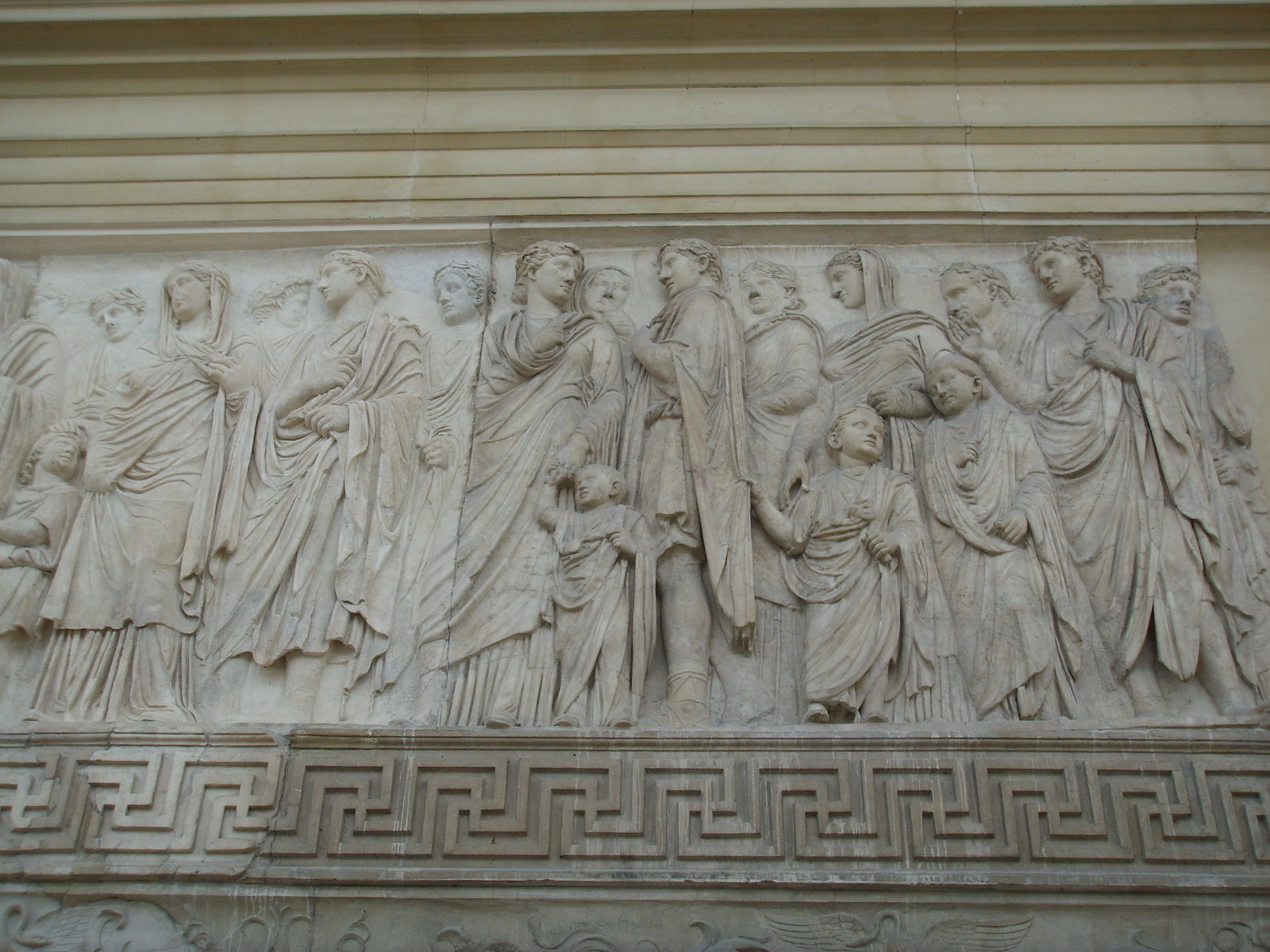
On the short sides "Procession for the altar dedication" that recalls the Panathenaic frieze of the Parthenon in Athens
The most important scene is on the right end side: people from all of the imperial family dressed in a toga in a hierarchical order: after the lictors Augustus, then Flaminii, Agrippa, the small Gaius Caesar, Julia, Tiberius, Antonia Minor, Germanicus son of Drusus and Antonia Minor (child himself with the robe), the small Domitius (which will be the father of Nero) and his older sister's children Domizia with their parents Domitius Enobarbus and Antonia Major
The left end side is not so well preserved and almost all the heads were recarved in the sixteenth century: procession according to the ordo sacerdotum, with the auguri, maybe bearing paintings or the insignia of their power, and quindecemviri sacris faciundis, recognizable by the camillo with the symbols of Apollo, followed by the septemviri epulones, also identified by the symbols of the second Camillo. Then again, in parallel with the procession of the right side, the parade of characters from the imperial house, opened by Lucius Caesar and his mother Julia Major
"It is not a great work of art, but it is a testimony very typical of his time. There is no connection between the compositions of the narrow sides and of the long sides, nor is there any tectonic relationship between one and the other of the two sections of the procession. Such lack of logic and structural organicity between the parties would have horrified the taste of the Greeks of the classical age, but in the Roman-Italic area these approaches were not new. However, when we look at the art form, we must convince ourselves that the artists who designed it and actually made it were Greek artists. A minute study of the decorative system of the frieze of the Ara Pacis plant did acknowledge that the motive is typically Pergamene; but in Pergamum itself is nowhere to be found anymore at the time when the Ara Pacis was made, but much earlier, in full second century BC. This finding indicates a clear retrospective and classicist mindset: Pergamon, Alexandria and Athens are merging their artistic legacy in this work that is typically Augustan in the programmatic maturity of its culture" (Ranuccio Bianchi Bandinelli)