Showing posts with label Augustus. Show all posts

Saturday, January 25, 2020

MARCELLUS THEATER

TEATRO MARCELLO
Via del Teatro Marcello

Begun by Julius Caesar and finished by Augustus (27 BC/14)

Probably completed in 17 BC when it was used for the so called secular games, but the dedication took place only in 13 or in 11 BC, when it was named after Marcellus (42/23 BC), nephew and son-in-law of Augustus who died at age 19
Marcellus was the son of Augustus' sister, Octavia, and the husband of the daughter of Augustus, Giulia

The theater was built on the site where the provisional theater used to be erected in the Republican period

In order to build the theater two temples were destroyed, maybe the TEMPLE OF PIETAS and the TEMPLE OF DIANA later reconstructed at the center of a large exedra behind the stage

In 23 BC Vespasian (69/79) restored the stage

Capacity of about 15,000/20,000 spectators
Originally the height was about 32.60 m (107 feet), the current height is about 20 m (65 feet)

Palazzo Orsini Savelli

Orsini Savelli Palace

Structure built above the Theater of Marcellus since the Middle Ages for the Pierleoni family, Jews converted to Christianity, one of whom became antipope with the name of Anacleto II (1131/38) in opposition to Innocent II Papareschi (1130/1143)

This happened during the period of the turf war between the Pierleoni and the Frangipane families, the most powerful ones in Rome at the time

The presence here of the Pierleonis was perhaps the reason why many Jews were forced to move from the Trastevere neighborhood to this area, which later became the Jewish Ghetto

Current building 1523/27 by Baldassare Peruzzi (1481/1536) for the Savelli family. The line of the family ended in the eighteenth century
The palace was sold to the Orsini family in 1716 and it was finally divided into luxury apartments

Monday, August 17, 2015

PALATINE HILL

PALATINO


51 m (167 feet) above sea level

It was the most suitable place for the creation of a settlement to control the area below, the so called Forum Boarium, important market near the river port

There are remains of artifacts dating back to the middle Paleolithic (100.000/35.000 BC) proving the human presence in prehistoric times although the first settlement dates from the late Bronze Age (1.300/1.200 BC)

The first urbanization took place in the early Iron Age (800/700 BC) on the top of Germalus, the place where tradition has placed the house of Romulus and in accordance with the chronological Varronian tradition locating here the foundation of Rome sixteen generations after the Trojan war, i.e. in 754/753 BC

With urbanization one refers to:
1) Agricultural increase with surpluses
2) Early secondary and tertiary activities
3) Contacts with the contemporary Greek colonization in Ischia and Cumae

The day of the foundation, April 21, was the same of the feast for the ancient cult of Pales, Italic goddess of flocks and shepherds, which would give rise to the name of the hill, Palatium

The ROMA QUADRATA (Square Rome) mentioned by Dionysius of Halicarnassus, Plutarch, Dio, Solinus and Festo included Palatine and Germalus excluding the Velia

Tacitus gives some indication of the primitive enclosure of the city, under which it is possible to hypothesize the following route, along approximately 1.5 kilometers (0.9 miles):
From S. Anastasia, along the south side of the Palatine to St. Gregory, then bend toward the Arch of Constantine, then to the Arch of Titus and S. Francesca Romana then to rejoin the track's Via San Teodoro and down the Velabro again until S. Anastasia

The ends were marked by altars:
The High Altar of Hercules in the Forum Boarium
The Altar of Consus in the valley of the Circus Maximus
The Sanctuary of the Lares at the foot of the Velia
The Curiae Veteres at the northwest corner of Palatine Hill

The hill was always a favorite place for the rich homes of notables. Among the ones who lived here in the late Republican period Marco Emilio Scaurus, Crassus, Cicero, the triumvir Mark Antony and then Augustus (27 BC/14)

His choice was followed by his successors, especially Nero (54/68), Domitian (81/96) with his architect Rabirius, Septimius Severus (193/211) and Elagabalus (218/222)

A single large complex was built called PALATIUM (the Palace) from the name of the hill and not viceversa

It was the seat of Gothic kings (as Theodoric), Byzantines exarchs, popes and emperors of the Holy Roman Empire, until Otto III (983/1002)

Then there was complete abandonment and reuse of churches, convents, houses, towers and fortresses (Frangipane family)
 
In 1542 most of the hill was transformed by Jacopo Barozzi aka Vignola (1507/73) by order of Cardinal Alessandro Farnese in the VILLA DEGLI ORTI FANESIANI (Villa Farnese Gardens) which was a botanical garden, with new plants such as the acacia farnesiana

Tuesday, May 19, 2015

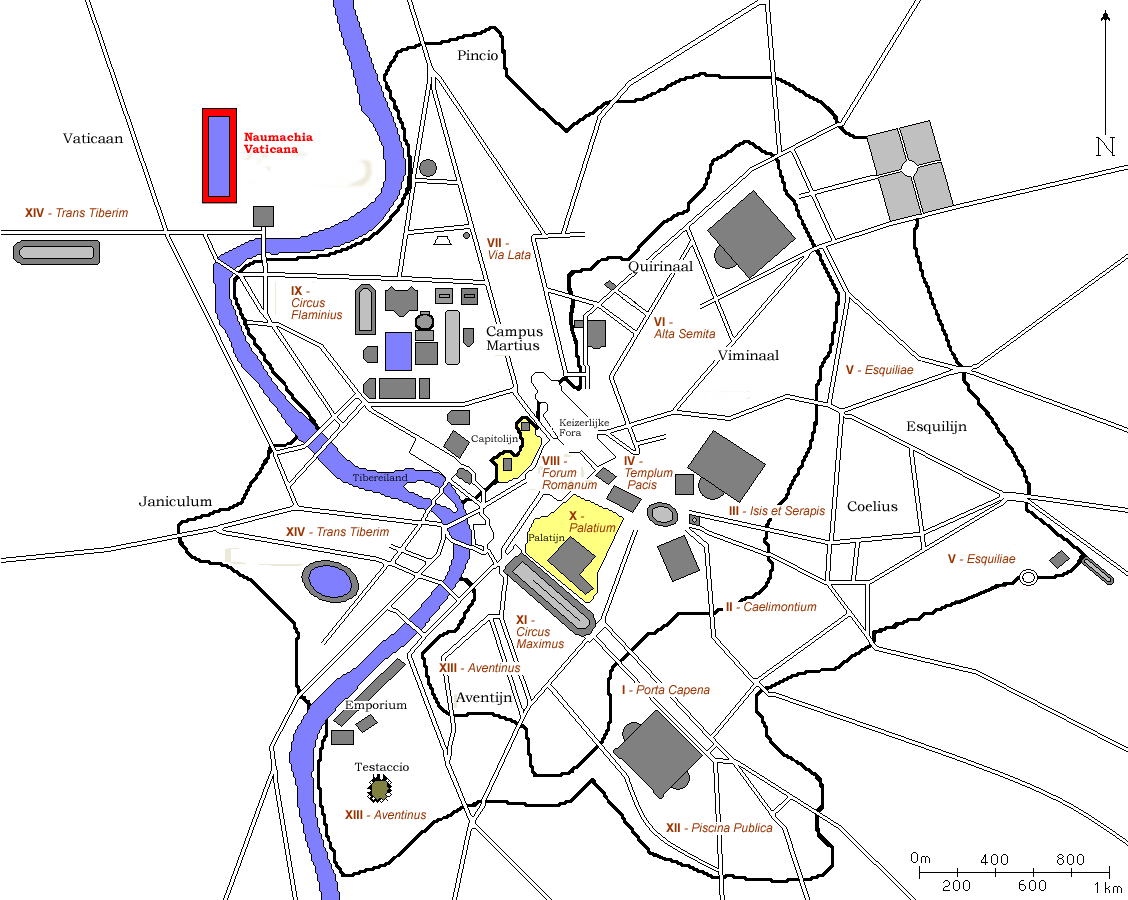
VATICAN NAUMACHIA

NAUMACHIA VATICANA
 

Beginning of the second century AD for Trajan (98/117) in addition or in substitution of the Naumachia of Augustus

Some remains of about 102 x 300 m (335 x 985 feet), maybe belonging to the Naumachia were seen during the construction of the Prati district at the end of the nineteenth century

The remains have not been completely excavated and it is believed to have been certainly larger
In 1996 other remains were found during ground surveys for the planned, but never built, tunnels below Castel Sant'Angelo

Monday, March 10, 2014

MAUSOLEUM OF AUGUSTUS

MAUSOLEO DI AUGUSTO
Begun in 29 BC at the behest of Augustus (27 BC/14 AD) as a tomb for himself and for his family
The diameter is about 87 m (285 feet) and it was probably 30 m (100 feet) high
At the top maybe there was a bronze statue of Augustus, a copy of which may be the '"Augustus of Prima Porta" in the Vatican Museums
It was not a burial mound of Etruscan origin, but a complex structure in superimposed layers derived from Hellenistic funerary monuments like the tomb of Alexander the Great in Alexandria that Augustus had visited the year before or the Mausoleum at Halicarnassus itself, built in 351 BC for Mausolus, who gave his name to this type of monumental tombs
Here were buried, in chronological order:
Marcellus, Agrippa, Gaius Caesar and Lucius Caesar (sons of Agrippa and Julia, the daughter of Augustus, who was not buried here because she was deemed unworthy for her sexual behavior too promiscuous), Augustus himself, Drusus Minor, Augustus' wife Livia, Agrippina Maggiore mother of Caligula and the emperors Tiberius (14/37), maybe Caligula (37/41), Claudius (41/54) and Nerva (96/98)
For a short time the mausoleum housed the ashes of Vespasian (69/79) and after over a century since the last deposition it was reopened to house the ashes of Julia Domna, wife of Septimius Severus (193/211)
The door that opened to the south was preceded by TWO OBELISKS Roman imitation of the Egyptian ones, now in Piazza del Quirinale and Piazza Esquilino
On two pillars at the side of the entrance there were brass plates with the official autobiography of Augustus, the RES GESTAE, known from a copy found in Ankara, Turkey
On the paving slabs there are graffiti used to work the marble blocks of the Pantheon
In the twelfth century it was turned into a DEFENSIVE STRONGHOLD OF THE COLONNA FAMILY (Agosta) stormed in 1241 by the Conti family
It passed later to the Orsini family, and in 1550 to the Soderini family, who transformed it into a hanging garden, after the upper part had collapsed
The Mausoleum then became a vineyard, an arena for bull fights, an arena for shows during the day under the name of ANFITEATRO UMBERTO (Humbert Amphitheater) until 1888, a warehouse, a workshop of the sculptor Enrico Chiaradia (1851/1901) who modeled here the equestrian statue of Victor Emmanuel II for the Victor Emmanuel Monument, an auditorium for classical music with the name of AUGUSTEO for the orchestra and choir of the Academy of St. Cecilia from 1905 to 1936, when the mausoleum was restored to its original structure
In the years 1934/40 the old neighborhood around it was dismantled
It seems incredible the difference between the amount of money spent for the nearby Ara Pacis, which is not even located in its original site, and the lack of funds, resulting in total abandonment, suffered by the Tomb of Augustus and of the Roman emperors

Wednesday, September 18, 2013

ARA PACIS

ARA PACIS
The Ara Pacis Augustae was dedicated by Augustus (27 BC/14 AD) on the 30th of January 9 BC (date of the birthday of Livia, wife of the princeps) to Pax, understood as the Roman goddess, and placed in an area of the Campus Martius, on the side of Via Flaminia, dedicated to the celebration of victory
On 4 July 13 BC the Senate had decided to build it upon return of Augustus from a peacemaking expedition of three years in Spain and southern Gaul
Rectangular enclosure with an altar inside
Dimensions: 11.65 x 10,62 x h 3.68 m (38 x 35 x h 12 feet)
It was a symbolic place located exactly one Roman mile (1,472 m - 0.91 mile) from the pomerium, the edge of town where consuls back from a military expedition used to give up their powers (imperium militiae) and regain possession of their civil powers (imperium domi)
In 1568, nine blocks were discovered in the Palazzo Fiano AlmagiĆ  (formerly known as Peretti) at the corner of Via in Lucina and Via del Giardino Theodoli under the current Cinema Nuovo Olimpia
Then in 1859 more reliefs were found during works directed by Gioacchino Ersoch (1815/1902)
In 1879 Von Duhn first identified it
In 1903 first excavations carried out scientifically
1937/38 excavations were completed on the two-thousandth anniversary of the birth of Augustus
The building that surrounded the Ara Pacis built in 1938 by Vittorio Ballio Morpurgo (1890/1966) was recently destroyed to make way for the controversial structure in 2005 by the great American architect Richard Meier (1934)
However beautiful, the structure inevitably changes the visual perspective and perception of the faƧades of the two adjacent churches, the Mannerist S. Girolamo degli Illirici and, most of all, the neoclassical S. Rocco
In the upper register "Crowns (festoons) supported by bucrani with patere" that were probably linked to paintings now disappeared
In the lower register "Vertical grooves" simulating a temporary wooden stockade used during the inauguration ceremonies
The altar is decorated with "Female figures" of allegorical character at the bottom part (perhaps personifications of the provinces of the empire), while in the upper frieze that runs inside and outside the altar there is a depiction of a "Sacrifice with Pontifex Maximus and Vestal Virgins"
In the lower part of naturalistic ornamentation "Spirals of acanthus" and, between them, "Small animals" such as lizards and snakes
In the top section of the long sides on the left representation of the "Lupercale" with a few original fragments and on the right "Aeneas sacrifice a sow to the Penati", both less important than other decorations in the monument
On the opposite side on the left "Peace (or maybe the Earth, Tellus)" represented as a thriving woman with two children between two seminude female figures representing the other elements: on the right the "Water" a sea monster and on the left the "Air" a swan: it is the most prestigious sculptural part of the Ara Pacis. On the right end side "Dea Roma" of which remains only a fragment
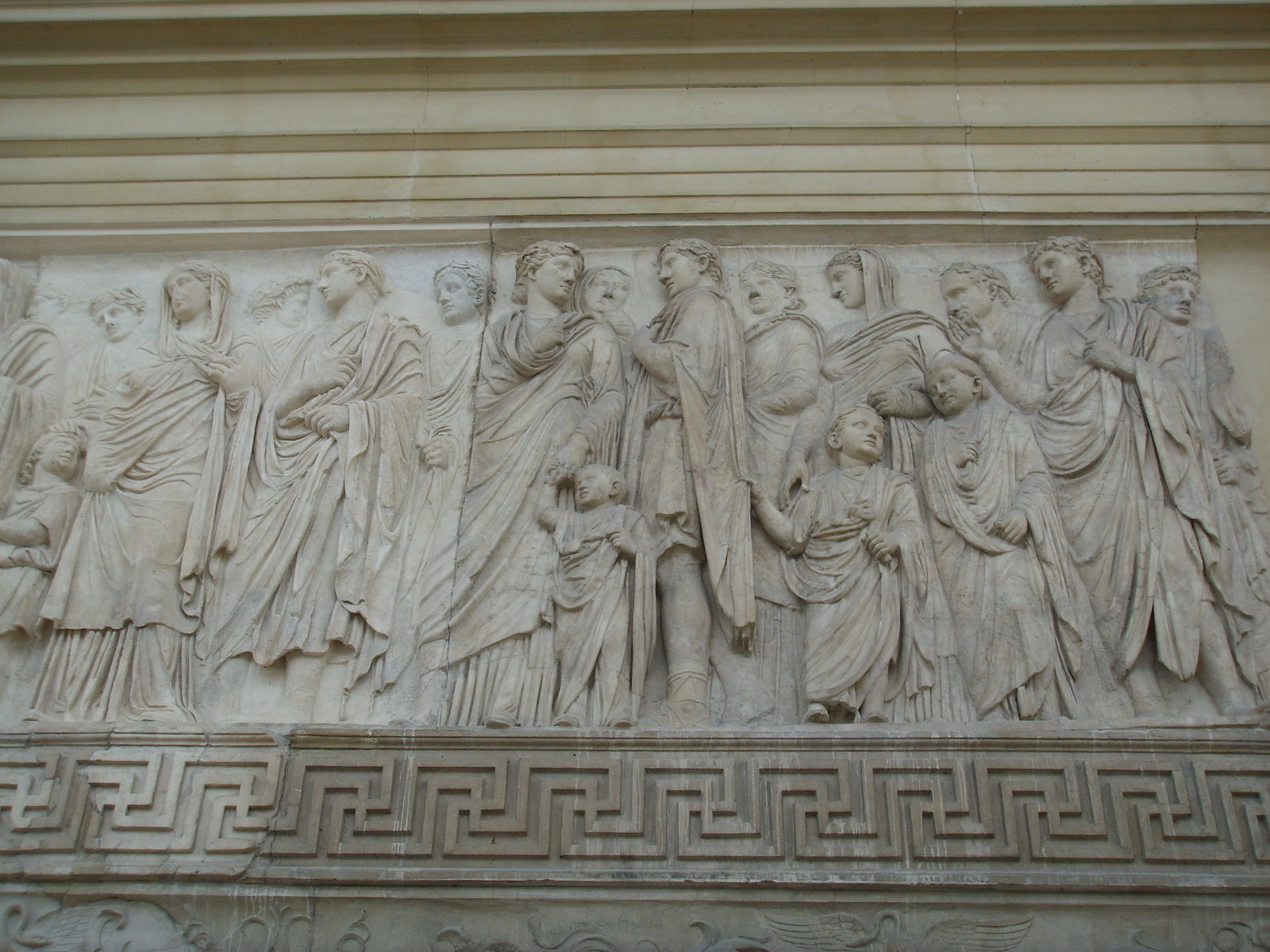
On the short sides "Procession for the altar dedication" that recalls the Panathenaic frieze of the Parthenon in Athens
The most important scene is on the right end side: people from all of the imperial family dressed in a toga in a hierarchical order: after the lictors Augustus, then Flaminii, Agrippa, the small Gaius Caesar, Julia, Tiberius, Antonia Minor, Germanicus son of Drusus and Antonia Minor (child himself with the robe), the small Domitius (which will be the father of Nero) and his older sister's children Domizia with their parents Domitius Enobarbus and Antonia Major
The left end side is not so well preserved and almost all the heads were recarved in the sixteenth century: procession according to the ordo sacerdotum, with the auguri, maybe bearing paintings or the insignia of their power, and quindecemviri sacris faciundis, recognizable by the camillo with the symbols of Apollo, followed by the septemviri epulones, also identified by the symbols of the second Camillo. Then again, in parallel with the procession of the right side, the parade of characters from the imperial house, opened by Lucius Caesar and his mother Julia Major
"It is not a great work of art, but it is a testimony very typical of his time. There is no connection between the compositions of the narrow sides and of the long sides, nor is there any tectonic relationship between one and the other of the two sections of the procession. Such lack of logic and structural organicity between the parties would have horrified the taste of the Greeks of the classical age, but in the Roman-Italic area these approaches were not new. However, when we look at the art form, we must convince ourselves that the artists who designed it and actually made it were Greek artists. A minute study of the decorative system of the frieze of the Ara Pacis plant did acknowledge that the motive is typically Pergamene; but in Pergamum itself is nowhere to be found anymore at the time when the Ara Pacis was made, but much earlier, in full second century BC. This finding indicates a clear retrospective and classicist mindset: Pergamon, Alexandria and Athens are merging their artistic legacy in this work that is typically Augustan in the programmatic maturity of its culture" (Ranuccio Bianchi Bandinelli)