Showing posts with label Publio Morbiducci. Show all posts

Sunday, September 22, 2019

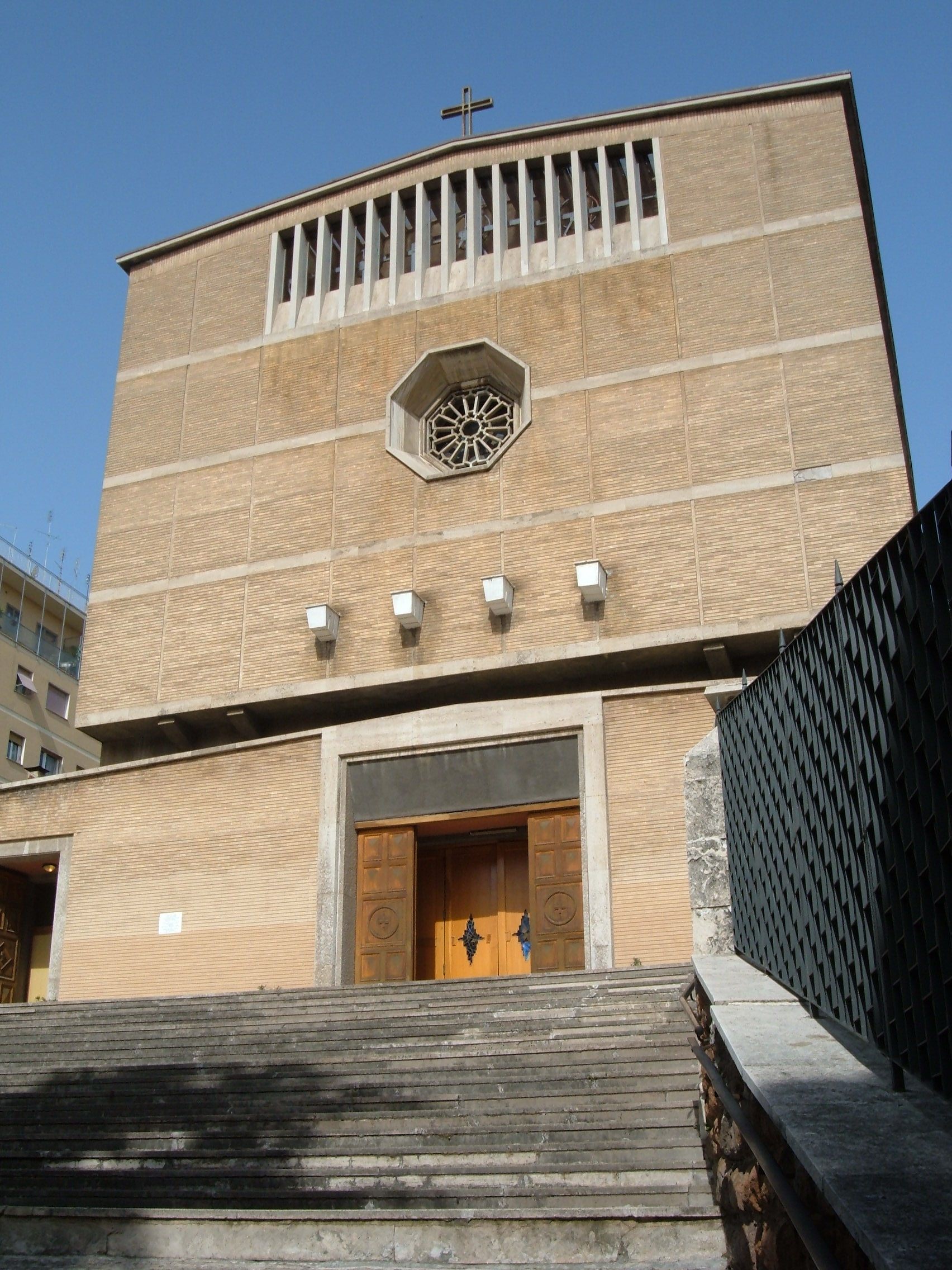
St. PIUS V

S. PIO X
Piazza della Balduina 5
1957/61 Alberto Ressa (1902/?)
St. Pius X Sarto (1903/14) was canonized in 1954 and he was the last pope to be declared a saint until John Paul II and John XXIII in 2014 
“Terracotta panels of the Stations of the Cross” 1963 by Raul Vistoli (1915/90)

CHAPEL OF St. PIO OF PIETRELCINA 
Painting “St. Pio of Pietrelcina” 2003 by Ulisse Sartini (1943) popular painter of very realistic, almost photographic portraits

MAIN ALTAR 
“Bronze Crucifix” by Publio Morbiducci (1889/1963), the sculptor of the statue of the Bersagliere (the running soldier) opposite Porta Pia 
Huge organ made in 1969 by the Tamburini firm

In 1964 in this church was shot the final scene of the sci-fi movie The Last Man on Earth with Vincent Price from the novel by Richard Matheson I Am Legend which also inspired the eponymous movie starring Will Smith in 2007
The Last Man on Earth is considered a cornerstone of the horror genre in Italy

Thursday, December 22, 2016

PALACE OF THE CIVILIZATION OF WORK

PALAZZO DELLA CIVILTÀ DEL LAVORO
1938/43 Giovanni Guerrini (1887/1972), Ernesto La Padula (1902/68) and Mario Romano (1898/?)
Formerly known as Palazzo della Civiltà Italica (Palace of the Italian Civilization) and popularly known as COLOSSEO QUADRATO (Square Colosseum)
50 m (164 feet) high, 68 m (223 feet) with the base
216 arches with six horizontal rows of nine arches each
It appears that this choice was not random, but it might have hinted at the name (Benito, six letters) and surname (Mussolini, nine letters) of the dictator
The palace expresses an obvious and surreal fascination of metaphysical architecture
“The name of La Padula is linked - as leader of the group with Guerrini and Romano - to the most emblematic building of Fascist Rome, the Palace of the Italian Civilization, which until the eighties of the twentieth century has weighed the prejudice of spurious and disingenuous architects, instilled by Giuseppe Pagano and Gio Ponti, and strengthened by Bruno Zevi, who saw in it a masking of the frame in reinforced concrete and therefore a betrayal of the rationalist dogma of the visual identity of form and structure. (...) In the executive phase the project was changed, both in proportions (from a cube pierced by eight galleries of thirteen overlapping arches to a parallelepiped of six galleries of nine arches, crowned by an attic) and in the internal structure, so as to be essentially disowned by its architects” (Sergio Cortesini - Dizionario Biografico degli Italiani Treccani)
Since November 2003, is being restored. At the end of the work it should become the Audiovisual Museum
Under the arches of the ground floor there are twenty-eight statues (one per arc) representing arts and crafts: about 3.40 m (11 feet) high, built in 1942 by eight companies specialized in marble in the provinces of Lucca and Massa Carrara

From the front door to left clockwise:

“Heroism, Music, Handicraft, Political Genius, Social Order, Labor, Agriculture, Philosophy, Commerce, Industry, Archaeology, Astronomy, History, Inventive Genius, Architecture, Law, Primacy of Navigation, Sculpture, Mathematics, Genius of Theatre, Chemistry, Press, Medicine, Geography, Physics, Genius of Poetry, Painting and Military Genius”
On the sides of staircases “Four groups of Dioscuri” by Publio Morbiducci (1889/1963)

Wednesday, November 23, 2016

EUR PALACE

PALAZZO DELL'ENTE EUR
1937/38 Gaetano Minnucci (1896/1980) for the offices of the autonomous institution E42 later known as ENTE EUR
The first building to be constructed in the EUR district and the one of the few to be finished before the war
“The way to think about architecture of Minnucci, as recalled by his partner Cigni (...), was logical-sequential, 'you might say scientific, in the sense that nothing was to be entrusted to fantasy, without accurate and binding technical and functional research. That's why I believe that he never had a precise point of reference, even in his long cultural involvement I think he has never been fully and critically aligned. (...) Ready to implement whatever new and concrete manifested itself in architecture, he always rejected ideas not demonstrable with facts” (Alessandra Capanna - Dizionario Biografico degli Italiani Treccani)
OUTSIDE
Bronze statue of “Genius of sport”, originally “Genius of fascism” by Italo Griselli (1880/1958) and “Two groups of statues” by Mirko (Mirko Basaldella) (1910/69)
In front of the portico three bodies of water decorated with “Eighteen mosaic panels” by Gino Severini (1883/1966), Giulio Rosso (1897/1976) and Giovanni Guerrini (1887/1972)
IN THE ENTRANCE ROOM
Bas-relief “History of Rome through its buildings” by Publio Morbiducci (1889/1963)
INSIDE
Fresco “Foundation of Rome” by Giorgio Quaroni (1907/60)

Sunday, November 6, 2016

VIMINAL PALACE

PALAZZO DEL VIMINALE
1912/21 Manfredo Manfredi (1859/1627)
Semicircular arrangement of the square 1929/31 according to the Manfredi's project
“The complex consists of several buildings connected by courtyards and varying characteristics in terms of volume and indicates the existence of a secret dialectic between the severity of the general project and the desire to qualify artistically this architecture as much as possible” (Raffaella Catini - Dizionario Biografico degli Italiani Treccani)
Fountain in front of the palace by Publio Morbiducci (1889/1963) in imitation of the “Barcaccia” in Piazza di Spagna by Pietro Bernini
The area was leveled and the soil was brought to the area where later the Città Universitaria (University City) would be built
It is the HEADQUARTERS OF THE MINISTRY OF THE INTERIOR
HALL
Paintings in ten panels “Activities of the Italian Genius i.e. Navigation, Poetry, Sculpture, Wheat Harvest, Printing, Weaving, Science, Architecture, Industry, Grapes Harvest and Victorious Italy in the center” by Rodolfo Villani (1881/1941)
ROOM OF THE COUNCIL OF MINISTERS

Paintings by Giulio Bargellini (1896/1936)
Paintings in the other rooms by Umberto Vico, Umberto Amati e Tito Ridolfi (1886/1956)

Sunday, October 2, 2016

PALACE OF THE MINISTRY OF PUBLIC EDUCATION

PALAZZO DEL MINISTERO DELLA PUBBLICA ISTRUZIONE

1912/25 Cesare Bazzani (1873/1939)
On the FAÇADE statues in travertine marble:
“Science” by Publio Morbiducci (1889/1963), “Philosophy” by Bernardo Morescalchi (1895/1975), “Education” by Ernesto Vighi (1894/1950) and “Art” by Volterra Volterra
In 1914 during the construction an inscription was found that identifies the area as that of the TEMPLE OF FONS
COURTYARD
“Twelve caryatids” by Publio Morbiducci and Bernardo Morescalchi
ROOMS OF THE MINISTER
Frescoed by Paolo Paschetto (1885/1963)
HALL OF MINISTERS
So named for the twelve portraits of the Ministers from 1859 to 1922
At the center of the ceiling “Triumph of education”, at the sides “Victory of the Kingdom of Italy in World War I”, great frieze “Evolution of education from ancient times to the present” all paintings by Antonino Calcagnadoro (1876/1935)

Sunday, April 13, 2014

MONUMENT TO THE BERSAGLIERE

MONUMENTO AL BERSAGLIERE
1931/32 bronze statue and reliefs by the Roman Publio Morbiducci (1889/1963)
Architecture by Italo Mancini (1897/1971
 The project was personally selected by Benito Mussolini
On the sides of the foundation bas-reliefs in stone of Trani with characters and battles fought by the Bersaglieri Corps:
On the left "Bridge Goito, Luciano Manara and Porta Pia"

Sunday, January 26, 2014

JANICULUM HILL

GIANICOLO
Dubbed the eighth hill and connected to the history of Rome just as much as the legendary seven hills
It is 82 m (270 feet) high
It is located on the right bank the Tiber, originally in Etruscan territory
The name of the hill in the tradition derives from the god Janus, who would have founded a town on the hill known by the name of Ianiculum. In reality, the name is in relation to this divinity on the Janiculum Hill there was only a chapel dedicated to his son Fons or Fontus
There was a small town (Pagus Ianiculensis) at the foot of the hill in the area corresponding to today's Piazza Mastai
It would have been occupied and annexed to Rome by Anco Marcio (640/616) who would have fortified it and connected to the city via the SUBLICIO BRIDGE on which the ancient road going through the hill and coming from Etruria used to pass; it later became the Via Aurelia
The original bridge was named Sublicio for the sublicae, planks of wood with which it was built, fixed by bronze nails. Horatius Cocles, according to legend, in 507 BC stopped the Etruscans on the bridge Sublicius and the Romans cut it behind him
The hill was not very much inhabited for the water shortage until the construction of the Trajan aqueduct
The Romans used to raise a flag on the Janiculum as a safety signal when the speeches were held in the Campus Martius outside the city walls
An area of the Janiculum Hill was covered with the sacred woods of the TEMPLE OF FURRINA near which Gaius Gracchus killed himself in 121 BC
Another area of worship, in a later period, was the SANTUARIO SIRIACO (Syrian Shrine) on the east slope of the hill, today Via Dandolo

The road winding from Via Garibaldi towards S. Pietro in Montorio was traced in the years 1865/68 by Federico Arcangeli and was lined with elm, locust, plane trees and melie azedarach

The PASSEGGIATA DEL GIANICOLO (Janiculum Esplanade) was opened in the years 1883/96. The stretch between the "Fontanone" of the Acqua Paola and Piazzale Garibaldi was inaugurated in 1884 and other large sections were opened to the public in 1887

Along the walking path of the hill there are “Eighty-four marble busts of Garibaldi's heroes” 1883/1949 made by various sculptors including:

 “Luigi Mercantini” beginning of 1900s by Ettore Ximenes (1855/1926)

“Angelo Tittoni” 1902 by Ettore Ferrari (1845/1929)

“Achille Sacchi” about 1908, “Eugenio Agneni” 1923 and “Giovanni Costa” 1926/27 by Giovanni Prini (1877/1958)

“Colomba Porzi Antonietti” 1910/11 by Giovanni Nicolini (1872/1956)

“Paolo Narducci” 1921, “Augusto Valenziani” about 1920 and “Raffaele Cadorna” 1923 by Publio Morbiducci (1889/1963)

Four busts represent foreigners fighting with Garibaldi: an Englishman, a Finn, a Hungarian and a Bulgarian
Under the Belvedere (viewpoint) of the Janiculum Hill every day since 1904 at 12 o'clock three soldiers load a cannon with blanks and fire a shot
The tradition dates back to Pius IX Mastai-Ferretti (1846/78) who instituted this service in 1846 to avoid confusion with time. Before firing from the Janiculum Hill, the cannon used to fire from Castel Sant'Angelo first and then from Monte Mario

Thursday, October 24, 2013

HOUSE OF THE WOUNDED VETERANS OF WAR

CASA MADRE DEI MUTILATI
1925/28 Marcello Piacentini (1881/1960)
It was expanded in 1936 with the section toward the River Tiber
It now partly houses judicial offices
main hall external portal by Giovanni Prini (1877/1958), internal portal by Publio Morbiducci (1889/1963)
Portraits "Paulucci de Calboli" and "Giulio Giordani" by Adolfo Wildt (1868/1931)
Portrait "Carlo Delcroix" and frescoes by Antonio Santagata
"Statue of St. Sebastian" (symbol of the soldier martyr) by Arturo Dazzi (1881/1966)
Frescoes "King Emperor" and "Il Duce in the shrine" by Mario Sironi (1885/1961)
Interior frescoes and in the courtyard by Cipriano Efisio Oppo (1891/1962)
In the HALL OF THE CENTRAL COMMITTEE
"Wood inlays" 1928 by Edoardo Del Neri (1890/1932). The inlays are also in mother of pearl and ivory with subjects of war alternating with chalices for the holy host