Showing posts with label Arturo Dazzi. Show all posts

Thursday, December 26, 2019

Sts. AMBROSE AND CHARLES ON THE CORSO

SS. AMBROGIO E CARLO AL CORSO
Via del Corso 437

It replaced S. Nicola de Tofo national Church of the Lombards since 1471

Work began in 1612 with Onorio Longhi (1568/1619), after the canonization of St. Charles Borromeo in 1610, and continued from 1619, the year of the death of Onorio Longhi, until 1640 with his son Martino Longhi the Younger (1602/60)
Works finished in the years 1668/69 with Pietro Berrettini aka Pietro da Cortona (1597/1669) who designed the apse, the dome and the stuccos in the interior

FAÇADE
1682/84 G.B. Menicucci and Fra Mario da Canepina from a project of Cardinal Luigi Omodei
The construction of the church took therefore 72 years

In the PIAZZA AUGUSTO IMPERATORE behind the church, at the sides of the APSE, gigantic statues “St. Ambrose” by Arturo Dazzi (1881/1966) and “St. Charles Borromeo” by Attilio Selva (1888/1970)

The church is not aligned with Via del Corso because it followed the alignment of the ancient church of St. Nicholas: it originally faced a small square and buildings that used to separate the church from the Via Lata (now Via del Corso)

“The apse was not created to be seen in an open space, which followed the demolition implemented in 1936/40 for the isolation of the Mausoleum of Augustus, but it once stood with its dome at the bottom among the small streets and alleys typical of the urban fabric of Roman Baroque” (Simonetta Ceccarelli)

Seat of the Confraternity of the Lombard Nation

STUCCOS by Cosimo Fancelli (1620/88) and his brother Giacomo Antonio Fancelli (1619/71), designed by Pietro da Cortona

CENTRAL NAVE “The Fall of the Rebel Angels” 1677/79, PENDENTIVES “Evangelists” 1671/72, VAULT, TRANSEPT and PRESBITERY “Glory of St. Charles” 1677, APSE “St. Charles and the plague” all works by Giacinto Brandi (1621/91)

NICHES OF THE NAVES AND OF THE DEAMBULATORY
“Ten plaster statues of saints” 1677/82 masterpiece by Francesco Cavallini (known since 1672/1703)

“These statues were the largest commission of this clever decorator; they are of unequal value and overall show a close affinity with the style of the turbulent Ercole Antonio Raggi. Cavallini did not learn, however, neither from Raggi nor from Ferrata: he was a disciple of Cosimo Fancelli the most important brother of Giacomo Antonio” (Rudolf Wittkower)

“Monochrome and fake stucco” 1677/80 by Paolo Brozzi

CEILINGS OF THE NAVES AND OF THE DEAMBULATORY
ELEVEN FRESCOS painted in the years 1678/81

From right:
“Temperance” by Paolo Albertoni (about 1670/after 1695)
“Justice, Peace, Law and Truth” by Girolamo Troppa (1630/after 1710)
“Religion, Fortress, Purity and Chastity” by G.B. Beinaschi (1638/88)
“Devotion” by Carlo Ascensi
“Humility, Prayer, Perfection and Fortitude” by G.B. Boncuore
“Glory of Angels” by Luigi Garzi (1638/1721) a pupil of Andrea Sacchi, later influenced by Carlo Maratta
It is behind the altar in the opposite direction to the others because it had to be visible through the arch closed later by the painting by Maratta
“Vigilance” by Ludovico Gimignani (1643/97)
“Patience, Tolerance and Discretion” by Fabrizio Chiari (about 1615/95)
“Faith” by Luigi Garzi (1638/1721)
“Charity” by Francesco Rosa (known since 1674/d. 1687)
“Hope and Truth” by Pio Paolini

1st CHAPEL ON THE RIGHT
“Christ and Sts. Ambrose and Charles” maybe by Pier Francesco Mazzucchelli aka Morazzone (1573/1626)

2nd RIGHT - CHAPEL OF THE VIRGIN MARY AUXILIUM CHRISTIANORUM (Help of Christians)
Altar piece with the same of the chapel painted in the nineteenth century

3rd RIGHT - CHAPEL OF THE HOLY FAMILY
On the left “Madonna with St. Francis” by Pier Francesco Mazzucchelli aka Morazzone

RIGHT TRANSEPT - ALTAR OF THE IMMACULATE CONCEPTION
1769 maybe by Paolo Posi (1708/76) with a copy in mosaic of the altar piece “Immaculate Conception” by Carlo Maratta in the Cybo Chapel in S. Maria del Popolo
On the side statues: on the left “David” by André Jean Lebrun and on the right “Judith” by Pietro Pacilli (1716/after 1769)

MAIN ALTAR
“Glory of Sts. Ambrose and Charles with St. Sebastian, Virgin Mary and the Redeemer” 1685/90 by Carlo Maratta (1625/1713) restored after a fire in 1831 by Vincenzo Camuccini (1771/1844)

DEAMBULATORY
Unique in Rome, evidently inspired by the Duomo of Milan: in a niche behind the altar there is the heart of St. Charles Borromeo
Above there is a banner with “St. Charles in adoration of the Virgin Mary and Child” by an artist of the school of Giacinto Brandi

LEFT TRANSEPT 
“Altar of the Most Holy” 1929 by Cesare Bazzani (1873/1939) which imitates the opposite transept
Altar piece “The Lord and praying angels” 1632 by Tommaso Donini (or Luini) aka Caravaggino (1601/37)
On the sides statues “Religion” by Eugenio Maccagnani (1852/1930) and “Faith” by Guido Galli (1873/?)

3rd LEFT - CHAPEL OF St. OLAV
1893 with painting of the Norwegian king saint “St. Olav” by the Polish Pius Welonski
On the left “Agony in the Garden” by Pasquale Rossi
On the right “Holy Family” by Cristoforo Roncalli aka Pomarancio (1552/1626)

2nd LEFT - CHAPEL OF S. FILIPPO NERI
Paintings on the sides: on the left “Communion of St. Stanislaus Kotska” and on the right “St. Aloysius Gonzaga among the lepers” by Giacomo Zoboli (1681/1767)

1st CHAPEL ON THE LEFT
Above the altar “Preaching of St. Barnabas” by Pier Francesco Mola (1612/66)

ANTICHAMBER OF THE SACRISTY
“Crucifixion” by Guillaume Courtois aka Borgognone (1628/79)

LARGE SACRISTY
“St. Ambrose and two deacons” by Tommaso Donini (or Luini) aka Caravaggino (1601/37)
Above the doors “Marble busts of the Cardinal Omodei and Cardinal D'Adda” by Agostino Cornacchini (1683/1740)

ORATORY OF St. AMBROSE
Sculptures “Deposition” and two “Sibyls” about 1583 by Tommaso Della Porta (about 1550/1606)

Friday, January 18, 2019

St. JOHN BOSCO

S. GIOVANNI BOSCO
1953/58 Gaetano Rapisardi (1893/1988) who also designed the square, for the Salesians, the order founded by St. John Bosco (1815/88) also known as Don Bosco
FAÇADE
High relief at the center:
“St. John Bosco among young men and angels” by Arturo Dazzi (1881/1966)
In the large arches on the sides statues:
“Archangel Gabriel” and “Archangel Michael” by Ercole Drei (1886/1973)
In the four smaller niches statues from left:
“St. Francis de Sales” by Giovanni Amoroso (1913/73)
“Pius IX Mastai-Ferretti (1846/78)” and “Pius XI Ratti (1922/39)” by Francesco Nagni (1897/1977)
“S. Giuseppe Cafasso” by Antonio Venditti (1914/81)

DOME
31 m (101.3 feet), the third largest by diameter in Rome after the Pantheon (43.3 m - 142,06 feet) and St. Peter (42.56 m - 139.63 feet)
On top of the dome “Four bronze angels and crown surmounted by a cross of light” by Alessandro Monteleone (1897/1967)

PORCH
On the main door:
Reliefs “Symbols of the Four Evangelists” and stories of Don Bosco: “Pius IX blesses the work of the St. John Bosco”, “Leo XIII entrusted him with the construction of the Basilica of the Sacred Heart in Rome”, “Mass of St. John Bosco in the Basilica of the Sacred Heart”, “Apostolate in Rome of St. John Bosco as a young priest” by Federico Papi (1897/1982)
Above the two side doors:
Bronze statues “Redeemer” and “St. John the Baptist” by Attilio Selva (1888/1970)

INTERIOR
Marble coating by Triestino Trognoni con Cima Gargari, Fausto Gargari and Aonio Paleario
“Stations of the Cross” by Venanzo Crocetti (1913/2003)

1st CHAPEL ON THE RIGHT
“Crucifix” in bronze by Venanzo Crocetti

2nd CHAPEL ON THE RIGHT
Painting “S. Maria Domenica Mazzarello” co-founder of the Institute of the Daughters of Mary Help of Christians by Paolo Giovanni Crida (1907/67)
“He renders in a popular form an orderly and readable arrangement of interesting episodes from the life of the saint. She appears in the center in a radiant halo supported by angels. The commitment of the painter turns to a historical documentation of the facts, illustrated with a minute and diligent realism with no synthesis and abstractions” (Official Website of the Parish of St. John Bosco - www.donboscoparrocchia.pcn.net)

2nd ALTAR ON THE RIGHT
Painting “S. Domenico Savio” student of Don Bosco by Mario Caffaro Rore (1910/2001)

3rd ALTAR ON THE RIGHT
Painting “St. Joseph the Worker” by Emilio Notte (1891/1982)

MAIN ALTAR
Mosaic “Glory of St. John Bosco with saints and blessed” by Giovanni Brancaccio (1903/75)
It covers an area of about 100 m² (1,100 square feet) with about 15 million tiles
Altar in Carrara marble weighing about 10 tons (11 tons) by Father Costantino Ruggeri (1925/2007)
The huge block seems to break at the base to symbolize both the crack that opened in Mount Calvary at the death of Christ, and the moment when Christ broke bread during the celebration of the Eucharist
Tabernacle with “Crucifixion with Angels” and “Bronze Candelabra” by Pericle Fazzini (1913/87)
Eight huge marble bas-reliefs (four on each side) on the sides of the tabernacle with “Stories of Don Bosco”, from bottom to top, by Alessandro Monteleone (1897/1967), Luigi Venturini (1912/98), Francesco Nagni (1897/1977) and Vico Consorti (1902/79)
Monumental “Candlestick” in bronze for the Easter candle by Lyda Preti

SMALLER DOME
24 windows with “Seven Sacraments and Works of Mercy” engraved by Bruno Saetti (1902/84)

Stained Glass “Stories from the Life of Jesus” by Marcello Avenali (1912/81) and Lorenzo Gigotti (1908/94)
Ring at the base with mosaic “Dreams of St. John Bosco” by Augusto Ranocchi

CHAPEL OF St. ANNE
Painting “St. Anne with Madonna as a young girl and angels” by Lorenzo Gigotti (1908/94)

1st CHAPEL ON THE LEFT
“Baptismal font” and “Angels” in bronze by Emilio Greco (1913/95)

1st ALTAR ON THE LEFT
Painting “Virgin Help of Christians with Don Bosco, saints and boys' choir singers” by Gisberto Ceracchini (1889/1982)
In the church there are also works by Attilio Torresini (1884/1961), Primo Conti (1900/88) and other artists

Sunday, September 25, 2016

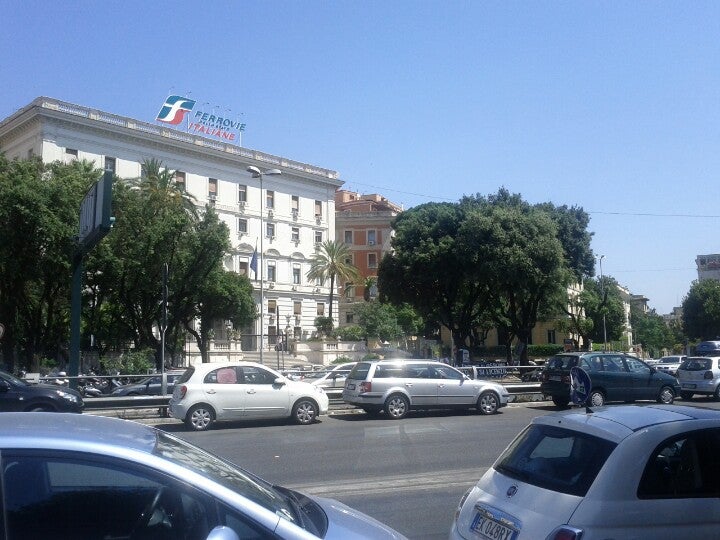
PALACE OF THE MINISTRY OF TRANSPORTATION

PALAZZO DEL MINISTERO DEI TRASPORTI

1927 Pompeo Passerini (1875/?) in the area of the demolished Villa Patrizi
In the garden “Monument to the railwaymen who died for their country” 1930 by Arturo Dazzi (1881/1966)
It is now one of the two office buildings of the MINISTRY OF INFRASTRUCTURE AND TRANSPORTATION

Saturday, May 23, 2015

GUGLIELMO MARCONI'S OBELISK

OBELISCO DI GUGLIELMO MARCONI


1937/59 Arturo Dazzi (1881/1966)

It was built in reinforced concrete, 45 m (148 feet) high

92 panels in Carrara marble with “Guglielmo Marconi achievements, and other allegorical scenes”
Guglielmo Marconi (1874/1937) in 1895 invented the radio, or more precisely, the wireless telegraphy using radio waves

Although other scientists of his time as the Serbian-born American Nikola Tesla or the Russian Alexander Stepanovič Popov conducted similar experiments in the same years, Marconi's experiments were the first to prompt applications of practical use and commercial scale

“Because of the war Dazzi worked with numerous interruptions on the truncated pyramid stele, until in 1952, at the height of a crisis of dissatisfaction, he broke all the plasterboards. Once he was given the job back for the involvement of the Marconi family, he began all alone, even without the help of a rough-hewer, and he completed the work in 1957. He drew the figures in charcoal on the marble rocks, then lowering the bottom plate in order to bring out the contour line. The representation, divided into 'Songs' - the 'Joy', the 'Dance', the 'Harvest', the 'Flood' and so on - celebrates the universality of the medium that unites all peoples of the world, including even animals. It is as one of the great medieval encyclopedias interpreted, however, with a completely modern spirit” (Maria Antonietta Picone Petrusa - Dizionario Biografico degli Italiani Treccani)

Sunday, November 24, 2013

ETOILE MOVIE THEATER

CINEMA ETOILE
Piazza S. Lorenzo in Lucina
1916/18 Marcello Piacentini (1881/1960)
Originally known as CINEMA-TEATRO CORSO
Piacentini designed it originally in a style influenced by the Vienna Secession style but he had to change it into a more "Roman" style during the First World War because critics considered it unpatriotic
It was the first building ever to be built entirely in reinforced steel in Rome and it did not have pillars or columns to support the two upper galleries 
The theater had a capacity of 800 seats and, with the galleries, the capacity was 1,300 seats 
"The entire interior was soberly decorated with stuccos with very soft lines and with bas-reliefs by Arturo Dazzi and Alfredo Biagini. Particularly interesting was the solution of the façade, set on a continuous surface marked by four windows connected by a headband with a delicate frieze in stucco. At the sides the building was completed by two small bow windows while the ground attack was marked by a striking glass and metal canopy supported by chains. Once completed, the project aroused very negative reactions and at the end of a long controversy Piacentini was prescribed substantial changes to the façade" (Piero Ostilio Rossi)
It is part of PALAZZO RUSPOLI
It has been recently modified in a very invasive way and it has become the biggest Louis Vitton store in Rome

Thursday, October 24, 2013

HOUSE OF THE WOUNDED VETERANS OF WAR

CASA MADRE DEI MUTILATI
1925/28 Marcello Piacentini (1881/1960)
It was expanded in 1936 with the section toward the River Tiber
It now partly houses judicial offices
main hall external portal by Giovanni Prini (1877/1958), internal portal by Publio Morbiducci (1889/1963)
Portraits "Paulucci de Calboli" and "Giulio Giordani" by Adolfo Wildt (1868/1931)
Portrait "Carlo Delcroix" and frescoes by Antonio Santagata
"Statue of St. Sebastian" (symbol of the soldier martyr) by Arturo Dazzi (1881/1966)
Frescoes "King Emperor" and "Il Duce in the shrine" by Mario Sironi (1885/1961)
Interior frescoes and in the courtyard by Cipriano Efisio Oppo (1891/1962)
In the HALL OF THE CENTRAL COMMITTEE
"Wood inlays" 1928 by Edoardo Del Neri (1890/1932). The inlays are also in mother of pearl and ivory with subjects of war alternating with chalices for the holy host