Showing posts with label Aniene. Show all posts

Wednesday, February 7, 2018

INA CASA MAMMOLO BRIDGE NEIGHBORHOOD

QUARTIERE INA-CASA PONTEMAMMOLO
1959/62 Giuseppe Vaccaro (1896/1970) designed the SOUTHERN AREA and Luigi Vagnetti (1915/80) the NORTH WEST AREA
It is situated between the Via Tiburtina and the Aniene River and it is inhabited by about 3000 people in 562 apartments
“It is distinguished by the peculiarity of the typological and architectural solutions adopted and the richness of the internal distribution of individual blocks. It constitutes a reference model for settlements with low population density” (Giorgio Muratore)
“He worked often in official commissions, and participated in the monumentality of the time by searching sometimes a futuristic interpretation, with elements in the language of Rationalism (Rome, Ministry of Corporations, today of Industry, Via Veneto, 1928/31, with Marcello Piacentini, Naples, Palazzo delle Poste, 1929/35, with Gino Franzi). His executive accuracy and the use of rationalist terms within a symmetrical architectural system (...) had considerable influence on Italian architecture” (Enciclopedia Treccani)

Sunday, January 21, 2018

NEIGHBORHOOD OF THE GARDEN CITY ANIENE

QUARTIERE CITTÀ GIARDINO ANIENE
1920 Gustavo Giovannoni (1873/1947), Quadrio Pirani (1878/1970) and Edmondo Del Bufalo (1883/1968)
It is connected with Via Nomentana through the TAZIO BRIDGE 1927 by Gustavo Giovannoni over the Aniene River. It was restored and partially reconstructed in the years 1938/39
“Particular attention was devoted to the design of the roads layouts, rich in curvilinear patterns with a configuration adhering to the altitude of the terrain and capable of proposing an environmental quality with a suburban character” (Piero Ostilio Rossi)
PIAZZA SEMPIONE
1920/27 by Gustavo Giovannoni and Innocenzo Sabbatini (1891/1984)
CHIESA DEI Ss. ANGELI CUSTODI (Church of Saints Guardian Angels)
1922/24 by Gustavo Giovannoni
“At the center of a web of roads, inspired by models of the English garden suburb, Giovannoni designed in 1922 Church of the Guardian Angels in a traditional style. In plan and elevation, the building reproduced Baroque models with elongated plan. Again here it is shown the duality between the engineer, able to grapple with the most up to date techniques, and the student of Roman history tied to stylistic references of local inspiration” (G. Zucconi - Dizionario Biografico degli Italiani Treccani)
PALAZZO PUBBLICO
1921/25 by Innocenzo Sabbatini
CASA DELLA GIOVENTÚ A MONTE SACRO (House of Youth on the Sacred Mountain)
1934/43 by Gaetano Minnucci (1896/1980)

Thursday, January 4, 2018

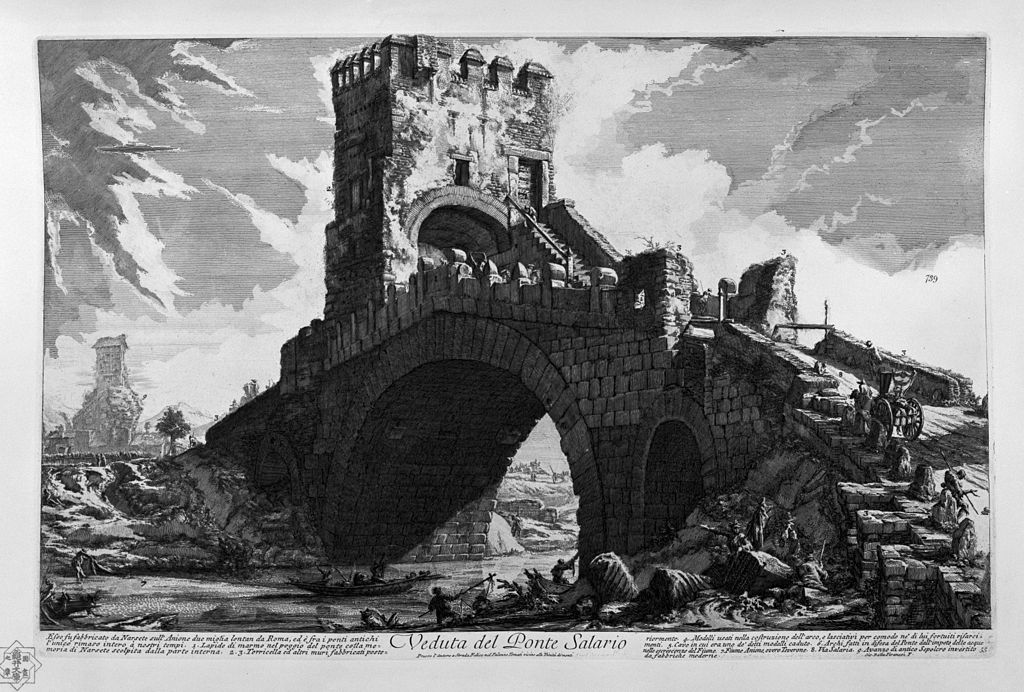
SALARIA BRIDGE

PONTE SALARIO
Built in the Republican period so that the VIA SALARIA could pass the ANIENE RIVER
The original bridge was constructed by the Etruscans who used the Via Salaria to take salt from the salt marshes near the mouth of the Tiber to the Sabina region
It was destroyed and rebuilt several times
The MODERN PONTE SALARIO was built in 1870 with an expansion in 1930
The structure of the end of the second/first half of the century BC there are only two minor arches incorporated into the modern bridge. They are in cement with shards of tuff, while the outer blocks are made of tuff stone from Fidene

Monday, January 1, 2018

NOMENTANO BRIDGE

PONTE NOMENTANO
Built in the Republican period so that the VIA NOMENTANA could pass the ANIENE RIVER
It was destroyed by the Goths of Totila in the year 549
Rebuilt by the Byzantine general Narses in 552
The current upper part dates back to that time, while the central arch is of the first century AD
It was fortified under Pope Adrian I (772/795)
Restored under Nicholas V Parentucelli (1447/51) and also under Innocent X Pamphilj (1644/55)
After being damaged in 1849 by the French army it was again restored
Now it is inserted in a PUBLIC PARK and the stretch of Via Nomentana to which it belongs has been closed to traffic

Saturday, December 30, 2017

MAMMOLO BRIDGE

PONTE MAMMOLO
Built in the Republican period so that the VIA TIBURTINA could pass the ANIENE RIVER
It was made in opus quadratum of travertine marble and tuff stone with two large arches, of which remains only part of the eastern span and the base of the pillar of the central one
Its original structure probably consisted of three arches with the central one larger
It was known as Mammolo since 1338 perhaps for having been attributed to Giulia Mammea, the mother of Septimius Severus (193/211), or more likely for a language contraction from marmoreus being the original in travertine
It was destroyed by the French in 1849
The NEW MAMMOLO BRIDGE further north was rebuilt in the years 1853/57 for Pius IX Mastai-Ferretti (1846/78) and restored in 1871