Showing posts with label Via Salaria. Show all posts

Tuesday, July 7, 2020

ADA VILLA

VILLA ADA
Via Salaria 267

The actual area of the villa’s park is 150 hectares (370 acres) 3.4 times the size of the territory of Vatican City
It is the second public park in Rome in size after Villa Doria Pamphilj
In the 1600s it was a farm and the headquarters of the Collegio Irlandese (Irish College)
At the end of the 1700s it became the property of the Pallavicini princes and it was rearranged by the French architect Auguste de Chevalle Saint-Hubert (1755/98) as a landscape garden with the opening of geometric paths and small buildings like the Belvedere or the Cafehaus (Temple of Flora)

The park on various levels provided backgrounds and views congenial to the sensitivity of the Romantic period
In 1872 it was bought by the Italian royal family, the Savoy who transformed it since 1874 in an English country park by the landscape architect Emilio Richter
Richter moved about 25,000 m³ (20.2 acre feet) of land, created two lakes, built two large greenhouses for exotic species still existing and planted no less than 100,000 plants
Among the many varieties of plants and flowers in the park there are the rare dwarf palm and the aquatic fir from Tibet

“A typology that exploited and exalted the landscaped characteristics of the site, thoroughly reshaped by man. Determinants of this composition are alternating hollows and undulations of the land, with sudden forests by seemingly spontaneous open glades and trees in groups or isolated with the function of eye-catchers” (Sandro Santolini – Verdi Delizie, le ville, i giardini, i parchi storici del Comune di Roma)

In 1878 the villa was sold at preferential price to the administrator of the property of the royal family, Count Tellfner, who named it after his wife Ada
In 1904 Vittorio Emanuele III bought the villa again and it became a royal residence under the name VILLA SAVOIA (Savoy Villa) until 1946
It was in the Palazzina Reale of Villa Ada that Benito Mussolini was arrested on July 25, 1943 by order of King of Italy
At the fall of the monarchy, the villa was the subject of a long dispute, at the end of which a section (84 hectares - 207 acres - out of about 150 hectares - 370 acres - in total) remained private property of the Savoy later sold in different periods. It is the part that still retains traces of the eighteenth-century garden
The part by Via Salaria (34 hectares - 84 acres) was acquired to the public domain in 1957


Casino Pallavicini and Temple of Flora (Coffee-House)

Formerly known as Casino Calzamiglia. It is still inhabited by the heirs of the Savoy family
The monumental gate on Via Salaria dates back to 1795

“The Coffee-House stands out for architectural quality. (...) It testifies the imperial taste between the end of the eighteenth century and the beginning of the new century. Its type, with pronaos and neoclassical façade, hides on the back an apse, which echoes the motif of the colonnade, overlooking an underlying basin shaped as an amphitheater with a central fountain in cast iron of the late-nineteenth century, the result of a romantic reshuffle of this place” (Sandro Santolini - Verdi Delizie, le ville, i giardini, i parchi storici del Comune di Roma)


Palazzina Reale

1873/74 with the supervision of the technical office of the Royal House Gennaro Petagna
The neo-Gothic tower was built by Emilio Richter to mask a water tank
In the years 1930/40 embellishments were added with the Secret Garden connected to the villa with new stairs adorned with statues and fountains
Now the building is home to the Embassy of the Arab Republic of Egypt

Royal Mews

Three buildings of which only the first towards south-west, the closest to the Palazzina Reale, was evidently designed as a stable in the years 1873/74 probably by Gennaro Petagna


Church of the Divine Love

Abandoned and badly damaged
The exterior dates back to the early 1800s, maybe designed by Fabio Puri De Marchis
Inside “Marble balustrade”, ALTAR in stucco and polychrome marble and “Crucifix” of the eighteenth century in papier-mâché
The building, however, is probably very ancient, identified in 1632 by Antonio Bosio as the CHURCH OF THE HOLY MARTYRS DARIA VIRGO AND CHRISTANTUS stoned, according to tradition in 257 under Valerian (253/260). Bosio identified two small buildings preexisting under the church, possibly dedicated to the two saints


Other houses

HOUSE TRIBUNA I, HOUSE TRIBUNA II, BARN now used as a riding center, HOUSE KNOWN AS “LA FINANZIERA” seat of the WWF and HOUSE OF MARES MOTHERS, so named because it was used for mares from the Quirinal Stables to give birth
In the south-west area of Villa Ada is the VILLA POLISSENA
On the hill now occupied by Forte Antenne was located the ancient city of ANTEMNAE (ante amnem = before the river), where the Aniene River joins the Tiber River
Inside the villa is visible the underground channel of the aqueduct AQUA VIRGO
In the area of the villa near Via Salaria were identified the catacombs of Trasone and of Priscilla

Thursday, January 4, 2018

SALARIA BRIDGE

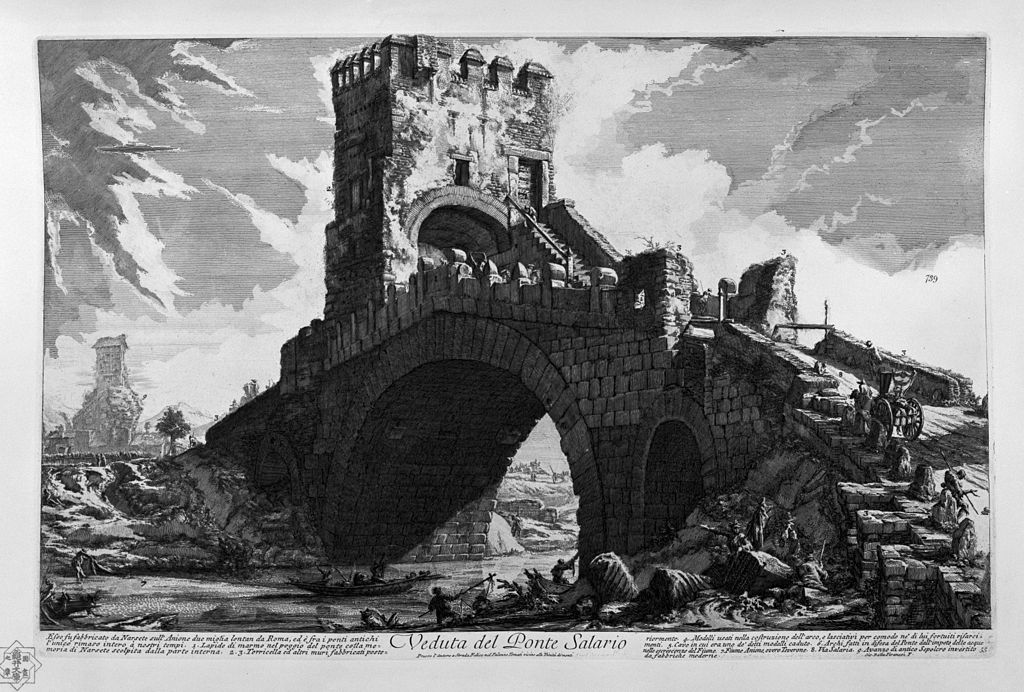
PONTE SALARIO
Built in the Republican period so that the VIA SALARIA could pass the ANIENE RIVER
The original bridge was constructed by the Etruscans who used the Via Salaria to take salt from the salt marshes near the mouth of the Tiber to the Sabina region
It was destroyed and rebuilt several times
The MODERN PONTE SALARIO was built in 1870 with an expansion in 1930
The structure of the end of the second/first half of the century BC there are only two minor arches incorporated into the modern bridge. They are in cement with shards of tuff, while the outer blocks are made of tuff stone from Fidene

Wednesday, March 12, 2014

MAUSOLEUM OF LUCILIUS PAETUS

MAUSOLEO DI LUCILIO PETO
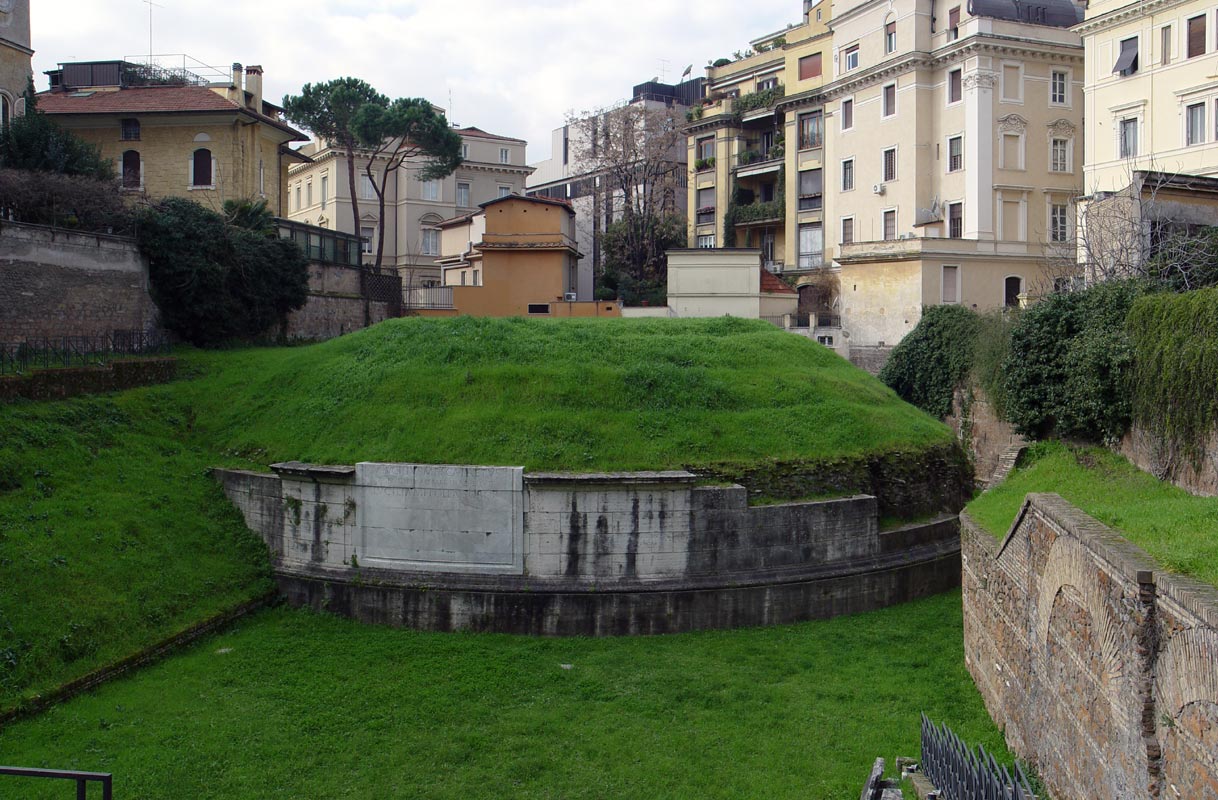
Monumental tomb built in about 20 BC with a diameter of about 34 m (112 feet)
It was discovered in 1887. It belonged to the military tribune, and prefect of the genius commander of the cavalry Lucilius Paetus and his sister Lucilia Polla
It is covered with travertine marble and there is a small burial chamber with a cross vault and three niches for three funeral beds of which only one is preserved
In the fourth century under the tomb a small catacomb was excavated

Tuesday, November 5, 2013

CATACOMB OF PRISCILLA

CATACOMBA DI PRISCILLA
It takes its name from the matron Priscilla a descendant of the gens Acilia Glabriona maybe the founder of the catacomb or, more likely, the donor of the ground
Two floors plus an intermediate one, maybe the Cemetery of Novella for a total length of approximately 12 km (7.5 miles)
Many martyrs were buried in the catacomb including Pope Marcellinus (296/304), the first bishop of Rome to be called Pope, and six other popes:
Marcello (308/309), Sylvester (314/335), Liberius (352/366), Siricius (384/399), Celestino (422/432) and Vigil (537/555)
It is one of the five catacombs open to the public with those of the Appian Way (St. Callistus, Domitilla and St. Sebastian) and that of Via Nomentana (St. Agnes)
Tomb of manufacturers of barrels or carriers of water represented in a fresco on the wall. On the fresco there is the signature written with coal by the Maltese scholar Antonio Bosio (1575/1629)
Paintings of the second half of the third century AD:
"Here the realistic tradition of Roman art, all committed to translating, maybe quickly and easily, a humble and ordinary 'cursus vitae' (story of a life) is combined with new figurative fashions, with signs and metaphors that suggest a life and a condition that go beyond the earthly horizon, to see a new and suspended world. (...) The atmosphere is heavenly and, while remaining on a real level with the scenes of motherhood and marriage, it rises in paradise with the central figure-portrait, in an attitude of prayer, in proportions much greater than the other, and thus, symbolically, more significant" (Fabrizio Bisconti)
On the opposite side "Jonah rejected by the monster"
At the center of the vault "Good Shepherd"
"The three episodes are very frequent in early Christian iconography: in the Roman catacombs, the only frescoes (without taking sculptures, therefore, into account) of Jonah are sixty-eight, twenty-third those of the Sacrifice of Abraham and those of Jewish youths twenty-two. These figures refer to the paintings found so far because, as is well known, archaeological research continues" (Sandro Carletti)
SANDSTONE AREA
"Madonna with Child and prophet who points the star" maybe Balaam or Isaiah, of the third or fourth decade of the third century AD, the oldest depiction of this kind in catacombs
To the left of the Madonna fragmented "Good Shepherd" in stucco
The decoration was on the upper part of an arched tomb that was demolished to make way for more graves
Maybe it was a room that was part of the house of Priscilla and was perhaps intended to be used as a burial place at a later time. It was the first nucleus of the catacomb
Square room with two painted inscriptions in Greek (dedications of some Obrimo to his cousin and fellow Palladio and to his wife Nestoriana) and paintings "Scenes of the two Testaments" and "Fractio panis" (Eucharistic supper) maybe half third century
The scenes from the Old and New Testaments are:
"Moses drawing water from the rock" episode that prefigures baptism and was found seventy-three times in the catacombs of Rome
"Susanna threatened by the elders" and in front two more episodes involving Susanna, perhaps the charge of the elderly and thanksgiving to God from Daniel and Susanna
In the upper part fragment of "The Healing of the paralytic"
On the right corner of the entrance wall "Phoenix at the stake" very damaged, the only example of this subject in ancient painting in the world
On the front of the arch partition "Adoration of the Magi"
On the reverse of the arch "Resurrection of Lazarus". This episode is represented seventy-three times in the Roman catacombs and it is the New Testament episode more represented
In the lower part of the arch "Noah's ark"
Traces of frescos to the right of the Fractio Panis "Daniel among the lions" and to the left "Sacrifice of Abraham"
"The most external of the Greek Chapel, dated to the late Gallienic period, shows, more than any other monument of late antiquity, a series of registers and a semantic growth. Above a lower part in fake marble, in fact, takes place in the cycle of Susanna in megalographic (massive) proportions, while the vault - mostly lost - seems to receive, within a complex linear plot, themes and signs of the cosmos, interpreted in a Christian sense" (Fabrizio Bisconti)
HYPOGEUM OF THE ACILI
Here the inscriptions were found with the names of family members of the Acili
CUBICLE OF THE ANNUNCIATION
Fresco in the vault interpreted as "Annunciation"
In the back wall "Good Shepherd"
BASILICA OF St. SYLVESTER built above ground after 313. It was rebuilt in the years 1904/07
Nearby, on the Via Salaria Vetus, there are the CATACOMBS OF VIA ANAPO and the CATACOMBS OF THE GIORDANI not open to the public
The Catacomb of Via Anapo was the first to be found intact since antiquity on May 31, 1578
"The first to look at the underground cemeteries carefully as a scholar was in mid-1500s, the Augustinian Onofrio Panvinio. (...) He was the founder of the group of scholars who in the second half of 1500s turned to the catacombs with new scientific interest. Time, on the other hand, was ripe for the appreciation of these ancient monuments. The movement of the Counter-Reformation watched with interest the material evidence of early Christianity, capable, through a 'targeted' interpretation to confirm the dogmas of the Roman Catholic church. (...) This group of scholars was joined at the end of 1500s by the Maltese Antonio Bosio (1575/1629) the one who would lay the foundations of Christian archeology. (...) The 'Christopher Columbus' of the Roman catacombs (as he was described by G.B. De Rossi) was able to discover and study, in forty years, thirty new underground cemeteries" (Vincenzo Fiocchi Nicolai)