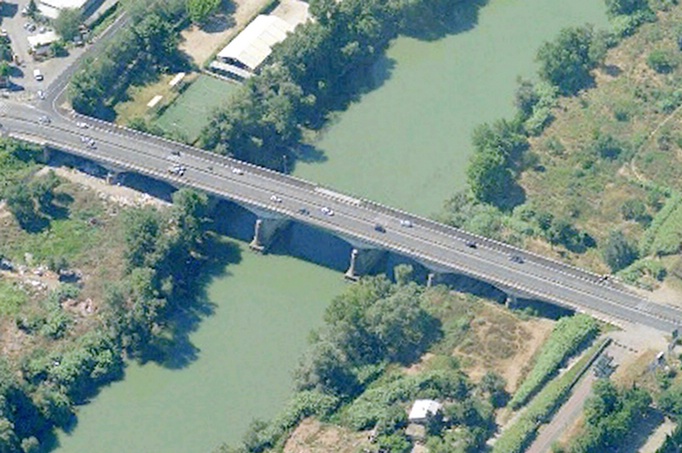
VIADOTTO DELLA MAGLIANA
Autostrada Roma - Aeroporto
1965 Riccardo Morandi
(1902/89)
Built in
the bend of the Tiber River, where the Magliana district is at beginning of the
Rome-Fiumicino highway
“On June 28,
1965 a landslide, extended in width for about 200 meters, hit the Magliana bend
of the River Tiber and the motorway bridge still under construction at the time.
The designer Riccardo Morandi - commissioned by ANAS to remedy - identified two
possible solutions: either rebuilding the ruined stretch, with a deck based on
sets of poles inserted in the ground in great depth; or cross over the whole
area of the landslide with a suspension bridge with a single arch. ANAS chose
the second option, the most ambitious and never attempted in Rome until then”
(Antonella Anappo - Il Ponte Morandi, Monografia)
“In a
continuous research, which does not consider technology for its own sake and at
the same time is devoid of formal preconceptions, Morandi designed works marked
by a perfect balance between functionality, rigor of structural solutions and
quality of the final image. (...) He studied the prestressed concrete,
developing a system, for which in 1948 won the first of seven patents related
to his name” (Enciclopedia Treccani)
Showing posts with label Magliana. Show all posts
Showing posts with label Magliana. Show all posts
Saturday, June 27, 2020


Sunday, September 1, 2019
St. PASSERA
S. PASSERA
Via S. Passera 1 - Magliana
Probably built in the fifth century AD on the ruins of a ROMAN MAUSOLEUM of the late second/early third century AD, still visible
The church is mentioned in the sources for the first time in the eighth century
The present church dates back to the thirteenth century
Here were kept the relics of the martyrs Sts. Cyrus and John, brought to Rome in the year 407. They were two doctors from Alexandria in Egypt killed during the persecution of Diocletian (284/305), which took place in the year 303
The Catholic Church does not include any S. Passera in the lists of saints and, according to historical sources, no saint has ever existed under the name Passera
The curious name Passera (sparrow) is mentioned in the sources only since 1317 and it comes maybe from a contraction of S. Prassede (St. Praxedes), the saint to whom the church was originally dedicated, and of whom a relic was preserved here
The name could also come from the phonetic corruption of the title Abbas Cyrus (father Cyrus), from which S. Abbaciro, given to the church
Over the centuries the term underwent a distortion in the popular language, becoming Appacero, Pacero, Pacera and, finally, Passera
APSE
Two orders of frescoes of the fourteenth century:
In the upper part “Jesus and Sts. Peter, Paul and John the Evangelist”
In the lower part “Virgin Mary and Child with Sts. Praxedes, Cyrus and John martyr with two images of laymen, probably the patrons”
ARCHAEOLOGICAL EXPLORATIONS
The underground of the church, buried after 1706, was rediscovered only in 1904
On the north wall there are some faded frescoes “Cycle of Goddess Dike” with the goddess holding a pair of scales, a bird and a boxer
On the south wall “Sheep and red lines”
In the vault “Large six-pointed and eight-pointed star and decorative motifs”
There are some unrecognizable images in the counter façade
At the end of the thirteenth century a “Virgin Mary and Child” was painted here, but it was stolen in 1968

Via S. Passera 1 - Magliana
Probably built in the fifth century AD on the ruins of a ROMAN MAUSOLEUM of the late second/early third century AD, still visible
The church is mentioned in the sources for the first time in the eighth century
The present church dates back to the thirteenth century
Here were kept the relics of the martyrs Sts. Cyrus and John, brought to Rome in the year 407. They were two doctors from Alexandria in Egypt killed during the persecution of Diocletian (284/305), which took place in the year 303
The Catholic Church does not include any S. Passera in the lists of saints and, according to historical sources, no saint has ever existed under the name Passera
The curious name Passera (sparrow) is mentioned in the sources only since 1317 and it comes maybe from a contraction of S. Prassede (St. Praxedes), the saint to whom the church was originally dedicated, and of whom a relic was preserved here
The name could also come from the phonetic corruption of the title Abbas Cyrus (father Cyrus), from which S. Abbaciro, given to the church
Over the centuries the term underwent a distortion in the popular language, becoming Appacero, Pacero, Pacera and, finally, Passera
APSE
Two orders of frescoes of the fourteenth century:
In the upper part “Jesus and Sts. Peter, Paul and John the Evangelist”
In the lower part “Virgin Mary and Child with Sts. Praxedes, Cyrus and John martyr with two images of laymen, probably the patrons”
ARCHAEOLOGICAL EXPLORATIONS
The underground of the church, buried after 1706, was rediscovered only in 1904
On the north wall there are some faded frescoes “Cycle of Goddess Dike” with the goddess holding a pair of scales, a bird and a boxer
On the south wall “Sheep and red lines”
In the vault “Large six-pointed and eight-pointed star and decorative motifs”
There are some unrecognizable images in the counter façade
At the end of the thirteenth century a “Virgin Mary and Child” was painted here, but it was stolen in 1968
Tuesday, December 26, 2017
MAGLIANA BRIDGE
PONTE DELLA MAGLIANA
1930/48
designed by Romolo Raffaelli
It was
swept away by a flood of the Tiber in 1937 when it still had not been completed
Bombed and
damaged in 1943 by the Germans during the Battle of Magliana
Bombed and
destroyed by the Americans in 1944
Rebuilt in
1948 200 m away by Ignazio Guidi (1904/78), Cesare Valle (1902/2000) and Carlo
Cestelli Guidi for the Allegri firm without the previous fascist
decorations
It is
224 m long (735 feet) and is made up of seven arches in reinforced concrete and
travertine. The central bay can be opened and it is made of steel
Subscribe to:
Posts (Atom)