Showing posts with label Ignazio Guidi. Show all posts

Thursday, January 9, 2020

GIACOMO LEOPARDI ELEMENTARY SCHOOL

SCUOLA ELEMENTARE GIACOMO LEOPARDI
Via del Parco della Vittoria 30 - Monte Mario

 1929 Ignazio Guidi (1904/78)

Originally called Scuola Rosa Maltoni Mussolini (Rosa Maltoni Mussolini School), the mother of Benito Musssolini

It is inserted in the beautiful PARCO DELLA VITTORIA (Park of Victory) and it is composed of five pavilions with two classrooms in each one

“Part of the area of former Monte Mario Fort was transferred from the War Department to the City of Rome in order to be transformed into a public park. (...) The school is made out of a series of pavilions (...) according to the principles of outdoor schooling. This type of school was concocted in the twenties with the aim of preventively strengthening frail children through physical activity, contact with nature and heliotherapy. The Rosa Maltoni Mussolini School was presented on Capitolium magazine: 'The design of this school with pavilions is original, the children will gather in designated terraces for outdoors lesson with great hygienic and perhaps cultural gain’. (...) In addition to the fact that it was an important historical example of an innovative teaching method, several factors make the school quality architecture. The high environmental quality derived by the inclusion in the park of Monte Mario and the architectural quality of original masonry artifacts designed in the style of Roman Baroque by Ignazio Guidi, make the complex one of the best examples of Roman School” (University “ La Sapienza” - Observatory on modern Rome - Conservatory of the City of Rome - Research “ Schools” – arch. form M. T. Cutrì, V. Lupo)

ALESSANDRO MANZONI ELEMENTARY SCHOOL

SCUOLA ELEMENTARE ALESSANDRO MANZONI
Via Lusitania 18 - Porta Latina

 1932 Ignazio Guidi (1904/78)

Originally called Scuola Guglielmotti

The plan of the building is symmetrical even if the entrance is on one corner

“The two elementary schools, Guglielmotti at Porta Latina and Garroni in Ostia, are undoubtedly the first who reported Guidi’s works to the attention of the scholars of the time. Highly innovative for the floor plans and for the materials used and characterized by large windows, these two schools express with confidence and skill the strong adhesion of Guidi to European Rationalism, practically non-existent in Rome at that time” (Filippo Spaini - Dizionario Biografico degli Italiani Treccani)

Monday, January 22, 2018

DECIMA DISTRICT

QUARTIERE DECIMA
1960/66 Luigi Moretti (1907/73) coordinated the project for the Istituto Nazionale per le Case degli Impiegati dello Stato (INICIS) (National Institute for the Houses of State Employees) 
It was built to meet the growing demand for housing on the part of civil servants who gravitated around the EUR district, still expanding at the time
Buildings by Vittorio Cafiero (1901/81), Ignazio Guidi (1904/78), Adalberto Libera (1903/63) and Luigi Moretti
Other architects who worked on the project: Agrelli, Di Tullio, La Valle, Quadarella, Reggiani, Rinaldi, Rulli, Sebasti, Valle e Veroi
808 apartments for a population of about 7,500 people
Reorganization of the central square in 1999 by Aldo Aymonino (1953)
“So it was partly put together again the team a few years before had given a good performance in the realization of the Olympic Village; and the new district evokes some of the main characters of the Olympic Village: the prevalence of row houses with 4-5 floors on stilts, greenery as connective tissue, unification of coating materials (brick facing) and architectural solutions. Only the plan of the buildings is driven by a separate will, to determine complex visual perspectives, enveloping spaces and constantly changing. Hence the use of sinuous lines and open polygonal schemes, typical of those years in the formal research of Luigi Moretti” (Saverio- www.urbanistica.unipr.it)

Tuesday, December 26, 2017

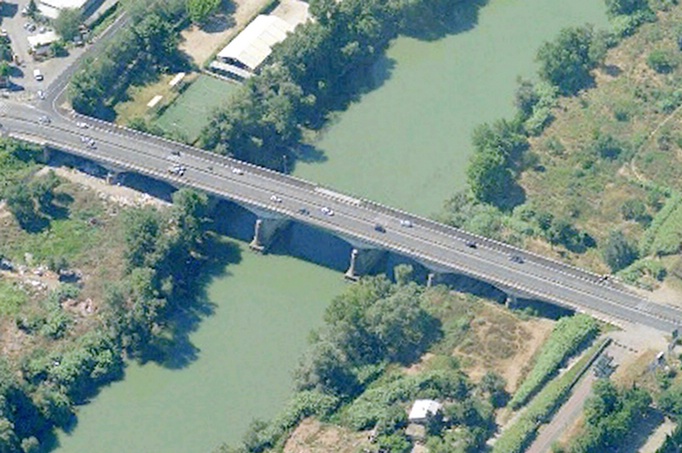
MAGLIANA BRIDGE

PONTE DELLA MAGLIANA
1930/48 designed by Romolo Raffaelli
It was swept away by a flood of the Tiber in 1937 when it still had not been completed
Bombed and damaged in 1943 by the Germans during the Battle of Magliana
Bombed and destroyed by the Americans in 1944
Rebuilt in 1948 200 m away by Ignazio Guidi (1904/78), Cesare Valle (1902/2000) and Carlo Cestelli Guidi for the Allegri firm without the previous fascist decorations
It is 224 m long (735 feet) and is made up of seven arches in reinforced concrete and travertine. The central bay can be opened and it is made of steel

Friday, November 11, 2016

PALACE OF THE REGISTRY OFFICE

PALAZZO DELL'ANAGRAFE
1936/37 Cesare Valle (1902/2000) and Ignazio Guidi (1904/78)
It is the area of the ancient PORTO TIBERINO (Tiberine Port) the first port of Rome
In order to build it, the Church of St. Galla was destroyed, as well as other buildings
“The project is characterized by a clear floor plan, in which the realization of the great courtyards, the highlighting of the substantial archaeological findings, the use of the curtain brick and travertine moldings and the large openings in iron glass summarize the choices that Guidi adopted for the setting of the buildings in an area unique in the world. The result is a great respect for the preexisting archaeological findings, without renouncing the use of elements of modernity that do not clash with the prestigious surroundings” (Filippo Spaini - Dizionario Biografico degli Italiani Treccani)
Inside the palace there is the large mural “Roman Carnival” 1937/39 by Orfeo Tamburi (1910/94)

Monday, November 7, 2016

ACEA PALACE

PALAZZO DELL'ACEA
1960 Cesare Valle (1902/2000) and Ignazio Guidi (1904/78)
ACEA is a public company that is responsible for the management of water and energy services
“Ignazio Guidi was in constant contact with fellow architects and engineers of his generation, with whom he formed design teams for competitions, and participated in the fervent cultural debate of the time, which led to the slow but steady emergence of modern architecture and the contemporary defeat of neoclassical and academic positions, who had many followers in Rome” (Filippo Spaini - Dizionario Biografico degli Italiani Treccani)
Fountain in front of the palace 1962 by Ludovico Quaroni (1911/87)