Tuesday, January 15, 2019

St. FRANCES OF ROME

S. FRANCESCA ROMANA
About 760 as an oratory for Paul I (757/767) in the area of the TEMPLE OF VENUS AND ROME built by Hadrian (117/138) between 121 and 135 AD
The oratory was built to guard the so called Apostolic Silices, i.e. the prints left in the stone on the nearby Via Sacra by the Apostle Peter when he fell on his knees in prayer during the episode of Simon Magus according to the apocryphal Acts of Peter
The prayers of St. Peter and St. Paul would have caused the haughty Simon Magus, who was flying thanks to a wizardry, to crash on the ground
About 850 St. Leo IV (847/855) built a church that incorporated the oratory
About 999 the church was enriched and expanded for Gregory V (996/999), who gave it the name of S. Maria Nuova having transferred here the worship from S. Maria Antiqua in the Forum
1161 restoration of the BELL TOWER (restored again in 1971) and of the mosaic in the apse. The church was also consecrated again at the behest of Alexander III Bandinelli (1159/81)
In 1352 it was entrusted to the Benedictines of the Congregation of Monte Oliveto founded in 1313 by St. Bernard Tolomei. They still officiate it today

FAÇADE and INTERIOR renovation
1615 Carlo Lambardi (1545/1619) for Cardinal Paolo Emilio Sfondrati
On this occasion the church was dedicated to St. Frances of Rome (1384/1440) who spoke here the oblation of 1425 and was buried here after her death
The façade is considered the first derivation in Rome of the style of Andrea Palladio (1508/80)
“Inside it was presented again the unified space of the Roman churches of the Counter-Reformation and the new front of the church prevailed in Roman architecture of the early seventeenth century for the classicists accents of the giant order and for eco of Palladio, perhaps already intuited by Militia and later highlighted by several scholars (Fasolo, Wittkower, Blunt), who have understood the importance for the beginnings of the early Baroque architecture in Rome, from S. Bibiana (1624) by G.L. Bernini to S. Gregorio al Celio (1633) by G.B. Soria” (Enrico Parlato - Dizionario Biografico degli Italiani Treccani)

From left: “Unidentified female saint”, “St. Frances of Rome and the Angel”, “Virgin Mary and Child”, “St. Cecilia” and “St. Agnes”
Other restorations in the nineteenth century for Pius IX Mastai-Ferretti (1846/78)

1816/29 Giuseppe Valadier (1762/1839) rebuilt
Now it is the home of the ARCHAEOLOGICAL SUPERINTENDENCE OF ROME and of the ANTIQUARIUM FORENSE (Archaeological Museum of the Forum), small museum with important artifacts found in the Forum still under interminable restructuring and therefore sadly closed to the public
Every 9 March, on the day of the feast of St. Frances of Rome, there is the blessing of cars
The real name of the saint was Francesca Bussa de' Leoni (1384/1440) and she was born into a noble family in Rome near Piazza Navona. She came to live in Trastevere when she was twelve, after her marriage to a nobleman from the Ponziani family who had become rich working as butchers

1612 Carlo Lambardi (1545/1619). Restored in 1867 and in 1951
Wood paneled with wooden relief in frames:
“Madonna and Child”, “Sts. Agnes and Cecilia”, “St. Benedict” and “St. Frances of Rome”
On the sides: “Insignia of the Olivetano Order and of Cardinal Sfrondati” commissioner of the radical restructuring of the church

FLOOR
Completely redone in 1952, with old cosmatesque fragments
In the CHORUS BALCONY frescoes with “Stories of St. Frances of Rome and the Blessed Tolomei” 1693

1st RIGHT - CHAPEL OF THE CROSS
Vault with “Four Doctors of the Church” very damaged and badly restored frescoes of the school of Melozzo degli Ambrosi aka Melozzo da Forlì (1438/94)
Above the altar “Crucifixion” second quarter of the eighteenth century maybe by Emanuele Alfani (active 1736/74)
On the left of “Rest on the Flight into Egypt” and on the right “Blessed Bernardo Tolomei in ecstasy” by an unknown artist of the last quarter of 1600s

ROOM OF THE SIDE ENTRANCE
On the right “Funerary monument of Cardinal Marino Volcanoes” about 1395 erroneously attributed to Paolo Taccone aka Paul Romano (about 1415/77)
It is one of the rare examples of late Gothic sculpture in Rome
On the left “Funerary monument Antonio del Rio on horse” d. 1450 (captain of Castel Sant'Angelo and commander in chief of the army of the pope) about 1470/77 by Mino del Reame (active about 1463/77) who completely avoided here any religious reference

Restored in 1937 by Lorenzo Cesanelli (1899/1965)
Above the altar “St. Benedict between Sts. Frances of Rome and Henry” 1937 by Augusto Orlandi (1879/?)

On the sides “Blessed Tolomei exorcises a maniac” and “Blessed Tolomei consoles a monk” first half of the eighteenth century by an artist of the Roman school close to the style of Etienne Parrocel (1696/1774)

3rd RIGHT - CHAPEL OF S. FRANCES OF ROME
Decorations 1727/28 by Francesco Ferrari (active in Rome 1721/44)
Above the altar “Virgin Mary with St. Frances of Rome in adoration of the Child” maybe by Michele Rocca (about 1675/1751) from Parma

WALLS BEFORE THE ALTAR
On the right of “St. Andrew in adoration of martyrdom” and on the left “Flagellation of St. Andrew” nineteenth-century copies maybe by Giovanni Silvagni (1790/1853) from the original by Guido Reni and Domenichino in the Oratory of S. Andrea al Celio

RIGHT TRANSEPT
On the right, behind a grate on the wall, there are the Apostolic Silices, the two fragments of basalt stone on which St. Peter would have knelt
On the left “Funeral monument of Gregory XI Beaufort (1370/78)” erected for resolution of the Roman Senate in memory of his return to Rome from Avignon in 1377 with reliefs and statues “Faith” and “Prudence” 1584 by Pietro Paolo Olivieri (1551/99 )
Painting “Madonna in Glory with St. Michael the Archangel” by an unknown artist of the end of seventeenth century

CONFESSION
1644/49 by Gian Lorenzo Bernini (1598/1680) after the discovery of the body of St. Frances of Rome beneath the main altar on April 2, 1638
Under the aedicula with four columns of rare pink jasper there is the “Statuary group with St. Frances of Rome and the Angel” 1866 by Giosuè Meli (1816/93)
It replaced a similar group by Giovanni Maria Fracchi from a project by Bernini that was lost after the French occupation in 1798

“Madonna and Child” board maybe of the third decade of the thirteenth century in a tabernacle of the fifteenth century, restored in 1949
On the sides “Martyrdom of S. Nemesio” and “Martyrdom of the companions of S. Nemesio” 1684 maybe by Domenico Maria Canuti (1626/84) or Giovanni Angelo Canini (1609/66) with reference to Nemesio and his five companions whose relics were brought here in the year 996 and placed under the altar in 1580 by Gregory XIII Boncompagni (1572/85)

APSE
Important mosaic with “Madonna and Child with Sts. James, John, Peter and Andrew” about 1160 or end of the twelfth century with similarities to the mosaics in S. Maria in Trastevere and St. Clement
Two statues of “Angels with cornucopia” of the Bernini school

Frescoes “Moses” and “David” 1870 by Cesare Maccari (1840/1919)

Tomb of St. Frances of Rome designed in 1868 by Andrea Busiri Vici (1818/1911)
Marble medallion “St. Frances of Rome and the Angel” 1648 by Ercole Ferrata (1610/86)

On the right “Blessed Tolomei comforting the lepers” maybe by the Roman Stefano Pozzi (1699/1768)
In the lower part niche with remains of a fresco “Crucifixion” of the tenth or eleventh century
Under the choir “Tabernacle” of the end of fifteenth century maybe by Mino del Reame (active about 1463/77)
On the left “Resurrection” copy from original by Jacopo Zucchi

Marble decorations of the seventeenth century
Interesting “False dome” in trompe l'oeil (optical illusion)
Above the altar “Bernardo Tolomei comfort a dying man” of the late eighteenth century by Giuseppe Pirovani (about 1755/about 1835)

3rd LEFT - CHAPEL OF OUR LADY OF SORROWS
Above the altar “St. Emygdius bishop” 1797 by Pietro Tedeschi (1750/1805) from Pesaro

2nd LEFT - CHAPEL OF St. GREGORY THE GREAT
Above the altar “Mass of St. Gregory the Great” first half of 1600s by Angelo Caroselli (1585/1652)

On the altar “Nativity” copy of the original by Carlo Maratta (1625/1713) in the church of S. Giuseppe dei Falegnami
On the walls “Blessed Tolomei in ecstasy” and “Blessed Tolomei and the devil” second half of the eighteenth century maybe by Andrea Casali (1705/84), a pupil of Sebastiano Conca and Francesco Trevisani

CORRIDOR LEADING TO THE SACRISTY
“Monument to Clement XII Corsini (1730/40)” 1735

SACRISTY
“Glycophilusa Madonna” (Madonna of the sweetness) precious icon of the first half of the fifth century from S. Maria Antiqua
“Madonna Enthroned with Sts. Benedict and Frances of Rome” about 1472 by Girolamo da Cremona (XV century)
“Madonna Enthroned with Saints” 1524 by the Umbrian painter Sinibaldo Ibi (active 1496/1548)
“Paul III Farnese (1534/49) and Cardinal Reginald Pole” maybe by Pietro Bonaccorsi aka Perin del Vaga (1501/47) and his pupils Jacopino del Conte (aboiut 1515/98) and Girolamo Siciolante da Sermoneta (1521/80)
“To Sermoneta might be referred the Double Portrait in St. Frances of Rome hitherto attributed to Perin del Vaga. The right hand of the Pope, depicted in the act of making a movement, coincides exactly with that of the Judge on the throne of the Martyrdom of St. Catherine in S. Maria Maggiore, also the left, as well as the other person's hand, are in the style of Sermoneta, but above all the face of the secondary figure has that fixity, that stiffness of expression, caused mainly by his bulging eyes, which often distorts the portraits of this artist” (Hermann Voss)
“Miracle of St. Benedict” 1744 by Pierre Subleyras (1699/1749) formerly in the Chapel of St. Benedict
“Although his art was aiming to ideal beauty, antithetical to objective realism, Pierre was not only alien to the conventionality of expression, but he was often inspired by a frank observation of nature and he was able to represent it with wonderful lighting effects and an analysis sometimes painstaking of details, with which he used to bind together the main masses of his compositions, as in the altarpiece of St. Frances of Rome” (Giancarlo Sestieri)
“Trinity and Blessed Tolomei” about 1689 by Giacinto Brandi (1621/91) formerly in the Chapel of St. Benedict
“Tobias and the Angel” by Giovanni Domenico Cerrini (1609/81)

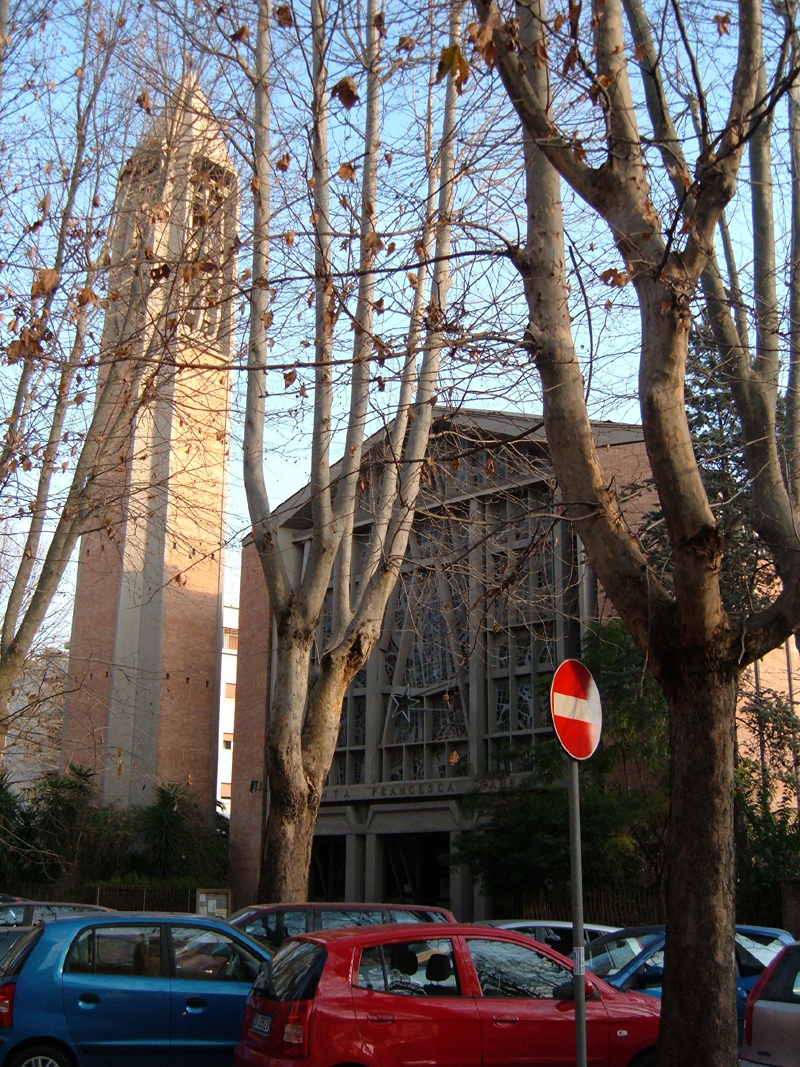
St. FRANCES XAVIER CABRINI

S. FRANCESCA CABRINI
1958 Enrico Lenti (1909/c. 1981) and Mario Muratori
“The dosage of the openings is in function of the internal environment so to introduce enough grazing light from above creating an effective vibrating chiaroscuro on the ceiling beams. The same light is instead filtered downwards through the inner walls completely perforated in order to have a particular formal expressiveness not detached from the secondary, but not negligible, task to adjust the acoustics. (...) Among the churches of this time, built without too much abundance of means and without undue pretensions of grandeur, this seems one of the most remarkable and significant, for an obvious architectural and spiritual unity that distinguishes it” (Carlo Ceschi)
St. Frances Xavier Cabrini (1850/1917) came to America at age forty, she took American citizenship in 1909 and was canonized in 1946
She was the first in chronological order of the seven U.S. saints, the first woman missionary and the patron saint of emigrants

St. PHILIP NERI

S. FILIPPO NERI
First half of the seventeenth century
Commonly known as S. FILIPPINO
Completely renovated in 1728 maybe by Filippo Raguzzini (1680/1771) for Benedict XIII Orsini (1724/30)

FAÇADE
1767/68 by the Roman Giovanni Francesco Fiori (1709/84)
Restoration in 1853 after a disastrous flood of the River Tiber
Left abandoned and in ruin since 1940
The door is now walled to prevent homeless people to use the building as a temporary home as they used to do in the past

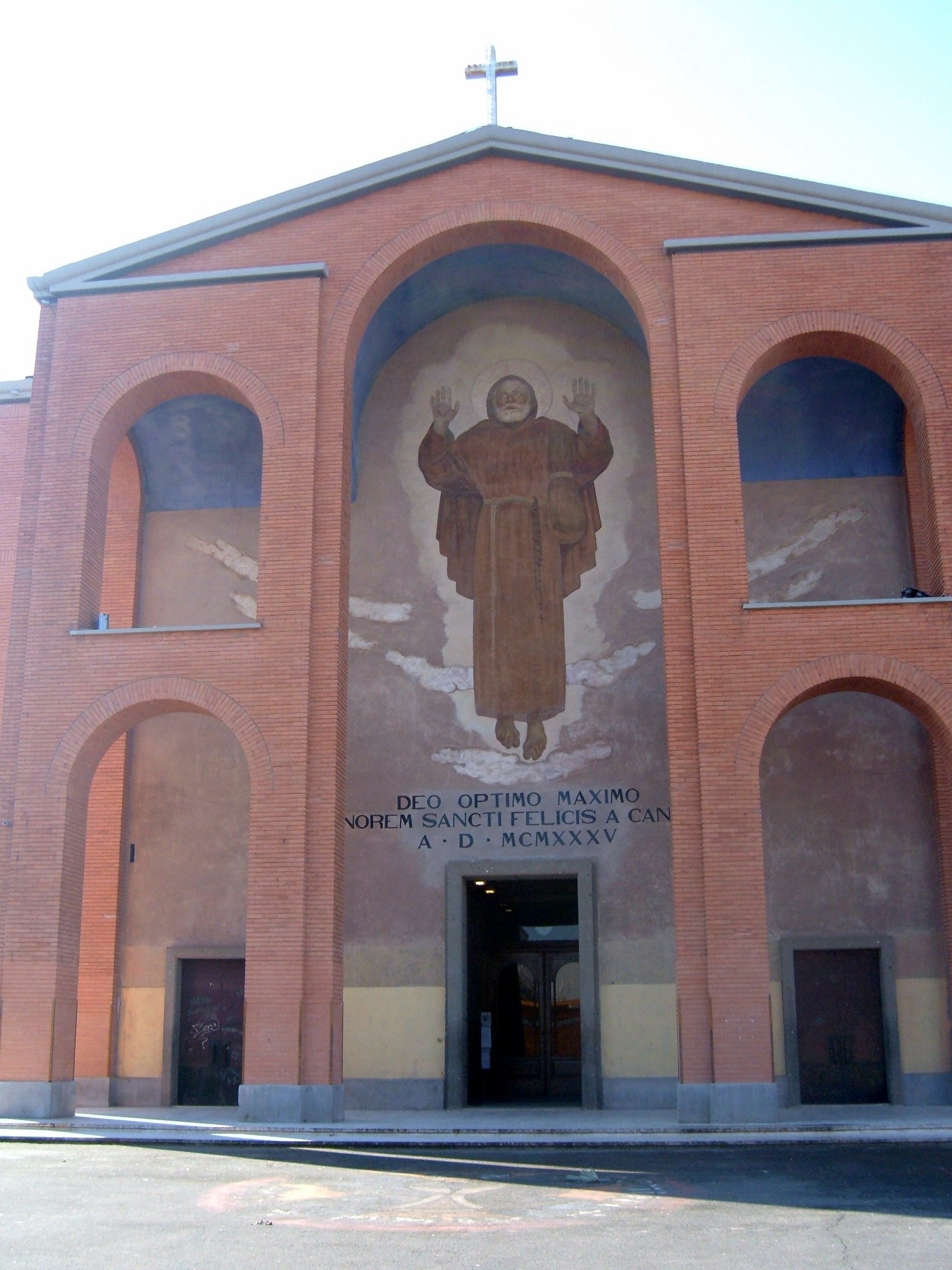
St. FELIX OF CANTALICE

S. FELICE DA CANTALICE
1935 Mario Paniconi (1904/73) and Giulio Pediconi (1906/99)
St. Felix of Cantalice (about 1515/87) was a Capuchin friar who lived for forty years in Rome on alms and prayer, wandering around with a bag on his back
He was buried in the church of St. Mary of the Immaculate Conception

IN THE FAÇADE
Painting “St. Felix of Cantalice” by Rodolfo Villani (1881/1941) nicknamed “Big Foot”
After the World Cup of 1982, which ended with the victory of the legendary Italian national team, the image was jokingly modified with the addition of a temporary football and boots

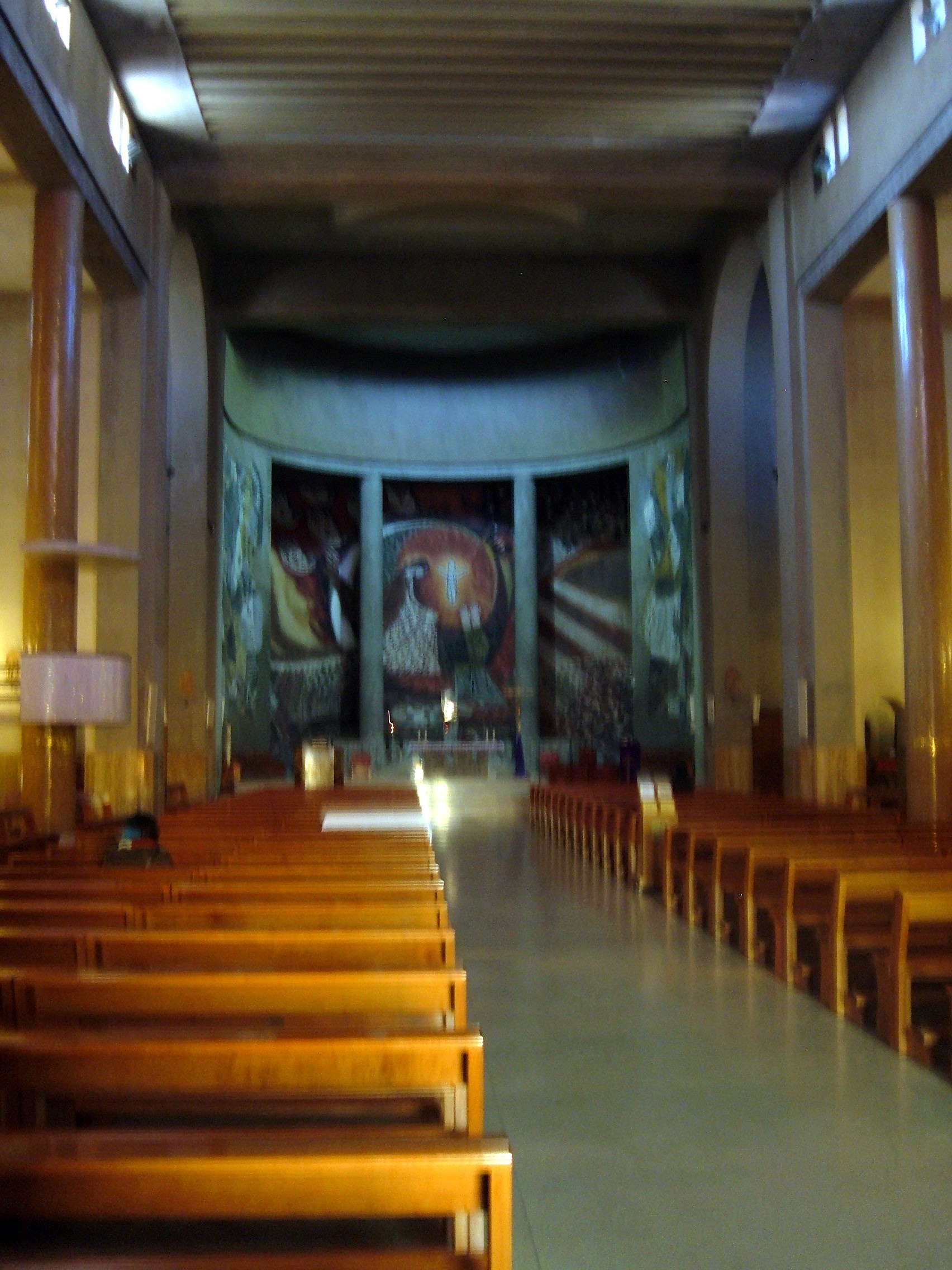
APSE
Huge fresco integrated with the technique of sgraffito “Madonna gives the Child to St. Felix” 1968/69 by Silvio Alessandri known as father Ugolino da Belluno (1919)
The surface is about 480 m² (5,200 square feet) and it was inaugurated on January 1, 1970 by Pope Paul VI Montini (1963/78) on the occasion of the World Day of Peace

Monday, January 14, 2019

St. EUSTACE

S. EUSTACHIO
Maybe founded by Constantine (306/337) on the site where St. Eustace was martyred and buried with his wife and two children, according to tradition, at the time of the reign of Hadrian (117/138)
This is impossible of course, because during the reign of Hadrian there was, according to historical sources, no persecution. Moreover, according to pagan sources such as the Historia Augusta, Hadrian, shortly before his death, had decided to recognize Christianity and was ready to dedicate temples without statues to Christ
St. Eustace, according to tradition, was a Roman army officer named Placido who had a vision of the crucifix between the antlers of a deer as he was hunting
Mentioned as a diaconia at the time of Gregory II (715/731)
A diaconia was an establishment for the care of the poor and distribution of the church's charity in the Middle Ages
Restored and re-consecrated in 1196 by Celestine III Orsini (1191/98), who also built the bell tower reusing the base dating back to about 1090
Complete reconstruction begun in the years 1701/03 by Cesare Crovara (active from 1682/d. 1703) from a design of 1692 by G.B. Contini (1641/1723)
1703/08 further works directed by G.B. Contini after the death of Crovara. He designed the chapels and the porch
1724/27 completion of work with transept and apse by Antonio Canevari (1681/1759), by Nicola Salvi (1697/1751) and, in the years 1728/30, by Giovanni Domenico Navone (known from 1706/d. 1770), thanks to a legacy of Pope Innocent XIII Conti (1721/24)
The construction of the church therefore lasted about 29 years
Restoration in 1861, in the years 1930/40 and 1992

FAÇADE
1701/03 by Cesare Crovara
It was restored in 1992 with the original so-called “color of the air”, a beautiful celestial hue
Above the pediment sculpture “Deer Head” by Paolo Morelli (known from 1712/d. 1719)
The head was not considered similar to that of a deer by most people, so much that there was a lampoon who claimed to not understand why one would confuse deers with donkeys

TO THE LEFT OF THE ENTRANCE
“Funerary monument of Giovanni Giraud” 1843 by Giuseppe Barba
“The interior is a splendid set of architectural structures, figurative elements and ornamental solutions of the more mature Baroque style. Visitor is immediately inserted into a space 'animated' by the intertwining of real or illusory lines and a pleasant harmony of colors and gilding, on which the light is diffused in a game of refractions and references. It seems clear, in this way, as the decoration is not an extrinsic and distracting component, but contributes fully to organize a perfect environment balanced between exuberant magnificence and measured sobriety” (Vincenzo Francia)

COUNTER FAÇADE
Spectacular “Organ” 1764 by Johannes Conradus Werle (1701/77)
Stained glass window with “Penitent Magdalene” of the end of the nineteenth century by Gabriel and Louis Gesta from Toulouse

1st RIGHT - CHAPEL OF THE HOLY FAMILY
Above the altar “Holy Family in the Temple of Jerusalem” about 1854 by Pietro Gagliardi (1809/90)
On the right “Funerary monument of Luigi Greppi” 1673
In the two ovals on the sides there were two paintings unfortunately stolen not long ago

2nd RIGHT – ANNUNCIATION CHAPEL
Designed by Ferdinando Fuga (1699/1782)
On the altar “Annunciation” about 1620 by Ottavio Lioni (1578/1630)

3rd RIGHT - CHAPEL OF THE SACRED HEART OF JESUS
Above the altar “Sacred Heart of Jesus”, on the right “Christ on the Cross and St. Longinus”, on the left “Supper at Emmaus” and other decorations 1934/37 by Corrado Mezzana (1890/1952)
“In his artistic production (...) it is apparent a crystallization of formulas of classical academic style, especially in the works with sacred subjects (...), while in the stamps' designs, to which he devoted himself assiduously since the thirties, Mezzana was able to synthesize the compositional complexity of the details and the expressive immediacy of allegory” (Rosanna Ruscio - Biographical Dictionary of Italian Treccani)

RIGHT TRANSEPT
“St. Jerome penitent” 1725 by Giacomo Zoboli (1681/1767) from Modena
Under the canvas fine “Confessional in wood” by Corrado Mezzana

1739 by Nicola Salvi (1697/1751) for Cardinal Neri Corsini
On the altar “Martyrdom of St. Eustace” 1725 by Francesco Fernandi aka Imperiali (1679/1740)
The nickname comes from the fact that the artist was protected by Cardinal Giuseppe Renato Imperiali
Under the altar “porphyry urn” which contains the bodies of St. Eustace, his wife Theopista and his son Agapito and his daughter Theopista

CANOPY
1746 Ferdinando Fuga
He devised a remarkable and innovative suspended canopy so not to burden the space

APSE
In the upper part plaster relief “Triumph of the Cross” by Galileo Parisini (1872/1949)
In the niches at the sides plaster statues “Redeemer” and “Immaculate” 1900 by Augusto Foli
“An interesting and original architectural solution can be admired in the transept: the edges are beveled so as to evolve the layout of the church toward an elliptical plan. The elliptical impression is accentuated by the shallow depth of the apse. Elegant balconies accompany, with a smooth convex line, the concavity of the rounded corners” (Vincenzo Francia)

VAULT OF THE TRANSEPT
Fresco with fake dome of 1930

LEFT TRANSEPT
“Meeting of the Virgin and St. Elizabeth” 1725 by Giacomo Zoboli
Under the canvas fine “Confessional in wood” by Corrado Mezzana

PULPIT
Decorated in polychrome marble. Built in memory of the preaching here of Bishop Giacomo Della Chiesa who later became Pope Benedict XV (1914/22)

3rd RIGHT - CHAPEL OF THE IMMACULATE HEART OF MARY
1771 Melchiorre Passalacqua, son of Pietro Passalacqua, and Agostino Penna (active since 1768/d. 1800)
On the altar ovate painting “Immaculate Heart of Mary” of the Venetian G.B. Casanova (1730/95) copy from an original donated to the church by Charles Emmanuel IV of Savoy
On the right “Holy Family” 1774 by Tommaso Maria Conca (1734/1822) who was a pupil of his uncle, the great Sebastiano Conca
On the left “Flight into Egypt” 1774 maybe by Étienne de La Vallée Poussin (1735/1802) or Michele Paolini

2nd LEFT - CHAPEL OF St. MICHAEL THE ARCHANGEL
1714/19 Giuseppe Sardi (1680/1753) designed by Alessandro Sperone
Above the altar “St. Michael the Archangel” 1817 copy by Giovanni Bigatti (1774/1817) from the world famous original by Guido Reni in St. Mary of the Immaculate Conception
To the left “Funeral Monument of Teresa Tognoli Samonati Canale” d. 1807
To the right “Funeral Monument of Silvio Cavalleri” d. 1717 Alessandro Sperone with sculptures by Lorenzo Ottoni(1648/1736)

1st LEFT - CHAPEL OF St. JULIAN HOSPITALLER
Above the altar “S. Julian” in 1706 by Biagio Puccini (1673/1721)

St. EUSEBIUS

S. EUSEBIO
The original church dates back to the fifth century, one of the oldest churches in Rome
It was built, according to tradition, on the Titulus Eusebii, the house of S. Eusebius (about 319/about 357), one of the 43 saints with this name recognized by the Catholic Church
Rebuilt in 1238 for Gregory IX dei Conti di Segni (1227/41)
It was rebuilt again in 1600 by Onorio Longhi (1568/1619)
Restored in the years 1750/59 by Nicolò Picconi

FAÇADE
1711 Carlo Stefano Fontana (active 1700/about 1719) son of Carlo Fontana (1634/1714) and brother of Francesco Fontana

BELL TOWER of the time of Honorius III Savelli (1216/27)
Every 17 January for the feast of St. Anthony of Egypt the blessing of the animals takes place in the churchyard, moved here in the twentieth century from the churchyard of the neighboring church of St. Anthony of Egypt for reasons of public order

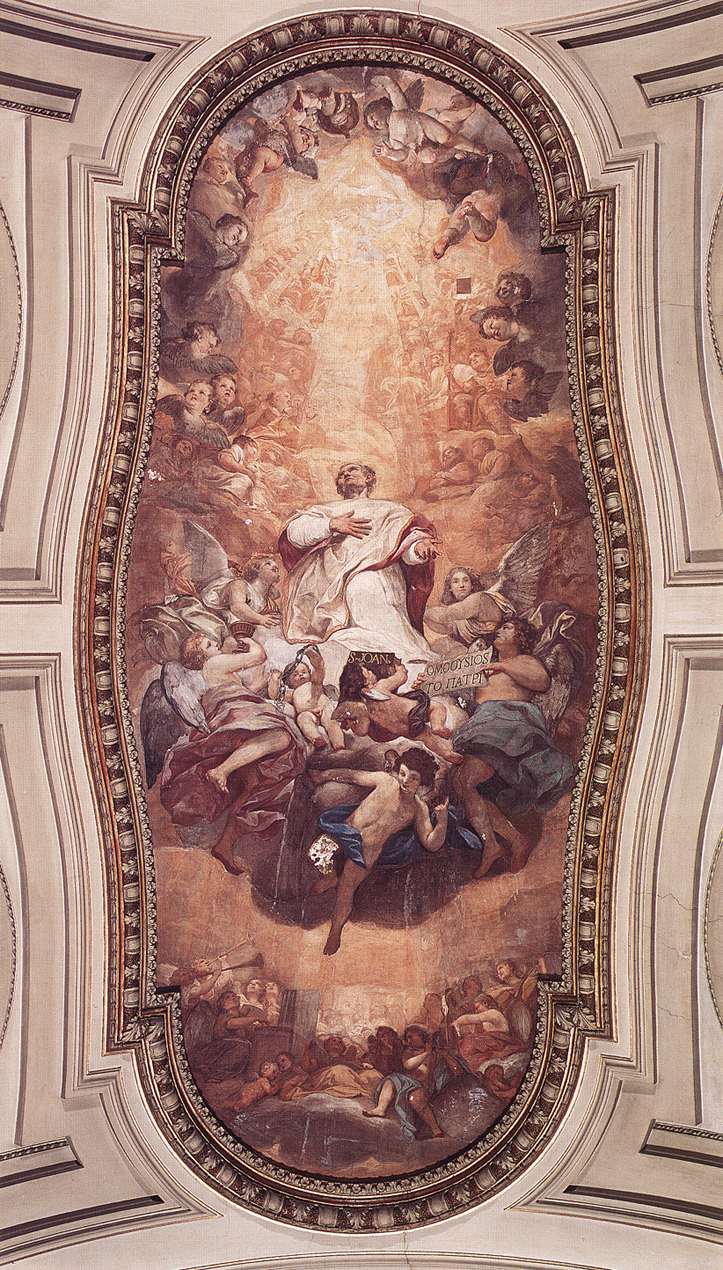
VAULT
“Glory of St Eusebius” 1757 by Anton Raphael Mengs (1728/79)
It is one of the first examples of a painting in neoclassical style
The face of one of the angels represented by Mengs is the portrait of the woman he loved

NAVE
Paintings between the windows by Giuseppe Passeri (1654/1714) pupil of Carlo Maratta

SIDE NAVES
End of 1800s/beginning of 1900s

MAIN ALTAR
Designed by Onorio Longhi
On the altar “Madonna and Child” maybe by Pompeo Batoni (1708/87)

CHANCEL
Stalls and music stand of walnut carved with grotesque figures in the seventeenth century
To the right “Madonna and Saints” by Baldassare Croce (about 1553/1628)

CLOISTER
1588 Domenico Fontana (1543/1607)
It is built with bricks and it features a central fountain
The MONASTERY, to which the cloister belongs, is the seat of the Central Directorate of Health of the State Police
It was the place where one of the first printers in Rome ever operated: it was run in the years 1470/71 by the German Georg Lauer

St. EUGENIUS

S. EUGENIO
1943/50 Enrico Pietro Galeazzi (1896/1986) and Mario Redini (1911/80)
It was built to celebrate the 25th anniversary of the episcopal consecration of Pius XII Pacelli (1939/58), whose baptismal name was Eugenio
It is one of the largest churches in Rome, with an area for the faithful of about 1,400 m² (15,000 square feet)
It is theoretically possible to accommodate in it about 4,000 people

FAÇADE
Sculptural reliefs “Figures of angels” in the center and “Allegory of Justice and Peace” at the sides by Alessandro Monteleone (1897/1967)
Sculptural reliefs “Four Evangelists” in the upper part by Francesco Nagni (1897/1977)
It is the Church of the Opus Dei controversial and powerful organization of the Catholic Church founded by the Spaniard S. Josemaria Escrivà (1902/75) who was canonized in 2002 by John Paul II (1978/2005)
The tomb of St. Josemaria Escrivà is in the nearby big church of S. MARIA DELLA PACE (Our Lady of Peace) incorporated in the building of the Opus Dei in Viale Bruno Buozzi 75
“Certainly the architects of St. Eugene were also positively influenced by the character of the place chosen for the new church, located between very special sights: the Vineyard of Pope Julius III, the little house by Pirro Ligorio with the fountain by Ammannati and the architecture of Vignola; everything would in fact inevitably and quite naturally lead them to the design of a work made of elements manifesting a certain solidity and a clear definition of forms: in a nutshell, to a kind of architecture being classic but also modern at the same time” (Website of the Parish of St. Eugene - www.parrocchiasanteugenio.it)
“Stations of the Cross” in bronze by Attilio Torresini (1884/1961) (stations 1-4), Alfredo Biagini (1886/1952) (5-7), Antonio Berti (1904/90) (8-10) and Giacomo Manzù (1908/91) (11 - 14)

1st CHAPEL ON THE RIGHT
Bronze “St. Frances Xavier Cabrini and an Angel” by Pericle Fazzini (1913/87)
“The dynamic group of the saint and of the angel crowning her is very compact in a composition 'arrow'-shaped and it is made lighter by the insistent pictorial style with which the assiduous folds of the garments are modeled” (Website of the Parish of St. Eugenio - www.parrocchiasanteugenio.it)

2nd CHAPEL ON THE RIGHT
Altar made out of red marble from the Timava River in Slovenia
Gilded bronze statue “St. Francis of Assisi back from heaven to earth” by Domenico Rambelli (1886/1972)
“Summoner, glorifier and transformer of life, his statues and bas-reliefs have a strong tone of stylistic abstraction which can only be seen in Romanesque or Egyptian sculptures” (Carlo Carrà)

3rd CHAPEL ON THE RIGHT
Altarpiece “St. Agnes and her stories” by Venanzo Crocetti (1913/2003)
“His graceful feminine images, earthly creatures caught in attitudes that make them protagonists of stories set in the immediacy of their becoming - the tying of a shoe, the drying after bathing, the combing and the undressing, but also the resting after the dance or the contemplation of the sea - are presented in rhythms of a mobile and musical geometry from which derive a wide variety of compositional inventions” (Website www.scultura-italiana.com)

RIGHT TRANSEPT
Mosaics in the upper part “Sacred Heart of Jesus”, in the lower part “Works of Mercy” and in the altar frontal “Last Supper” by Bruno Saetti (1902/84)

MAIN ALTAR
Huge and spectacular bronze statue “St. Eugene I (654/657)” and in the altar frontal relief “Deposition” by Attilio Selva (1888/1970)

IN THE APSE AND UNDER THE ARCH
“Triumph of the Cross and symbols of the Passion” 1951 by Ferruccio Ferrazzi (1891/1978)
“An artist with such a fecund career should be the pivot of every book about the history of Italian art of the twentieth century. Why, then, is he not known to most people as well as his colleagues of his time, Mario Sironi, Massimo Campigli or Gino Severini? Or at least as his followers who would in fact derive prolific teaching from him (technical annotations are also relevant, consistent and intuitive experiments recorded in his diaries) as Renato Guttuso, Alberto Ziveri or Mario Mafai (from whom, however, it looks as if he himself drew inspiration)? Yet the brush is firm and distinctive, some ideas are extraordinarily original (especially in the tones, but also in the modernity of some nervous gestures) and represent the best painting of the '20s and '30s in Italy” (Cristiana Curti - www.artincontro.com)

CHAPEL TO THE LEFT OF THE MAIN ALTAR
Frescoes “Stories of St. Joseph” by Gisberto Ceracchini (1889/1982)
“A primitive language, with squared and often monumental volumes, rather rigid in the engraved signs of the sharp contours, smooth and brilliant in the shades of color, full of references to fifteenth century models and, still, with influences from Giotto and Masaccio; a rugged design, 'passionately expressive' - as described by Roberto Longhi (1929) - which embodies 'obsolete and anachronistic feelings' for their ingenuity and candor” (Susanna Zatti - Biographical Dictionary of Italian Treccani)

CHAPEL OF OUR LADY OF FATIMA
Designed by the Portuguese architect Luiz Benavente (1902/93) for the government of the Republic of Portugal
At the center “Statue of Virgin Mary” by Leopoldo de Almeida (1898/1975)
Around paintings with, in the upper part, “Portuguese saints Antonio, Nuno Alvares Pereira, Queen Elizabeth and John of God”, in the lower part “Madonna with angels and people in the act of worship, after the vision” by Martins Barada

3rd CHAPEL ON THE LEFT
Statue “St. Philip Neri” 1951 and bronze candlesticks by Francesco Messina (1900/95)

2nd CHAPEL ON THE LEFT
Relief “St. Catherine of Siena in ecstasy” by Enrico Castelli (1890/?)
Frescoes “Stories of St. Catherine” by Giorgio Quaroni (1907/60)

1st CHAPEL ON THE LEFT
Statue “St. Nikolaus of Flue” by Corrado Vigni (1888/?)
S. Nicholas of Flue (1417/87) was a Swiss politician and a judge who lived for twenty years in meditation. He was canonized in 1947 by Pius XII Pacelli (1939/58) who also proclaimed him the patron saint of Switzerland

CLOISTER WITH BAPTISTERY IN THE CENTER
Outside of the baptistery there is a mosaic “Proclamation of the Dogma of the Assumption” by the Bavarian Josef Oberberger (1905/94)
Bronze group “Baptism of Jesus with angels” by Giovanni Prini (1877/1958) and ancient Roman mosaic floor with “Dove”
On the walls of the baptistery frescoes “Stories of the Old Testament alluding to baptism” by Giovanni Brancaccio (1903/75)

St. EMERENTIANA

S. EMERENZIANA
1942 Tullio Rossi (1903/97) with the architect Federico Fornari for Pius XII Pacelli (1939/58)
COUNTER FAÇADE
Triptych “St. Emerentiana in glory” 1944 by Olga Biancitti

APSE
Impressive mosaic “Triumph of the Church in the World” 1968 by the Capuchin Father Silvio Alessandri aka Ugolino da Belluno (1919/2002)
The mosaic covers an area of 523 m² (5,630 square feet) more than twice that of the Last Judgment by Michelangelo in the Sistine Chapel (about 200 m²)
About 12 tons of material (13.2 tons) were used for the mosaic
Among the characters represented in the adoring crowd there are also Bobby Kennedy and Martin Luther King both in the left group
“The immense Cross serving as a backdrop for the whole composition, through the multidimensional plans, stands for the cosmic mystery of redemption. Even inanimate nature, fallen under the curse of sin, has participated of the fruits of the Passion and Death of Christ (animals and the stars, arranged with abstract rhythm, around the clypeus surrounding the cross at the top, effectively represent the totality of the non-human world). The fruits of redemption, Grace and Truth are poured out like Pentecostal Fire across humanity that received the word of Christ through the Holy Scriptures symbolized by the four Evangelists at the foot of the Risen Christ. God's people, made up of persons of every race and condition, is cemented by the grace of baptism in a profound unity, and this is all arranged on the same level. But in the Church there is a variety of grades and functions. Hierarchy has, according to the will of Jesus, the task of leading the people of God and of authentically interpreting the revealed word: it is therefore at the center, as the hub of the visible unity of the Church, and closes the vertical line going from the Father and the Holy Spirit through the Word made flesh, testified to us by the four Evangelists” (Don Eutizio Fanano - Web Site of Santa Emerenziana - www.santaemerenziana.org )