TEMPIO DI SERAPIDE
Piazza del Quirinale
Built by Caracalla (211/217)
It was the
largest temple of ancient Rome and perhaps in the world together with the Temple of Venus and Rome, of
similar size:
135 x 98 m
(443 x 322 feet) with an area of 13,230 m² (3.25 acres)
The columns
had a diameter of nearly 2 m (6.5 feet) and were 21.17 m (70 feet) high
Serapis was
a Greek-Egyptian god, whose cult was introduced in Alexandria by Ptolemy I, who
built there the Serapeum
There are
conflicting theories about the origins of the deity: the most reliable are the
Sinopitic-Babylonian origin (Sinope is in northern Turkey) and the Memphis
origin connected with Osiris-Apis
For the
syncretistic phenomenon typical of the Hellenistic age, it was identified with
various Greek gods, especially Zeus
In the
nearby Villa Colonna there is the largest architectural element existing in
Rome of 34 sqm (366 square feet) and weighing 100 tons (110 tons)
Important
statues found in the nearby Baths
of Constantine were probably part of the decoration of the
temple:
“Two
Dioscuri” now in Piazza del Quirinale
Two colossal river gods “Tiber”,
originally the Tigris River, later transformed with the addition of the twins,
and “Nile”, both now in Piazza del Campidoglio
TEMPIO DI SEMO SANCUS DIUS
FIDIUS
Via
XXIV Maggio
Maybe
originally founded by Titus Tatius the Sabine king who, according to tradition,
shared power with Romulus
Semo Sancus
was a deity of Sabine origin
The temple
area corresponds to the current area of the church of S. Silvestro al Quirinale
The temple
building was probably begun by Tarquinius Superbus and inaugurated in the year
466 BC
Inside
there was a bronze statue of Tanaquil, wife of Tarquinio Prisco, and the Foedus Gabinus, a treaty signed with Gabii, one of the oldest examples of treaties
of alliance of Roman history, written on a shield made out of cowhide
“His
sanctuary stood on the Quirinal Hill, and it gave the name to the Sanqualis
Gate. Another shrine was on the Tiberina Island. This temple, generally
attributed to the Tarquin kings (Varro, De Ling. Lat., V, 52 and 66), was
dedicated in 466 by the consul Spurious Posthumus Regillense, according to the
Venosino Calendar. Dius Fidius can be linked for some of his attributes to
Hercules and Jupiter. Like Hercules he was worshiped ‘propter viam’, and in
Rome people used to swear ‘Mehercle’ and ‘Me and Dius Fidius’ (Prop., Iv, 9, 71
ff .; Tertull., De idol., 20). Jupiter is also called Dius Fidius, Ζεὺς πίστιος
(Dion Hal., Ant. Rom., iv, 58, 4; ix, 60, 8), so we can consider Semo Sancus, a
‘Genus Iovis’, a demigod protector of marital fidelity and of the law of
nations. On the other hand it was also a rural divinity, protector of the
fields and crops” (Susanna Meschini - Enciclopedia dell’Arte Antica Treccani)
TEMPIO DI PORTUNUS
Piazza
Bocca della Verità
Built in
the fourth or third century BC
Rebuilt in
the second half of the second century BC with renovations in the first century
BC
Mistakenly
believed to be the Tempio della Fortuna
Virile (Temple of Manly Fortune)
It is a
temple pseudoperipteral, ionic and tetrastyle
Travertine
columns, half-columns and wall of the cella in tuff of the Aniene River with bases
and capitals in travertine
It was
originally completely covered with stucco
It became a
church in the year 872 with the name of S. Maria Egiziaca (St. Mary of Egypt), the patron saint
of prostitutes, and it was granted to the Armenians
It was
commonly called S. Maria ad Gradellis
(S. Mary at the Steps) for the staircase that used to connect this area with
the River Tiber
It was
deconsecrated in 1924 and the copy of the Chapel of the Holy Sepulchre of
Jerusalem, which was kept in it, was moved to St.
Nicholas of Tolentino
MAIN ALTAR
“St.
Mary of Egypt” by Federico Zuccari (about
1542/1609)
TEMPIO DI “MINERVA MEDICA”
Via
Giovanni Giolitti 409
Built in
the fourth century AD
Grandiose
structure maybe formerly part of the HORTI LICINIANI (Gardens of Licinius) of
the emperor Licinius Gallienus (253/268) according to Filippo Coarelli
According
to Federico Guidobaldi it was rebuilt for Constantine (306/337) with bricks
marked with dates of the time of Maxentius (306/312) and used for the private
sector of Costantine’s PALATIUM SESSORIANUM, the large urban residence of Constantine and his family
Unusual
plan with ten sides and a diameter of 25 m (82 feet)
The
polygonal-shaped DOME gradually assumes an hemispheric aspect
Is often
mistakenly considered a nympheum or a fountain
Among the
statues found here:
A “Minerva
with serpent” called “Athena Giustiniani”
now in the Vatican Museums that gave the arbitrary name to the building
“Two
judges in place to launch a small sack to start the races in the circus”, “Statue
of dancing satyr” and “Statue of Dionysus with a panther” now on display at the
Centrale Montemartini, together
with the mosaic “Hunting Scenes” found in the vicinity and in part still
incredibly buried under rail tracks
TEMPIO DI MATIDIA
Vicolo
della Spada d'Orlando
Built on
the year 119 AD for Hadrian (117/138) who had it built in honor of his
mother-in-law Matidia (mother of his wife Sabina) who had died during that same
year
There are
remains visible in Vicolo della Spada d'Orlando: a column of cipollino marble
that had to be high not less than 17 m (56 feet) and a brick wall
The site of
the temple corresponds to the current Piazza Capranica
It was
placed between two buildings similar to porticos probably the BASILICA OF
MATIDIA on the site of the present church of St.
Mary in Aquiro and the BASILICA MARCIANA (mother of Matidia) on
the area of the buildings along Via dei Pastini
TEMPIO DI MARTE
Via degli Specchi/Piazza S.
Salvatore in Campo
135 BC
maybe Hermodoros of Salamis (active in Rome in
the II century BC) for Brutus Callaicus
Nothing is
left to be seen of this temple
It was
located at the west end of the Circus
Flaminius corresponding precisely to the block between Via degli
Specchi, the Via and the Piazza di San Salvatore in Campo to left the Palazzo
del Monte di Pietà
It was a
peripteral temple made out of Pentelic marble on a crepidoma with no podium and
therefore in purely Greek style
The
church of S. SALVATORE IN CAMPO was built
on the exact area of the temple
TEMPIO DI IUNONIS MONETAE
Via di S. Pietro in Carcere
On the prominence
of the Capitol Hill known as Arx
The
festival of Iuno Moneta, Juno Warner,
was celebrated here every June 1st
It was the
anniversary of the dedication
(dedication) of the temple made by the son of Camillus in the year 343 BC
Nearby,
between the late fourth and early third century BC, was built the mint of Rome,
later moved by Domitian in the area of the church
of St. Clement
From the
name of the goddess came the Italian word moneta
(money in English): it dates from the time of the siege of the Gauls of Brennus
in the year 396 BC, when the sacred geese of the Temple of Juno, the famous
geese of the Capitol, with their squawking woke former consul Manlius who gave
the alarm
In the area
of the Garden of the Aracoeli there were other facilities:
AUGURACULUM
Used for ritual
observations to foresee the future
CAPITOLINE
ISEUM
Dating back
at least to the year 58 BC, when it was mentioned for the first time by the
sources
To the
temple maybe belonged the Obelisk
of Villa Celimontana built for Ramses II (1297/1213 BC) around 1200
BC
There
were also the TEMPLE OF CAELESTIS and the TEMPLE OF MITHRAS
TEMPIO DI ISIDE
Via di S. Stefano del Cacco 26
Maybe built
at the behest of the members of the second triumvirate in the year 43 BC
It was
known as Iseum Campensis and it was
the most important sanctuary of the Egyptian religion in Rome
The site of
the temple corresponds to the present church of S.
Stefano del Cacco (St. Stephen of Cacco)
It was
hardly tolerated by Augustus and Tiberius, and it was rebuilt by Caligula,
Domitian and Alexander Severus
Grand
entrance from the north in the current Via del Seminario and two side entrances
closer to the temple. The east side entrance was the so-called ARCO DI
CAMIGLIANO (Arch of Camigliano) the left pilaster of which is still visible
“The
historian Dio Cassius says that in 53 BC the Senate ordered the demolition of
all the private temples, within the walls, not only dedicated to Isis, but also
to Serapis, other male deity imported from Egyptian, corresponding to the
Hellenized form of the god Osiris, brother and husband of Isis. The
construction of the Iseum Campensis took place significantly in 43 BC, ten
years after the senatorial ban, if another testimony of Dio Cassius is properly
interpreted, and the patrons are the protagonists of the second triumvirate, who
most likely continued the building program begun by Julius Caesar in the Campus
Martius. After a few years after its construction, the Temple of Isis was, on
and off, at the center of repressions and temporary suspensions, from Agrippa
in 21 BC, to the more incisive one of Tiberius, who even had the priests
executed. After the reintroduction of the cult by Caligula, and the complete
reconstruction of Domitian after the fire of 80 AD, the Iseum Campensis and the
worship of the goddess Isis continued until the end of the imperial period”
(Paolo Vigliarolo - ArcheoCommons)
The
structure was decorated with five small obelisks of about 6 m (20 feet) in
height:
1) Piazza della Rotonda from
Heliopolis by Ramses II (1297/1213 BC) about 1250 BC
2) War Memorial of Dogali from
Heliopolis by Ramses II about 1250 BC
3) Piazza
della Minerva by Apries about 500 BC
4)
Florence, Boboli Gardens from Heliopolis by Ramses II about 1250 BC
5) Urbino,
Palazzo Ducale by Apries by 500 BC
There was
also a higher one, perhaps the Agonal
Obelisk later moved to the Circus of Maxentius and later on again
to Piazza Navona, with the name of Domitian in hieroglyphics
Filippo
Coarelli and Jean-Claude Grenier deem it however coming originally from the TEMPLUM
GENTIS FLAVIAE that was erected in Via Vittorio Emanuele Orlando where now the Hall Octagonal or Hall of Minerva
is, the former Planetarium
Maybe it
was another obelisk whose pieces of pink granite were used for the thresholds
of the Collegio
Romano, Palazzo
Giustiniani and S. Andrea della Valle
Maybe it
corresponds to the square in the center of Via Pie' di Marmo on the Forma
Urbis marble map
MANY
STATUES were found in the area of the temple, including:
The two
statues of men representing rivers lying down: the “Nile” in the Vatican Museums and
the “Tiber” in the Louvre
Those that
make up the Egyptian Collection of the
Capitoline Museums found here in 1883
The “Pie' di
Marmo” placed in the street with the same name, Via del Pie’ di Marmo
The “Madama Lucretia” in Piazza Venezia
The “Dog-headed God Thoth” now the
Gregorian Egyptian Museum in the Vatican and mistakenly considered a macaque
monkey
TEMPIO DI HONOS E VIRTUS
Piazza di Porta Capena
Built in
the year 234 BC
The
location just outside Porta Capena is known, but no trace of it remains
Augustus
(27 BC/AD 14) fixed to May 29, the date of the feast of Honos and Virtus
TEMPLE OF
HONOS
Built by
Quintus Fabius Maximus the Procrastinator (275/203 BC)
Honos was
the deified personification of Honor, maybe specifically Military Honor,
revered in Rome from the third century BC on
TEMPLE OF
VIRTUS
Added in
208 BC by Claudius Marcellus, the conqueror of Syracuse
Virtus was
the deified personification of Military Virtue and almost always appears with
Honos in literary and epigraphic sources
“All
the figurative monuments present Honos as male personification, almost always
as a kind of a young man covered with pallium on one shoulder and on the lower
part of the body, with naked chest, and bearing in one or both hands
attributes, including frequently a cornucopia and an olive branch. We cannot
exclude that these iconographic characters would be the main differentiation in
worship between Honos and Virtus, the latter being constantly represented with
military attributes (helmet) as a warrior god” (Giovanni Scichilone -
Enciclopedia dell’Arte Antica Treccani)
TEMPIO DI HERCULES VICTOR
Piazza
Bocca della Verità
About 120
BC maybe by Hermodoros of Salamis (active in
Rome during the second century BC) in Pentelic Greek marble for the merchant
Marcus Octavius Herennus, perhaps enriched with the olive oil business
This temple
is mistakenly believed to be the “Temple of Vesta”
On a block
of stone that was found here, probably the base of the statue of worship, there
is the name of the deity Hercules
Olivarius, and the name of the sculptor of the statue Skopas Minor, Greek sculptor who also worked in the
area of the Circus Flaminius
So the
temple was dedicated to Hercules
Olivarius and maybe not to Hercules
Victor
It was
restored under Tiberius (14/37), perhaps after the flood of the year 15 AD
On that
occasion nine columns and eleven capitals of marble from Luni were rebuilt
It is the
oldest marble building remained in Rome. The first to be built in marble was
the Temple of Jupiter Stator in the Porticus
of Octavia
It is a
peripteral round temple (Tholos) with
twenty columns (there is only one base and perhaps the missing column is the “Column of Phocas” of the Roman
Forum) on a stepped plinth (crepidoma)
with circular foundation of tuff from Grotta Oscura
It became a
church in 1132 as S. Stefano delle Carrozze (St. Stephen of the Coaches)
from the name of the nearby street Via delle Carrozze (Coahes Street) now
disappeared
In 1560 the
name was changed into S. Maria del Sole
(S. Mary of the Sun) maybe because of a legend (a woman of 115 years emanated
light after a picture of the Virgin Mary found in the Tiber River was taken in
her house), or maybe because of the proximity of the Mithraeum of the Circus Maximus with the god Mithra
represented as the Sun
The
structures and the walls of the church were dismantled during the years 1809/14
by Giuseppe Valadier (1762/1839)
Last
renovation in 1996
Frescoes
with “Scenes of the Virgin Mary and Saints” 1475 by Pope Sixtus IV della Rovere
(1471/84) who wanted to place a commemorative plaque on the floor
TEMPIO DI HERCULES CUBANS
Via
Portuense/Via Ettore Rolli
About first
century BC
It was
discovered in 1889
Here
were found the “Eight herms of charioteers”
now at the National Roman Museum of Palazzo Massimo
TEMPIO DI BELLONA
Via
del Teatro Marcello
296 BC for
the censor Appius Claudius Cieco (the Blind) (350/271 BC) after whom were named
the Aqua Appia and the Appian Way
In front of
the temple was to be the Columna Bellica,
used in the ceremonies of the declarations of war
According
to the traditional rite, dating back to the ancient times of Roman history, war
should be declared hurling a spear from Roman territory to enemy territory
At the time
of the war against Pyrrhus, king of Epirus, (280/275 BC) since the two states
were not bordering, the rite seemed impossible to be executed
To solve
the issue a prisoner of war was forced to buy a small piece of land in this
area, where a column was erected, perhaps made of wood, which could
symbolically represent the enemy territory: the ceremony could therefore take
place hurling the spear against the column
Later
on the ritual continued to be repeated with these new methods and the last
recorded time it took place was on the year 179 AD under Marcus Aurelius. The
ritual was therefore repeated for at least 460 years!
TEMPIO DI APOLLO SOSIANO
Via
del Teatro Marcello
Since the
year 449 BC there was an altar dedicated to Apollinar
After a
plague the temple was built in 431 BC for Apollo
Medicus
Restorations
in the years 353 and 179 BC
It was
rebuilt in full on the year 34 BC by Gaius Sosio after whom the temple was
named
Current
podium 21.32 x 40 m (67 x 131 feet)
Three columns remain, 14 m (46 feet) high.
Originally there were six on the front and three on the sides
Here took
place often meetings of the Senate as in the nearby Temple of Bellona
The cella
was a museum with paintings and statues
Parts of
the original Greek statues of the pediment and other interior elements are now
in the museum of the Centrale Montemartini
TEMPIO DELLA SALUS
Via del Quirinale
306/303 BC,
built by Caio Iunius Bubulcus, consul on the year 311 BC, on the area of the
current Quirinal Palace, after his victories in the II Samnite War (326/304 BC)
Nothing is
left to be seen
There were
paintings by Fabio Pittore maybe with scenes of war
The
temple gave its name to the nearby PORTA SALUTARIS of the Servian Walls
TEMPIO DEL SOLE
Piazza S. Silvestro/Via del Corso
Built for
Aurelian (270/275) between the current Piazza S. Silvestro and Via del Corso
Nothing is
left to be seen
Nearby there were:
CASTRA
URBANA
Barracks
for about 1,500 soldiers with the job of keeping public order under the command
of the Praefectus Urbi. Their number
was increased to about 2,000 at the end of the first century AD
FORUM
SUARIUM
Market
of pork meat
TEMPIO DEL DIVO CLAUDIO
Via Claudia/Piazza Ss. Giovanni e
Paolo
Begun in
the year 54 AD for Agrippina, wife of Claudius (41/54) immediately after the
death of the emperor
Partially
demolished and turned into a monumental nymphaeum by the son of Agrippina, Nero
(54/68), who included it in his Domus
Aurea
Vespasian
(69/79) had it rebuilt after the death of Nero
It stood on
a great rectangular platform of 180 x 200 m (590 x 660 feet) supported by retaining
walls, still partly visible
From the Forma Urbis we know that the
temple was prostyle hexastyle with three columns on the sides
The
rest of the area, maybe surrounded by a portico, was occupied by a garden
TEMPIO DEL “DIO REDICOLO”
Via
della Caffarella
Second
century AD, mausoleum shaped as a temple considered to be the tomb of Annia
Regilla wife of Herod Atticus (101/177)
Herodes
Atticus was a wealthy Athenian chosen by Antoninus Pius (138/161) as tutor to
his adopted children Marcus Aurelius and Lucius Verus and charged with the
killing of his wife Annia Regilla who had brought him a dowry of properties on
the Appian Way
After being
acquitted he gave himself to blatant manifestations of mourning
The name of
the building derives from the mistaken identification with the temple of the “Return”
the divinity that would have forced Hannibal to go back
TEMPIETTO DI S. ANDREA
Viale
delle Mura Aurelie 4
1848. Small
temple by Gaetano Morichini with statue of “St.
Andrew” by Carlo Aureli pupil of Antonio Canova for
Pius IX Mastai Ferretti (1846/78)
It was
built to commemorate the place where the relic of the head of St. Andrew was found. It had recently been stolen from St.
Peter's Basilica
The relic
of the head of St. Andrew was donated in 1966 by Pope Paul VI Montini (1963/78)
to the Greek city of Patras as a gesture of detente toward the Orthodox Church.
The relic of the rest of the body of St. Andrew is located in the Cathedral of
Amalfi
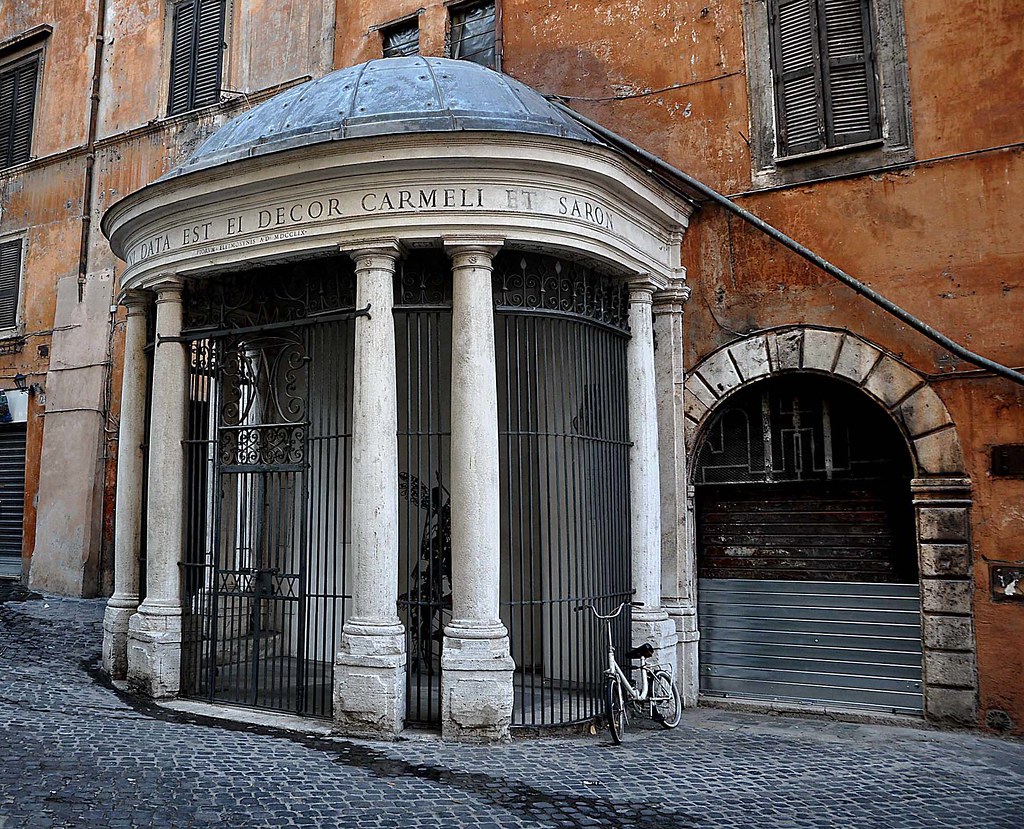
TEMPIETTO DEL CARMELO
Piazza Costaguti
Built in
1759 as a small church with the name of S. MARIA DEL CARMELO used for Christian
sermons forced on the Roman Jews who often would fill up their ears with wax so
not to hear
1825
restoration for the rich Fratellini family, grocers who lived near the Ghetto
“It is
inspired by the portico of S. Maria della Pace. It represents an evolution of
the monumental shrines that besides being an object of devotion, ensured the
night lighting because they were provided with lights that were kept always on.
The image of the Virgin Mary is, in this case, placed in a chapel that would
have the function of a church” (Alessandra Bartomioli)
It was a
member of the Order of Carmelites, the Englishman St. Simon Stock, to create
the feast of Our Lady, which was called del
Carmine (of Mount Carmel), the most common form of the term Carmel, the
mountain range of Palestine where monks following the example of the Prophet
Eli used to live
Tradition
has it that on the Carmel mountain range Our Lady appeared to St. Simon Stock
on July 16, 1251
“For years,
the agency Italia Nostra is fighting for its recovery, but every attempt of the
Superintendent was blocked by the impossibility to access the building. The
last occupant was a shoemaker, who was renting it from a mysterious owner. Before
he died, in the seventies, he left the keys to a un unknown person. Now the
temple has its rusty iron door tightly closed. There are two people who say
they are renting it from a mysterious owner who had emigrated to Israel. But
research conducted in Israel by the Superintendent to find him came to nothing.
In the solution of the mystery, is now engaged the architect Arianna Cajano, who
is about to begin a procedure called in legal jargon 'intervention in place', whereby
the restoration of the monument will proceed and then the costs will be charged
to the owner. If he will not turn up, the Temple will become public property”
(Lauretta Colonnelli - Corriere della Sera - 16 January 2001)
The
restoration was actually executed and the temple was entrusted to the Jewish
community in Rome
TEATRO VALLE
Via del Teatro Valle 21
1726/27 Tommaso Morelli (active first half of the eighteenth
century) for the Marquis Camillo Capranica and for Domenico Valle who, although
he was called Valle, did not give the name to the theater, which was named for
the place called “alla valle” (on the valley), the ancient STAGNUM AGRIPPAE on
which it was built
The
original building was made of wood
Restored
1820/22 by Giuseppe Valadier (1762/1839) with
the neoclassical FAÇADE and Giuseppe Camporese (1763/1822)
who was the project manager
A collapse
in the stage, however, made Valadier drop out of favor and he was replaced by Gaspare Salvi (1786/1849)
Here were
held premieres of operas by Gioachino Rossini Demetrio e Polibio and Cenerentola (Cinderella), as well as the
premieres of four operas by Gaetano Donizetti and various drama works by
Gabriele D'Annunzio as well as Six
Characters in Search of an Author by Luigi Pirandello
It is
the oldest of the Roman theaters still active
TEATRO TORDINONA
Lungotevere Tordinona - distrutto
1670 Carlo Fontana
(1634/1714) for Queen Christina of Sweden
It was
better known as TEATRO APOLLO (Apollo
Theater)
It was
demolished in 1888 to build the embankments of the Tiber River
It was the
first ever theater in Rome where women acted in 1798
Here were
held the world premiere of Giuseppe Verdi's operas Trovatore and Un ballo in
maschera
A commemorative plaque of
1925 by Cesare Bazzani (1873/1939) recalls these
events
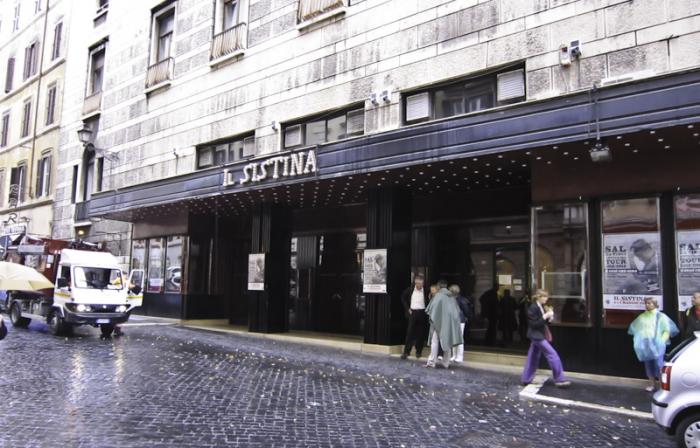
TEATRO SISTINA
Via Sistina 128/131
1948/49 Marcello Piacentini (1881/1960) on the area of the
destroyed church of S. Francesca Romana (St. Frances of Rome)
The
capacity is about 1,600 seats
The first
show was a musical comedy with the Italian comedia Totò
Among the
international artists who performed in this theater: Louis Armstrong, Burt
Bacharach, Liza Minnelli, Dionne Warwick and Woody Allen
Since 2003,
the Teatro Sistina has been recognized by the Ministry of Heritage and Culture
as Teatro Stabile (permanent Theater) for Italian Musical Comedy
“The
popularity of the Teatro Sistina arises mainly due to the never-ending
activities of Garinei and Giovannini who, in 46 years of management, have given
to the theater (not only Italian) masterpieces as Aggiungi un Posto a Tavola
(Add a Place at the Table), Rugantino, Il Giorno della Tartaruga (The Day of
the Turtle), shows performed in over 45 countries worldwide and translated into
16 languages” (Official website of the Teatro Sistina - www.ilsistina.it)
TEATRO SALA UMBERTO
Via della
Mercede 50
It opened
in 1882 in the ground floor of an existing building at the behest of the
architect Andrea Busiri Vici (1818/1911) who
commissioned the decoration of the interior to Alessandro
Bazzani
Expansion
in 1890 by Giulio Podesti (1857/1909). At the
time there were 650 seats
It was used
for operettas, plays or concerts
The use as
a theater for drama or music and as a theater for movies has alternated over
the years: in 1913 it was transformed into a cinema by Attilio
Spaccarelli (1890/1975)
In 1928 it
became a theater for drama again and took the name of SALA UMBERTO in honor of
King Umberto I (king of Italy 1878/1900)
From 1930
onwards it was again used as cinema until 1981 when the representations of
drama came back again after the restoration
In
1991 it became a cinema again and, since 2002, it has been a theater for auteur
comedy with a capacity of 485 seats
TEATRO ROSSINI
Via S. Chiara 14
1874 Virginio Vespignani (1808/82)
Here were
represented mainly shows in Roman dialect
It was
closed in 1886 and reopened in 1950 by the will of Checco Durante, poet and
actor who used to express himself in Roman dialect, and who directed the
theater
Since 1990
the direction passed to Alfiero Alfieri, another talented actor specialized in Roman
dialect
The
theater originally had 600 seats, now reduced to 200 and it was renamed TEATRO
ROSSINI - RENATO RASCEL in 2005
TEATRO QUIRINO VITTORIO GASSMAN
Via delle Vergini 7
Originally
built in 1871 almost entirely in wood
Designed by
Giulio De Angelis (1850/1906) for Prince Maffeo
Sciarra
It was the
first theater to be built in Rome after it became capital of Italy
1882/95
masonry structure also designed by Giulio De Angelis (1850/1906)
“Giulio De
Angelis acquired a position of absolute, unquestionable originality in the
architecture of the first decades of Rome, the new capital of Italy. He proved
himself to have an independent and peculiar temperament – and to have mastery
of the most advanced construction techniques, linked to the industrial
production of his time” (Giuseppe Miano - Dizionario Biografico degli Italiani
Treccani)
1889
rebuilding and expansion in Neo-Renaissance style by the architect Belloli and the engineer Moraldi
1915
renovation and expansion by Marcello Piacentini (1881/1960)
Restored in
1954 also by Marcello Piacentini and again in
1980 by Enrico Nespega
Here
were represented some world premieres of works by Luigi Pirandello, winner of
the Nobel prize for literature in 1934, and here the Italian comedian Ettore
Petrolini gave his farewell to the stage
TEATRO MARCELLO
Via del Teatro Marcello
Begun by
Julius Caesar and finished by Augustus (27 BC/14)
Probably
completed in 17 BC when it was used for the so called secular games, but the dedication took place only in 13 or in 11
BC, when it was named after Marcellus (42/23 BC), nephew and son-in-law of
Augustus who died at age 19
Marcellus
was the son of Augustus' sister, Octavia, and the husband of the daughter of
Augustus, Giulia
The theater
was built on the site where the provisional theater used to be erected in the
Republican period
In order to
build the theater two temples were destroyed, maybe the TEMPLE OF PIETAS and
the TEMPLE OF DIANA later reconstructed at the center of a large exedra behind
the stage
In 23 BC
Vespasian (69/79) restored the stage
Capacity of
about 15,000/20,000 spectators
Originally
the height was about 32.60 m (107 feet), the current height is about 20 m (65
feet)
Orsini Savelli Palace
Structure
built above the Theater of Marcellus since the Middle Ages for the Pierleoni
family, Jews converted to Christianity, one of whom became antipope with the
name of Anacleto II (1131/38) in opposition to Innocent II Papareschi
(1130/1143)
This
happened during the period of the turf war between the Pierleoni and the
Frangipane families, the most powerful ones in Rome at the time
The
presence here of the Pierleonis was perhaps the reason why many Jews were
forced to move from the Trastevere neighborhood to this area, which later
became the Jewish Ghetto
Current
building 1523/27 by Baldassare Peruzzi (1481/1536)
for the Savelli family. The line of the family ended in the eighteenth century
The
palace was sold to the Orsini family in 1716 and it was finally divided into
luxury apartments
TEATRO ELISEO
Via
Nazionale 183 a
1901 as
outdoor arena with the name of Apollo
Rebuilt
1906/10 masonry
“They were
very advanced technical solutions adopted and the coverage of the room is
probably the first built in Rome with reinforced concrete structures” (Piero
Ostilio Rossi)
Interior
completely renovated with rationalism in the years 1936/38 by Luigi Piccinato
(1899/1984)
The stage
was installed a rotating sector of 11 m (36 feet) in diameter, the first of its
kind in Italy
Modernization
in 1982 by Giancarlo Capolei with reduction to 956 seats
Between
the Teatro Eliseo and the Teatro Piccolo Eliseo there are EX-STORES ROVATTI
1901 with cast iron and reinforced concrete structures
TEATRO DI POMPEO
Largo di Torre Argentina/Campo de'
Fiori/Via del Sudario/Via di S. Anna
61/55 BC
for the consul Pompey
Restored in
the year 32 BC for Augustus (27 BC/14) who had the curia sealed and walled in
and moved the statue of Pompey behind the scene
Restored
again for Domitian (81/96), Diocletian (285/305) and Maximian (286/305)
associated with Diocletian
It was the
first theater in masonry in Rome
Diameter of
the auditorium 160 m (525 feet)
The
capacity was up to 17,580 spectators
The scene
had large statues of the Muses with Apollo, five of which still existing in the
Louvre, the National Museum of Naples and in the courtyard of Palazzo Borghese
At the
center there were two groves of sycomore trees bordered by lines of fountains
On top of
the auditorium there was the TEMPLE OF VENUS VICTRIX opened in 52 BC and
corresponding to the modern Palazzo
Pio Righetti
Behind the
scene there was the huge PORCH of about 180 x 135 m (590 x 443 feet)
On the side
of the porch opposite to the theater there was a great big rectangular exedra
known as CURIA OF POMPEY that was used as a Curia for Senate meetings. There
was a statue of Pompey
In the
Curia of Pompey Julius Caesar was killed on March 15, 44 BC
Traces of
the Curia are visible in the sacred
area of Largo Argentina
ARCH OF
GROTTAPINTA
In the Passetto
del Biscione, so named for the remains of paintings with columns, swags and
putti
S. MARIA IN GROTTAPINTA
Known
from 1291. Deconsecrated
TEATRO DI BALBO
Via delle Botteghe Oscure/Via
Paganica/Via dei Funari
13 BC for
Lucius Cornelius Balbus the Younger
The theater
was built with the proceeds of his triumph over the Garamantes (Africans) of
the year 19 BC
Lucius
Cornelius Balbus the Younger was the last one not of imperial family to
celebrate a triumph
The theater
was damaged by the fire of the year 80 AD
It is the
third and smallest theater in the Campus Martius
According
to the Regional Catalogues it contained
11,510 spectators
The
diameter is 90 m (295 feet)
In the
middle there was a temple, maybe the TEMPLE OF VOLCANO IN THE CAMPUS MARTIUS
The space
behind the stage was occupied by Balbi’s
Crypt
TEATRO DELL'OPERA
Piazza Beniamino Gigli 7
1878/80 Achille Sfondrini for Domenico Costanzi who was owner
of the land was the impresario until his death
Restored
radically in the years 1926/28 by Marcello Piacentini (1881/1960)
Further
restoration in the years 1957/60 with FAÇADE also by Marcello
Piacentini
Bronze
relief on the façade “Five Muse” by Luigi Scirocchi
Among the
world premiere of operas held in this theater: Cavalleria Rusticana by Pietro Mascagni and Tosca by Giacomo Puccini
FRESCO IN THE DOME by Annibale
Brugnoli (1843/1915)
The LAMP is considered the largest in the world with a
diameter of 6 m (20 feet), height of 3.5 m (11.5 feet), volume of 36 cubic
meters and weighing more than 3,000 pounds (473 stones)
It was made
in Murano and it is a masterpiece of glass art
It is
thoroughly cleaned every five years
TEATRO BRANCACCIO
Via Merulana 244
1913/16 Carlo Sacconi
The
original name was Teatro Morgana Morgana
Theater
It has a
capacity of 1,400 seats
It was
later used as a cinema, as variety hall and for concerts
Among the
artists who performed there, there were Louis Armstrong, Paul Anka and the
Italian comedian Totò
In 1968
here performed The Jimi Hendrix Experience, and in 1971 Jethro Tull
It was
again used as a theater since 1978
From 2001
to 2007 the art direction was entrusted to the actor Gigi Proietti with great
success
In
2011 here were performed the musicals Beauty and the Beast and Mamma Mia but
for lack of spectators the theater had to close