Friday, May 29, 2015

OBELISK OF THE MONUMENT TO THE 500 FALLEN IN DOGALI

OBELISCO DEL MONUMENTO AI 500 CADUTI DI DOGALI


Built for the pharaoh Ramses II (1297/1213 BC) at Heliopolis in Egypt in about 1280 BC

It was taken to Rome in the first century BC to decorate probably the driveway of the Iseo Campensis, the temple dedicated to the Egyptian goddess Isis

It was found in 1883 in Via Beato Angelico precisely in the area where the Temple of Isis used to stand
The monument was designed by Francesco Azzurri (1831/1901) and it was erected in 1887

It was located, in the first place, in front of the Termini Train Station and it was moved in the current location in 1925

It is dedicated to the 548 Italian soldiers killed in Dogali, Eritrea on January 26, 1887 after whom the nearby Piazza dei Cinquecento is named

In 1936 after the colonial conquest of Ethiopia a bronze statue of a “Lion of Judah”, the Ethiopian national symbol, was placed at its base. It was returned after the war

Wednesday, May 27, 2015

OBELISK AND FOUNTAIN OF PIAZZA DELLA ROTONDA

OBELISCO E FONTANA DI PIAZZA DELLA ROTONDA


FOUNTAIN

1575 designed by Giacomo Della Porta (1533/1602) and sculpted by Leonardo Sormani (before 1530/after 1589) in gray African marble

The dolphins have been installed during the restoration of 1880

OBELISK

Obelisk of Ramses II (1297/1213 BC) dating back to about 1250 BC (the time of Moses!) from the nearby Iseo Campense, the temple dedicated to the Egyptian goddess Isis

It was moved here from its original location in Piazza S. Macuto, about 200 m (650 feet) away, and it was placed over the fountain in 1711 by Filippo Barigioni (about 1680/1753) for Clement XI Albani (1700/21)

Tuesday, May 26, 2015

OBELISK AND FOUNTAIN OF MONTE CAVALLO

OBELISCO E FONTANA DI MONTE CAVALLO


Two marble giants “Castor and Pollux keeping two horses at bay” (or maybe, according to some scholars, two statues both representing Alexander the Great) from the nearby Baths of Constantine (306/337), Roman copies of Greek originals of the fifth century BC

The Quirinal Hill took the popular name of Monte Cavallo from these gigantic statues

In 1589 Sixtus V Peretti (1585/90) had them restored and moved to the center of the square

In 1786 Pius VI Braschi (1775/99) had them rotated by Giovanni Antinori (1734/92) who also erected the Obelisk of the Mausoleum of Augustus which, with its twin now behind S. Maria Maggiore, used to stand at the entrance of the Mausoleum where it was found in 1527

It is 14.63 m (48 feet) high and, with the base, 28.94 m (95 feet)

The material is the red granite of Aswan and, considering the lack of inscriptions, it is believed to have been carved in the same first century AD when it was brought to Rome

In 1818 Pius VII Chiaramonti (1800/23) had Raffaele Stern (1774/1820) to design a new fountain with a basin taken from the Roman Forum known at the time as Campo Vaccino, field of the cows

Sunday, May 24, 2015

PSAMMETICHUS II'S OBELISK

OBELISCO DI PSAMMETICO II


594/589 BC, erected for Psammetichus II at Heliopolis in Egypt

It was transported to Rome by order of Augustus (27 BC/14) who placed it in 10 BC in a square of about 160 x 75 m (525 x 246 feet) in the Campus Martius (north of Parliament Square) as the sundial gnomon

It measures 22 meters (72 feet)
With base and globe with papal coat of arms it measures 29 m (95 feet)

Augustus took the advice of astronomers and mathematicians from Alexandria including Facondo Novio

It was an instrument for measuring time located on a square divided into a pattern of bronze rules, but also a monument to the sun, to the stars and to the golden Augustan aetas, the golden age of Augustus
It fell in the ninth century and it was restored in 1792 with pieces from the Column of Antoninus Pius (138/161) of red granite and moved in Piazza Montecitorio by Giovanni Antinori (1734/92) at the behest of Pius VI Braschi (1775/99)

The Column of Antoninus Pius had been accidentally destroyed during the transport organized by Francesco Fontana in 1705 from the nearby garden of monks in which it had been found in Piazza Montecitorio

In 1998, a renovation of the square by Franco Zagari (1945) reinstated the visibility of the sundial

“The elegant topography is reconstructed as it was before the change made by Ernesto Basile at the beginning of the century, reconstructing a 'peacock's tail' similar to the original by Carlo Fontana, the point of culmination of an upward momentum of no less than four meters from the back of the piazza to the entrance of the building (part of the 'monte'). This reintroduces a counter-movement to the curvature of the palace by Bernini and Fontana, which is the essential key of the Baroque conception of the square. The project makes visible the sophisticated reuse of the obelisk as a sundial (...): a line on the ground allows to read the 'true noon' (astronomical), when sunlight passes through a hole of the spheroid on the top and makes a hole of light in the shadow on the ground” (Franco Zagari Web Site - www.francozagari.it)

An inscription on the base of the obelisk erroneously attributes it to Pharaoh Sesostris

There are two other Augustan inscriptions: the conquest of Egypt, and the dedication to the sun
Every September 23, the birthday of Augustus, the shadow of the tip coincided with the entry of the Ara Pacis

Every April 21, the birthday of Rome, one of the sides of the obelisk perfectly aligned with the rising sun

Saturday, May 23, 2015

GUGLIELMO MARCONI'S OBELISK

OBELISCO DI GUGLIELMO MARCONI


1937/59 Arturo Dazzi (1881/1966)

It was built in reinforced concrete, 45 m (148 feet) high

92 panels in Carrara marble with “Guglielmo Marconi achievements, and other allegorical scenes”
Guglielmo Marconi (1874/1937) in 1895 invented the radio, or more precisely, the wireless telegraphy using radio waves

Although other scientists of his time as the Serbian-born American Nikola Tesla or the Russian Alexander Stepanovič Popov conducted similar experiments in the same years, Marconi's experiments were the first to prompt applications of practical use and commercial scale

“Because of the war Dazzi worked with numerous interruptions on the truncated pyramid stele, until in 1952, at the height of a crisis of dissatisfaction, he broke all the plasterboards. Once he was given the job back for the involvement of the Marconi family, he began all alone, even without the help of a rough-hewer, and he completed the work in 1957. He drew the figures in charcoal on the marble rocks, then lowering the bottom plate in order to bring out the contour line. The representation, divided into 'Songs' - the 'Joy', the 'Dance', the 'Harvest', the 'Flood' and so on - celebrates the universality of the medium that unites all peoples of the world, including even animals. It is as one of the great medieval encyclopedias interpreted, however, with a completely modern spirit” (Maria Antonietta Picone Petrusa - Dizionario Biografico degli Italiani Treccani)

Friday, May 22, 2015

MINERVA'S OBELISK

OBELISCO DELLA MINERVA

About 500 BC, built for Apries, Pharaoh mentioned in the Bible as Ofra (Jer. 44.30)
5.47 m (17.9 feet) High, 12.96 m (42.5 feet) with the base

It was found in 1665 in the area of the Iseum Campensis (Temple of Isis) to the decoration of which it probably belonged

Elephant sculpted in 1667 by Ercole Ferrata (1610/86) on a design and idea by Gian Lorenzo Bernini (1598/1680) inspired by Alexander VII Chigi (1755/67)

It is commonly called “Pulcin della Minerva” (chick of Minerva) for a refined corruption of the original nickname: in the eighteenth century it was called “Porcin della Minerva” (pig of Minerva) for its vague resemblance to a hog and for the Romans' unfamiliarity with elephants at the time

Wednesday, May 20, 2015

ANCIENT BOATHOUSE

NAVALIA


In 193 BC the censors Lucius Aemilius Lepidus and Lucius Aemilius Paulus built the new port, the EMPORIUM near the Tiber River to the south of the Aventine Hill in the area of the Testaccio district with a long porch of 487 x 8 m (1600 x 26 feet) consisting of fifty communicating rooms

The censors of 174 BC Fulvius Flaccus and Albinus Postumius paved it, subdivided with barriers and built stairs down to the Tiber

Behind the Emporium there is a huge rectangular building measuring 487 x 60 m (1,600 x 200 feet) believed to be the “Portico of Aemilia” but, more probably, corresponding to the NAVALIA, a building mentioned by Cicero, built by Hermodoros of Salamis in 149/146 BC during the Third Punic War, considering the the building technique

It was used to house the Roman warships: fifty quinqueremes, ship with five men on each oar, as long as 60 m (196 feet) each

When, during the imperial period, there was no reason anymore to have a military port, it was used as a warehouse

The remains were found in the years 1868/70 and explored again in 1952

Some structures that date back to a rebuilding of the Trajan's period (98/117) are still visible and were embedded into the wall of Lungotevere Testaccio

Tuesday, May 19, 2015

VATICAN NAUMACHIA

NAUMACHIA VATICANA
 

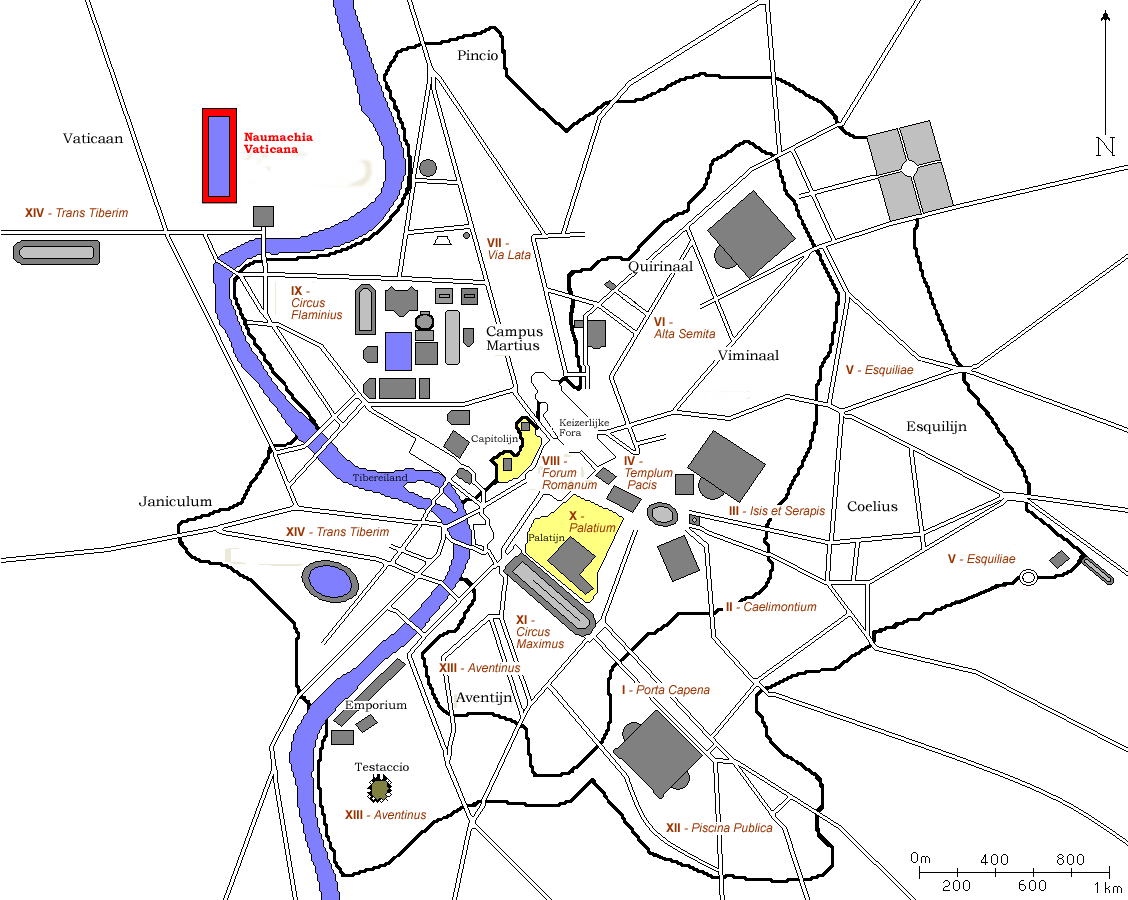
Beginning of the second century AD for Trajan (98/117) in addition or in substitution of the Naumachia of Augustus

Some remains of about 102 x 300 m (335 x 985 feet), maybe belonging to the Naumachia were seen during the construction of the Prati district at the end of the nineteenth century

The remains have not been completely excavated and it is believed to have been certainly larger
In 1996 other remains were found during ground surveys for the planned, but never built, tunnels below Castel Sant'Angelo

Friday, May 15, 2015

NAUMACHIA OF AUGUSTUS

NAUMACHIA DI AUGUSTO


2 BC for Augustus (27 BC/14) near the Horti of Caesar (Gardens of Julius Caesar)

The area covered was 552 x 355 m (1,800 x 1,200 feet), about three times larger than the Colosseum
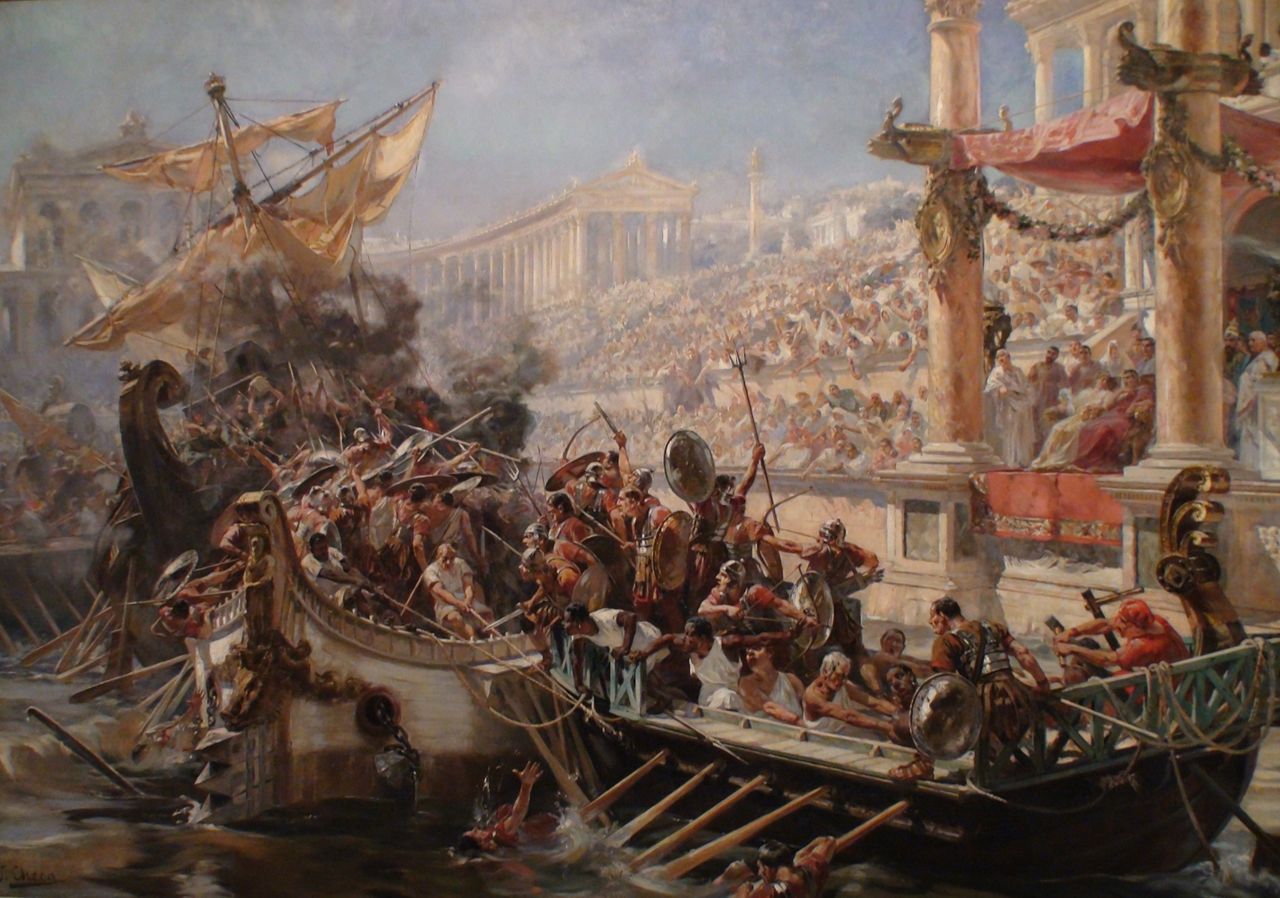
It was used for performances of naval battles that are commonly believed to have taken place in the Colosseum

If naval battles really took place in the Colosseum as reported by Martial and Cassius Dio, and suggested by some archaeological evidence, they must have lasted only for the few years before the construction of the large underground level under the floor of the arena

The main building where these shows would regularly take place was this one and, about 100 years later, the Vatican Naumachia, which maybe took the place of Augustus' Naumachia

No trace remains but the exact location is shown by the Forma Urbis (monumental map of Rome of the beginning of the third century AD) and by the discovery of a section of the aqueduct that used to fed the Naumachia, the Alsietino Aqueduct coming with underground conduits from the lakes of Bracciano and Martignano at a distance of 33 km (20.5 miles)

It was probably built just to fill up the Naumachia with water because water was not drinkable
In the Naumachia there was room for thirty ships among triremes and biremes (in the Colosseum three at the most) plus other smaller ships with 3,000 soldiers, not to mention thousands of rowers
At the center of the lake there was an artificial island

Here it was celebrated with naval battles the inauguration of the Temple of Mars Ultor in the Forum of Augustus

It is mind-blowing for our mentality today to think that 2,000 years ago the Romans had built a giant stadium and a 33 km aqueduct to fill it with water just because they loved to see men killing each other on boats

Tuesday, May 12, 2015

HISTORICAL MUSEUM OF THE LIBERATION OF ROME

MUSEO STORICO DELLA LIBERAZIONE


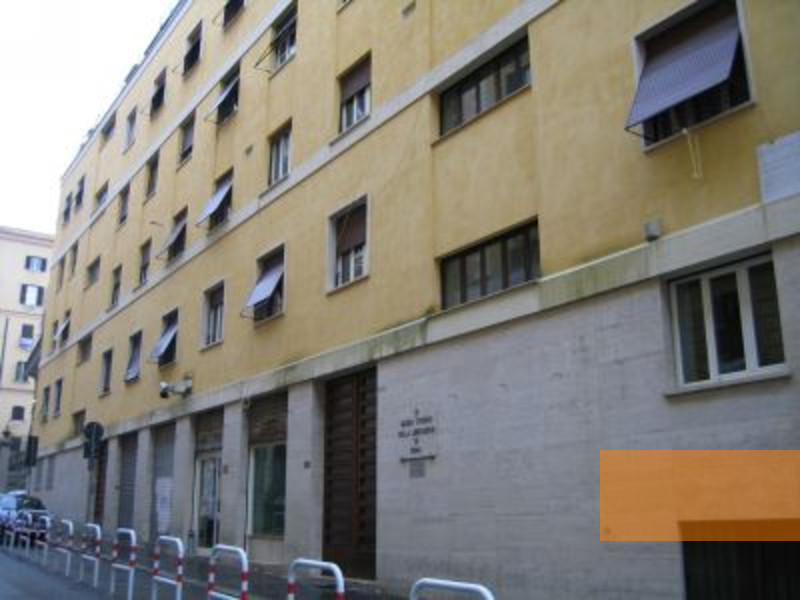
It was set up in 1954 into four apartments of the building which, in the 268 days of the Nazi occupation of Rome (11 September 1943 - 4 June 1944), was used as a prison by the command of the security police

The detention cells are still as they were left by the fleeing Germans and originally occupied the entire building and are now visible in two of the four apartments that the museum comprises

The building was built in the late thirties of the twentieth century for Prince Francesco Ruspoli who wanted to make apartments for rent

Eventually he rent it all to the German Embassy for its cultural offices and, during the fateful 268 days, it became a site of terror and death

The SS closed the windows with grates and brick and, under the command of the infamous Herbert Kappler, about 2,000 human beings in total were locked in tiny cells stacked like animals and tortured brutally

The prison at Via Tasso in Rome was regarded as “the antechamber of death”

After the Liberation of Rome the apartments were occupied by homeless people and in 1950 the Princess Josepha Ruspoli donated four of them to the Italian State with the obligation to turn them into a Liberation Museum to house objects and documents belonging or relating to victims

In the night between 22 and 23 November 1999 the Museum was the subject of a bomb attack of anti-Semitic nature. It did not cause disastrous consequences and it only caused damage to the windows of the apartments


First Floor


Conference room, Library and Archives
During the war this floor was used as the office of the Nazis


Second Floor


Prison itself: the rooms have remained, even in detail, exactly as the Germans, fleeing from Rome, left them. Same wallpaper, same windows bricked up, same grating on the doors of the various cells, same electrical system

CELL 1

Memories of the 335 Italians killed at the Fosse Ardeatine on March 24, 1944

CELL 2

Isolation cell with walls covered in graffiti made by prisoners

“Together with the upper floor, it is perhaps one of the most significant and poignant rooms in this museum. These rooms were the only two of the whole prison without wallpaper, and had plastered surfaces. More importantly, within them the prisoners were segregated individually. These, back from being questioned, alone with their anxieties and their tortured pain, carved on the wall, laboriously, with nails or fingernails, prayers, literary memories, trying to keep the sense of passing time, words of comfort for those who remained, important information for those who would continue to fight, the last wills waiting for death to which many were condemned” (Web site of the Historical Museum of Liberation - www.viatasso.eu)

CELL 3

It honors the seventy-seven Italians shot at Fort Bravetta

CELL 4

It is dedicated to the massacre of La Storta on June 4, 1944, the day of the Liberation of Rome, when fleeing Germans shot fourteen prisoners they had brought with them including the Italian MP Bruno Buozzi

Cell 5
Here was held prisoner the heroic Colonel of the Corps of Engineers Giuseppe Cordero Lanza di Montezemolo, head of the Clandestine Military Front

“For the duration of World War II he served in the operations office of the supreme command, of which he later became the head; on July 27, 1943, as a colonel, he was called to lead the secretariat of Badoglio, from which it split in not agreeing on his methods of leading the negotiations for the armistice. After September 8 he was at the side of the general Calvi di Bergolo as chief of the civil affairs bureau of the open city of Rome. Wanted by the Germans, he escaped capture and dedicated to the organization of the first clandestine military center in Rome” (Enciclopedia Treccani)


“He was tortured for days. The executioners tore his teeth one by one and then, just to make him talk, they continued with his nails. They broke his bones and he was whipped and beaten with chains. He resisted heroically, and even the Germans were impressed by his courage: 'Frankly, we were moved' Kappler said later” (Anthony Majanlahti and Amedeo Osti Guerrazzi)

The colonel, an authentic hero, one of the most courageous in the long history of Italy, while being aware of names and important facts, he never gave them out and he was brutally murdered at the Fosse Ardeatine

His name would deserve to be present in all the books of Italian history for school children


Third Floor


CELL 11

It was one of the torture chambers. On display there are prints and posters of the time

CELL 12

Isolation cell, like the one on the second floor. It holds the messages of those who were imprisoned

CELL 13

Collection of newspapers printed clandestinely

In a showcase there are the three-pointed nails used by partisans against German columns of trucks

There is also a touching and precious heirloom: a loaf of bread on which a prisoner before execution, recorded the words “coraggio mamma” (courage mother)

CELL 14

Flyers printed clandestinely

The first flag that waved on the tower of the Town Hall on Capitoline Hill at the liberation of Rome, on June 4, 1944

ROOM 1

Dedicated to the Jewish community of Rome, the oldest in Europe, dating back at least to the second century BC

1,022 Jews, including 221 children were deported to Auschwitz. Only seventeen returned alive, including a woman, and no children

Tuesday, May 5, 2015

HISTORICAL MUSEUM OF INFANTRY

MUSEO STORICO DELLA FANTERIA


Housed in a 1903 building formerly barracks of the second regiment of the Grenadiers of Sardinia
The museum was established in 1948 but it was open to the public only in 1959

In 1990 it was renovated and divided into three areas (weapons, flags and uniforms) with THIRTY-FIVE ROOMS, FIVE GALLERIES, a LIBRARY and a HISTORICAL ARCHIVE

The exhibition includes firearms from the eighteenth century to the present day, halberds, crossbows, armor and edged weapons, as well as models of battles as those of Zama and Waterloo, sketches and original documents relating to colonial wars and the two world wars

Memorial with bronze group “Redeemer on the Cross holds two soldiers dying” by Edmondo Furlan
Statue “Soldier leaving” by Biagio Poidimani (1910/2001)

Monday, May 4, 2015

HISTORICAL MUSEUM OF CARABINIERI

MUSEO STORICO DELL'ARMA DEI CARABINIERI


Built in the late nineteenth century to be the Scuola Allievi Ufficiali dei Carabinieri (Carabinieri School for Officers)

Modified in 1937 by Scipione Tadolini to transform the entire building in a museum. Since 1925 the museum had been located only in some rooms of the building

Completely renovated in 1985

The Carabinieri Corps was established in 1814 and in the museum its story is narrated with documents, memorabilia, statues and about forty paintings including works by Gianni Vagnetti (1897/1956) and Guido Greganti (1897/1986) and sculptures by Augusto Rivalta (1837/1925) and Edoardo Rubino (1871/1954)

There also are commemorative medals, artistic parchments and historic flags
In Piazza Risorgimento, across from the museum there is the


Monumento al Carabiniere a Cavallo

Monument of a Carabiniere on a Horse

2003. Bronze reworking of a small group also in bronze of 1886 by Stanislao Grimaldi (1825/1903) kept in the museum

Sunday, May 3, 2015

HISTORICAL MUSEUM OF THE GRENADIERS OF SARDINIA

MUSEO STORICO DEI GRANATIERI DI SARDEGNA


1922/24 in a building especially built for the museum by the architect Francesco Leoni, who was a Lieutenant of the Grenadiers, with economic contributions of Grenadiers from all over Italy and voluntary workers who were part of the corps

It houses memorabilia illustrating the corps' history and, at the same time, reviewing the history of Italy. It consists of FIFTEEN ROOMS

GROUND FLOOR

Memorabilia in chronological order, from the ancient Guards until the War of Liberation, and photos related to some recent overseas missions:

Weapons, uniforms, decorations, photographs, prints, documents, old tattered flags and portraits of many decorated with gold medal

FIRST FLOOR

Themed rooms and a lounge with effigies from the first Savoy dukes to the last king and a showcase containing the original of the will of the Duke of St. Peter

Room with an apse consisting of a shrine with a list engraved on the walls of 8,500 names of soldiers belonging to the Grenadiers the fallen in all wars

In addition, images, medals and documents that describe the life, and often the sacrifice of so many tens of thousands of Italians who for over three centuries have worn with honor the uniform of the Grenadiers

Saturday, May 2, 2015

NATIONAL MUSEUM OF MUSICAL INSTRUMENTS

MUSEO NAZIONALE DEGLI STRUMENTI MUSICALI
 

It occupies three floors of the 1903 Palazzina Samoggia, former Caserma Principe di Piemonte (Barracks Prince of Piedmont) and former home of the Grenadiers of Sardinia

It is the most important European museum of musical instruments for wealth and prestige of the preserved pieces and one of the most important in the world

The museum opened in 1974

Begun from the collection of tenor Evan Gorga (1865/1957), the first interpreter of Rodolfo in Puccini's La Bohème, purchased in 1949 by the Italian State

The museum's pieces are about 3,000 of which about 840 exhibited in EIGHTEEN ROOMS, coming from different parts of the world, ranging from the Far East to the archaeological sites in southern Etruria, and spread over a very wide time span, from the late Hellenistic period to the twentieth century

Among the most important pieces there is a 1722 “Piano”, one of the first in the world built by Bartolomeo Cristofori (1655/1732) from Padua who invented the instrument in the years 1698/1700 under the name “Gravicembalo with piano and forte” later called “Fortepiano”

It was the first to use hammers in the mechanism of the harpsichord, though at the time the invention was not an instant success

The piano by Cristofori exhibited here is one of only three built by him still extant. The other two are in Leipzig and in New York

“The workmanship and inventiveness displayed by the instruments of Cristofori are of the highest order and his genius has probably never been surpassed by any other keyboard maker of the historical period ... I place Cristofori shoulder to shoulder with Antonio Stradivarius” (Grant O'Brien)

AMONG THE OTHER PIECES OF THE MUSEUM:

Group of sixteenth-century bent “Cornamuti” by Weier

Some instruments that used to be owned and played by Benedetto Marcello

A trumpet dating back to 1461

The famous “Barberini Harp” represented in the painting “Venus plays the harp (Music)” by Giovanni Lanfranco at Palazzo Barberini

The fact that a museum so rich and important is virtually unknown in Rome is indicative of the prostration of Italy's cultural life today
The country where the piano, the violin, opera and musical notation itself were invented is now sadly at the mercy of ignorance spread by television